
REVIEW · FLORENCE
Small-Group Uffizi Tour + Optional Vasari Corridor Access
The best part of this Uffizi visit is its focused route through Florence’s greatest paintings. In about 90 minutes to two hours, you move from the flat gold backgrounds of Duccio and Cimabue to the emotional realism of Giotto, then on to Botticelli, Leonardo, Michelangelo, Raphael, and Titian.
I like the nine-person group limit, which keeps the guide close and makes the art easier to follow. I also like the choice of adding the Vasari Corridor, a rare elevated passage with windows toward the Arno and Ponte Vecchio. The main caution is that the corridor is one-way, so you cannot return to the Uffizi after leaving it.
Key points
- A clear Renaissance progression: See how Florentine painting changes from medieval icons to natural space, movement, and human feeling.
- Small groups capped at nine: The format is better suited to questions and close listening than a large museum crowd.
- Priority entrance: You bypass the regular ticket line, though everyone still passes through security.
- Essential Botticelli and Leonardo: The route includes The Birth of Venus, Primavera, Annunciation, and Adoration of the Magi.
- Optional Vasari Corridor walk: Continue from the Uffizi toward the Boboli Gardens and Pitti Palace, with no re-entry afterward.
- A practical $45 price: The cost is reasonable for a guided Uffizi visit, especially when you value orientation and line-saving, but check which corridor option is included.
Why this Uffizi route works
The Uffizi can feel like an art-history exam if you enter without a plan. Room after room brings another famous name, and it is easy to spend too much time on the first few galleries before reaching the works you came to see.
This tour gives you a sensible thread to follow. You begin with a short introduction to the Medici family and the Uffizi building, then move through a selection of works that shows how painting changed over several centuries.
I like this approach because the paintings are not treated as isolated celebrity objects. The guide connects technique, politics, religion, mythology, and Medici taste. That context helps you understand why certain works became symbols of Florence.
The group size matters here. With a maximum of nine people, you should have a better chance of hearing the guide without fighting through a large crowd. Headsets are supplied when the group reaches the number that requires them.
More Art Museum Tours in Florence
- Florence: Skip-The-Line Uffizi Gallery Timed Entry Ticket
★ 4.5 · 27,832 reviews - Florence: Uffizi Priority Ticket & Masterpieces Audio App
★ 4.2 · 6,402 reviews - Florence Accademia Gallery Tour with Entrance Ticket Included
★ 4.5 · 6,148 reviews
Meeting at Leonardo and entering the museum
The meeting point is listed near the statue of Leonardo da Vinci, although the exact location can vary with the option you book. Check your confirmation carefully before setting out, since the meeting instructions may differ between the regular Uffizi visit and the Vasari Corridor version.
Your guide gives the group a short orientation before entry. This is useful because the Uffizi is not simply a modern art museum built for easy navigation. The building began as offices for Florence’s government, and the Medici family later shaped its use as a place for collecting and displaying art.
Priority entrance takes you past the regular ticket line and toward the security checkpoint. It does not mean you skip every step. You still need to pass security, and large bags and luggage are not allowed.
You must also provide your full legal name exactly as it appears on your passport or identity document. Uffizi tickets are personalized, and an incorrect name can result in refused entry. This is an easy detail to overlook, so take care when booking.
Duccio, Cimabue, and Giotto show painting changing
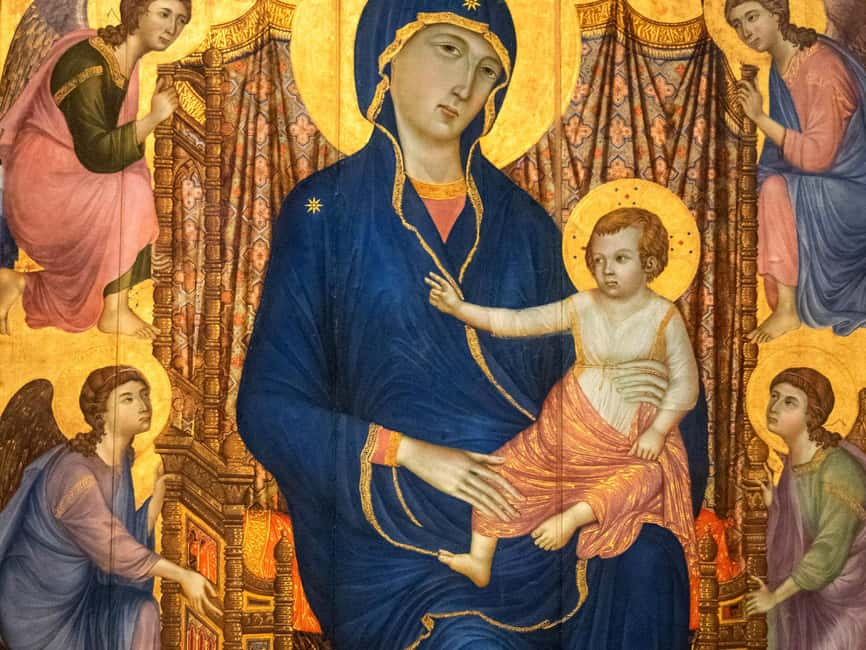
The opening art section sets up the whole visit. You see three Madonna paintings by Duccio, Cimabue, and Giotto, a compact lesson in the movement from medieval convention toward more lifelike space and emotion.
The earlier works use gold backgrounds and formal poses. They can appear flat to modern eyes, but they show the religious style that shaped Italian painting for generations.
Giotto’s work begins to suggest weight, space, and human presence. The point is not that one artist suddenly invented realism. The value is seeing the gradual change in front of you, with the guide explaining what to notice.
This stop is especially helpful if you do not already know Renaissance art. Instead of asking you to remember a long list of dates, the tour gives you a visual comparison. You can see the shift rather than simply hearing about it.
Botticelli’s Venus and Primavera
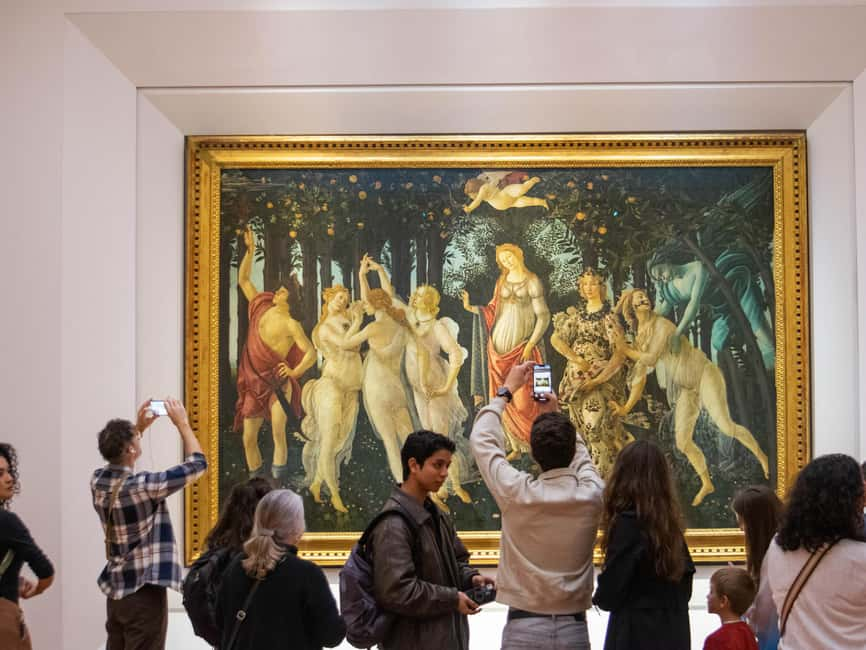
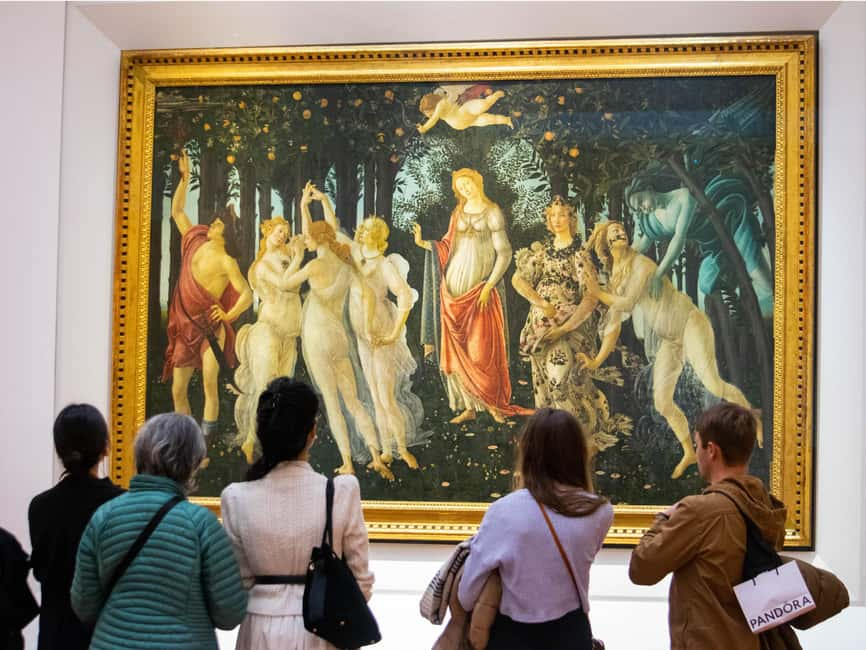
Botticelli is one of the main reasons people come to the Uffizi, and this route includes both The Birth of Venus and Primavera, also called Spring.
The Birth of Venus is instantly familiar, but familiarity can work against you. It is easy to glance at the painting, take a photograph where allowed, and move on without considering its strange, dreamlike quality.
The guide places the work within Medici culture and classical mythology. You learn why the painting mattered to the family and how its figures helped create the popular image of Florence as the center of the Renaissance.
Primavera is more crowded with symbols and characters. The explanation helps you sort out the mythology and the painting’s connection to beauty, renewal, and Medici ideas. Do not expect a long academic lecture. The route is designed to keep moving, so the interpretation stays focused.
This is one of the tour’s strongest sections for first-time Uffizi visitors. You see the famous images, but you also get a useful way to look at them. The guide’s storytelling is meant to make the details easier to remember.
More Uffizi tours and tickets:
- Uffizi Gallery: Renaissance Masterpieces Guided Tour
★ 4.6 · 6,070 reviews - Uffizi Gallery Small Group Tour with Guide
★ 4.5 · 4,923 reviews - Uffizi & Accademia Timed Entry: Small Group Duomo Walking Tour
★ 4.5 · 3,630 reviews - Florence: Uffizi Gallery Timed Entry Ticket & Audio Guide
★ 4.2 · 2,794 reviews
Leonardo’s unfinished ideas and Verrocchio’s workshop
The Leonardo section includes Annunciation and Adoration of the Magi, along with Verrocchio’s Baptism of Christ. These works give you a chance to consider Leonardo not only as a famous name, but as an artist testing light, movement, space, and composition.
Annunciation rewards a slow look at the setting and perspective. The painting’s sense of distance and natural detail points toward Leonardo’s later experiments.
Adoration of the Magi is especially useful for discussing process. It is not a tidy, finished picture in the way many visitors expect from a masterpiece. The guide can point out the energy in the figures and Leonardo’s interest in arranging movement across the scene.
Verrocchio’s Baptism of Christ adds a workshop connection. Leonardo’s role in the painting helps explain how artists learned through collaboration and apprenticeship. Renaissance art was not always the work of one isolated genius working alone.
This part may feel brief if Leonardo is your main reason for booking. The route covers the important works, but it cannot provide a full study of every painting. The benefit is that you get a clear introduction without losing time in less essential rooms.
Michelangelo, Raphael, and the High Renaissance
Michelangelo’s Doni Tondo is a major stop. It is the only panel painting by Michelangelo in Florence, making it a particularly valuable work to see in person.
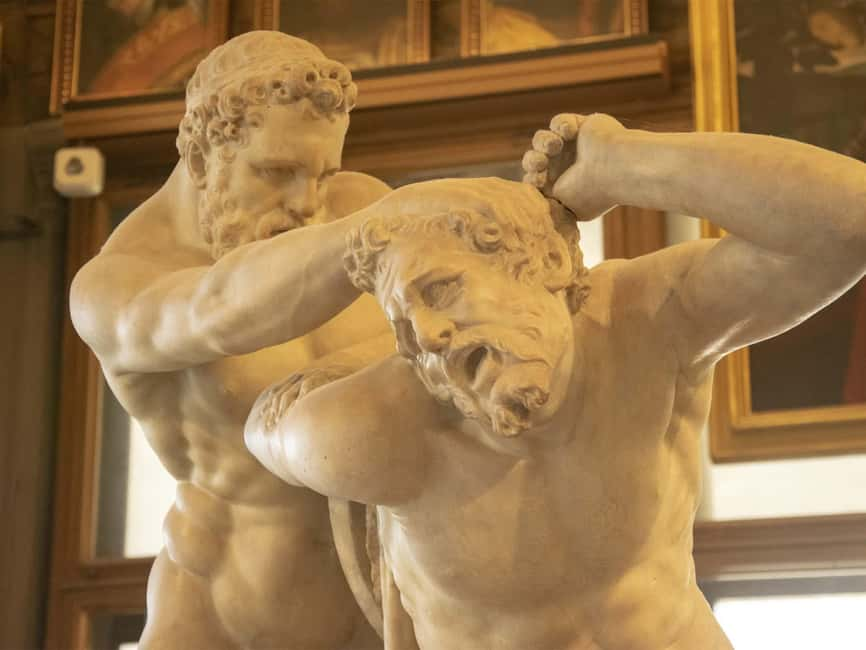
The painting’s round format and strong figures give the guide plenty to discuss. You can compare Michelangelo’s sculptural treatment of the human body with the softer elegance found in other Renaissance works.
Raphael’s Madonna of the Goldfinch shifts the mood. Its balanced arrangement and calm interaction between the figures help explain the ideal of High Renaissance harmony.
I like this pairing because it gives you contrast. Michelangelo brings force and physical intensity, while Raphael offers order, grace, and balance. You do not need advanced art training to see the difference once it is pointed out.
The tour does not attempt to cover every Raphael or Michelangelo work in the museum. That is a sensible choice. A guided visit becomes less useful when it tries to name every important painting and gives none of them enough attention.
Titian’s Venus and the question of looking
Titian’s Venus of Urbino brings the tour into a different conversation about beauty, private art, and the way paintings were viewed in their original setting.
The work is visually direct, but the guide can help you think beyond its surface. Who was meant to see it? Was it public, private, instructional, decorative, or some mix of all four? These questions make the painting feel less like a famous image on a wall and more like an object with a purpose.
You also hear about its later influence on Manet. That connection shows how one painting can continue shaping artists long after its original setting and audience have disappeared.
This is a good final major stop because it widens the story. The tour is not only about religious painting or Florence’s early Renaissance. It also covers changing ideas about the body, beauty, and artistic influence.
The Vasari Corridor adds a different kind of experience
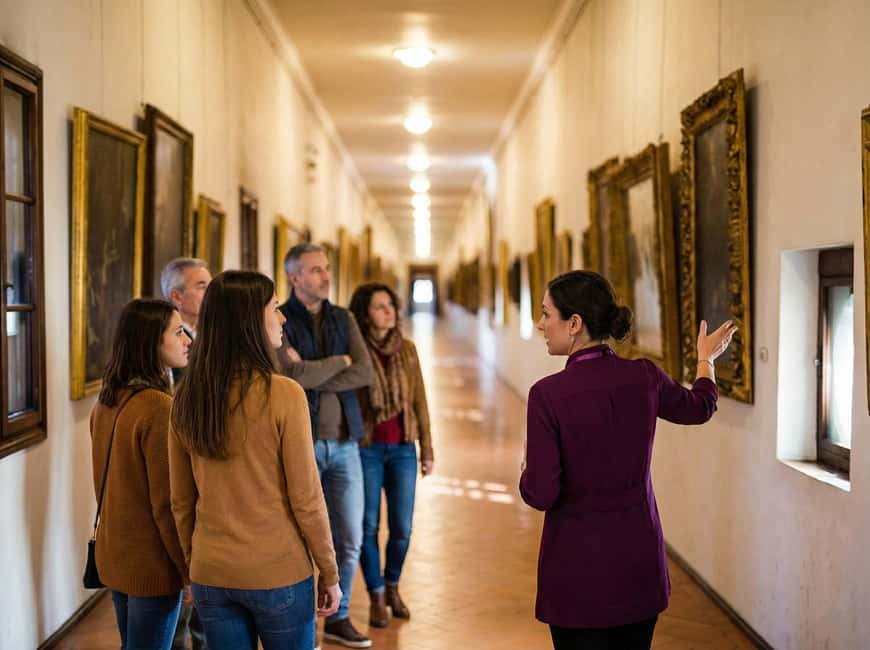
The Vasari Corridor option is separate from the standard Uffizi visit, so select it when booking if you want access. The guide accompanies the group to the corridor entrance inside the Uffizi, then you continue through the passage without a guided art tour inside it.
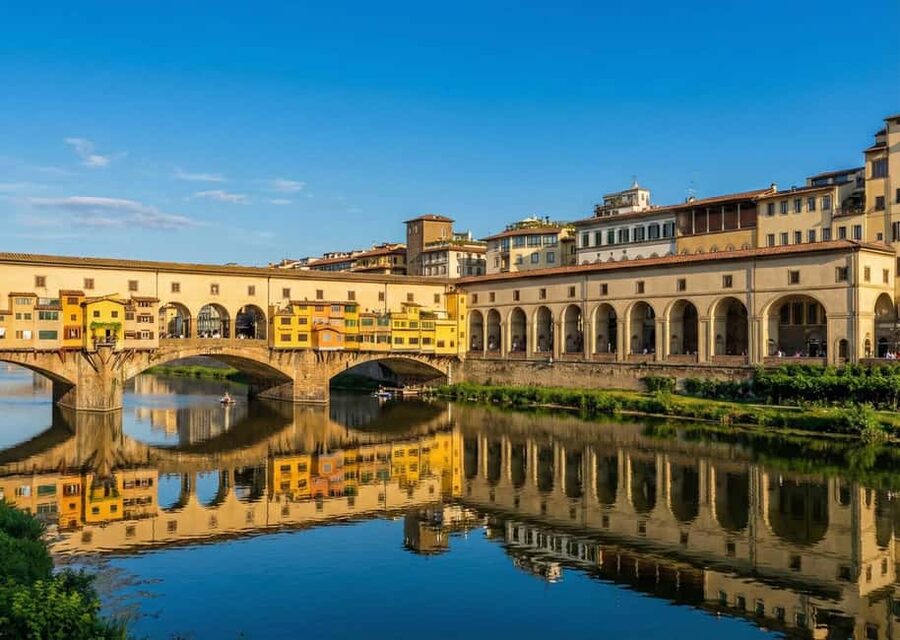
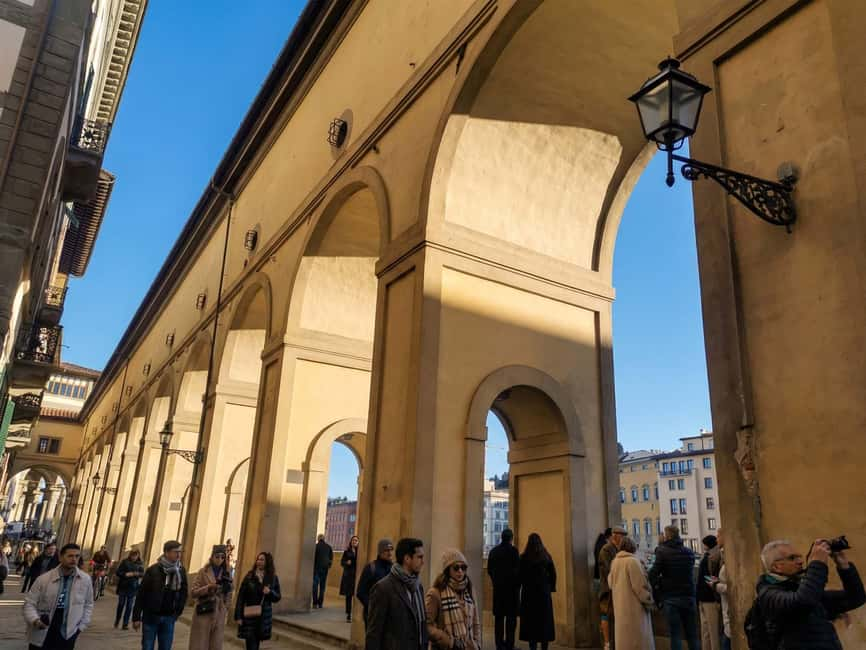
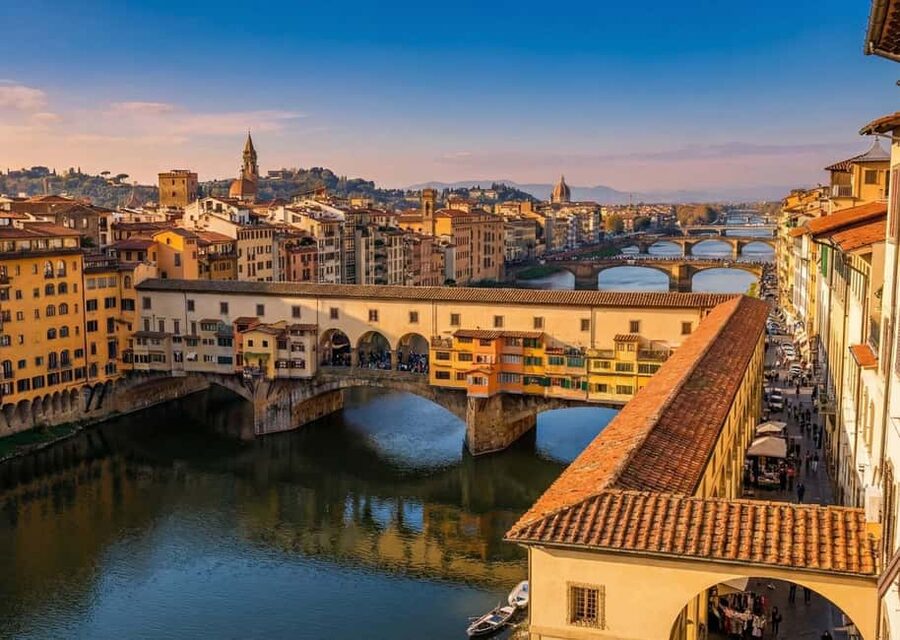
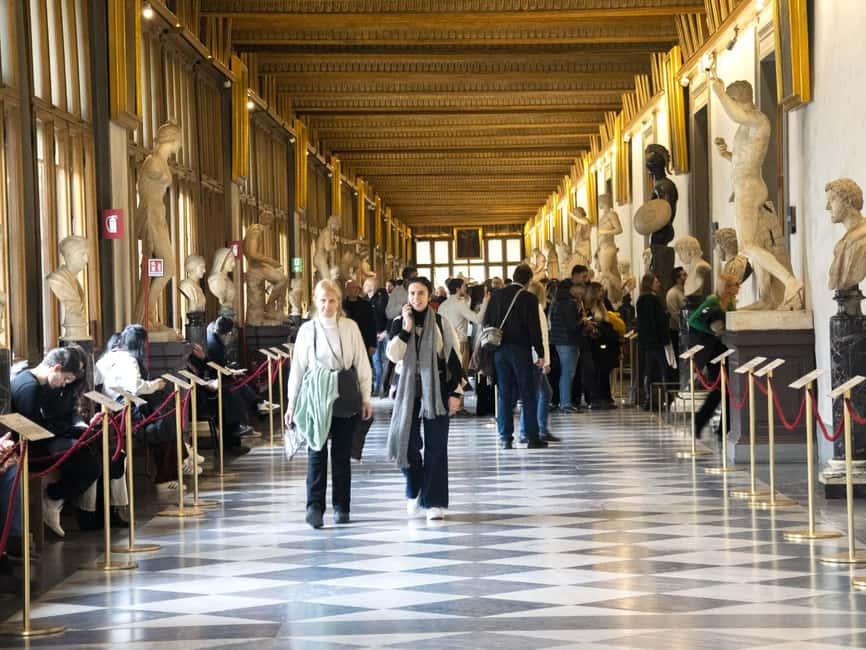
The corridor is an elevated, one-way route connecting the Uffizi with the Boboli Gardens and Pitti Palace area. Its windows look toward the Arno and Ponte Vecchio, offering a different view of Florence from the galleries.
This is not simply an extra museum room. The pleasure comes from walking through a passage that links major Medici sites and gives the city a new visual frame. You finish on the opposite side of the river, near the Boboli Gardens and Palazzo Pitti.
There are two important limits. First, the corridor is unguided on this shared tour. Second, once you exit, you cannot re-enter the Uffizi with the same ticket. If you still want time for the café, bookshop, terraces, or more galleries, do that before entering the corridor.
The corridor walk is listed at about 45 minutes, while the full activity can run from 1.5 to 3 hours depending on the option. Confirm the timing and endpoint before booking anything afterward.
Is $45 a fair price?
At $45 per person, this tour sits in a sensible range for visitors who want both orientation and priority entry. The regular Uffizi ticket has a museum-set base cost of €29, while the combined Uffizi and Vasari Corridor ticket has a base cost of €47.
Those figures help explain the price. You are paying not only for admission, but also for a licensed guide, a small group, and the time saved by avoiding the regular ticket line. The value is strongest if this is your first Uffizi visit or if you want the major works explained instead of simply locating them on a map.
The calculation changes if you prefer to wander alone. After the guided portion, you can remain in the Uffizi and continue independently, but the guided route itself is built around the main highlights rather than every gallery.
Also check the exact option. Vasari Corridor access is not included in every booking, and the listed price may vary according to the version you choose. The museum’s own combined ticket cost makes the corridor option easier to justify for visitors who want this particular historical connection.
Who should book this experience?
I would choose this tour for a first visit to the Uffizi, especially if you have limited time in Florence. The guide gives you a workable map of the collection and helps you recognize the artistic changes that make the museum important.
It also suits couples, families, and small groups who want a social visit without joining a large crowd. The maximum of nine is a useful middle ground between a private tour and a busy group outing.
Art lovers with one narrow interest should set expectations carefully. If you want a detailed study of Leonardo, Botticelli, or Titian alone, a private or longer visit may suit you better. This route aims for the essential works across several periods.
English is the listed tour language. A few guide names, including Sylvia, have been associated with especially clear explanations and engaging storytelling, but the guide assigned to your booking may be different.
The experience is wheelchair accessible. Pets are not allowed, and large bags or luggage cannot come inside. Cancellation is available up to 24 hours before the start for a full refund, and reserve-now, pay-later booking can help if your schedule is still shifting.
Should you book the Uffizi and Vasari Corridor tour?
Book it if you want Florence’s major Renaissance works explained in a compact, well-planned visit, and if skipping the regular ticket line matters to you. The strongest features are the small group, the clear progression from Duccio to Titian, and the option to finish with the Vasari Corridor.
Choose the standard Uffizi version if you want to keep exploring the museum afterward. Choose the corridor option if the one-way walk, river views, and arrival near Pitti Palace are more appealing than returning to the galleries.
The main decision is not simply guided versus unguided. It is about how you want to spend your time. For a first Uffizi visit, the $45 price is reasonable. Just enter your legal name correctly, check the meeting point, and remember that the Vasari Corridor sends you out on the other side of the river.
FAQ
How long does the Uffizi and Vasari Corridor experience last?
The listed duration is between 1.5 and 3 hours. The guided Uffizi visit takes about two hours, while the Vasari Corridor portion is listed at about 45 minutes. Timing depends on the option and starting time selected.
Is Vasari Corridor access included with every booking?
No. Access is included only when you select the Uffizi and Vasari option at booking.
Can I return to the Uffizi after walking through the Vasari Corridor?
No. The corridor is one-way, and you cannot re-enter the Uffizi with the same ticket after exiting near the Boboli Gardens and Pitti Palace area.
Is the Vasari Corridor guided?
The shared tour includes the walk through the corridor, but not a guided tour inside the corridor.
What artworks are included in the guided Uffizi route?
The route includes works by Duccio, Cimabue, Giotto, Botticelli, Leonardo, Verrocchio, Michelangelo, Raphael, and Titian. Specific highlights include The Birth of Venus, Primavera, Annunciation, Adoration of the Magi, Doni Tondo, Madonna of the Goldfinch, and Venus of Urbino.
What is the group size?
The small-group tour has a maximum of nine people. Private groups are also available. Headsets are provided when the group size requires them.
What should I provide when booking the Uffizi ticket?
You must provide your full legal name exactly as it appears on your passport or identity document. Uffizi tickets are personalized, and an incorrect name may lead to refused entry.
Just added around Florence
- Skip the line: Uffizi small group and walking tour of Florence★ 4.5 · 17 reviews
- Florence Private Walking Tour Including Uffizi and Accademia★ 3.5 · 4 reviews
- Private Tour: The Academy Gallery★ 5.0 · 6 reviews
- Uffizi Gallery Italian guided Tour semi private★ 4.5 · 9 reviews
- Private Tour: Accademia Gallery and City Tour★ 5.0 · 10 reviews
- Uffizi Express Entrance -private tour★ 5.0 · 9 reviews
- Uffizi and Palazzo Vecchio Combo Private Tour★ 5.0 · 3 reviews
- VIP Priority Access: Uffizi Gallery- Guided Experience★ 4.5 · 94 reviews
Art Museum Tours in Florence, compared.
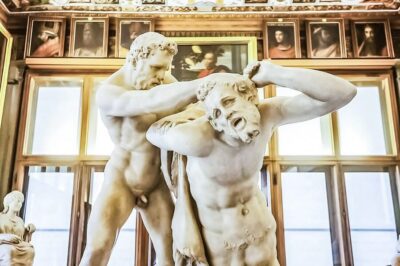
Skip-The-Line Uffizi Gallery Timed Entry Ticket
Read our review →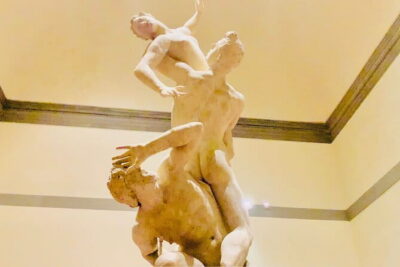
Florence Accademia Gallery Tour with Entrance Ticket Included
Read our review →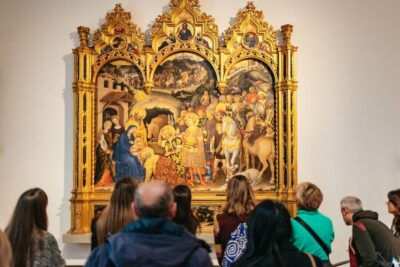
Uffizi Gallery: Renaissance Masterpieces Guided Tour
Read our review →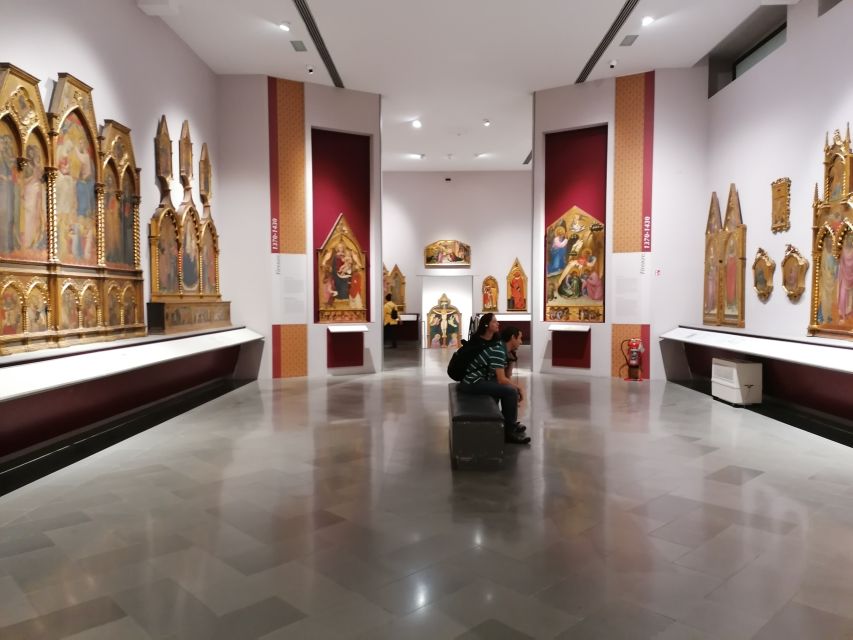
Uffizi Gallery Timed Entry Ticket & Audio Guide
Read our review →
Accademia Gallery Guided Tour with Entry Ticket
Read our review →Browse the lists this tour appears in