
REVIEW · FLORENCE
Semi Private Tour: Uffizi Gallery
The best part of this Uffizi Gallery tour is its tight focus on the paintings most visitors come to Florence to see. In about 1 hour and 45 minutes, you move from Giotto and early Renaissance works to Filippo Lippi, Botticelli, Leonardo da Vinci, and Michelangelo. I like the small maximum of nine people, and I like that you can remain in the museum after the guided portion ends.
The main drawback is the fixed 4:15 pm start. That late-afternoon timing can be pleasant, but Florence can still be very hot, and one visitor found the hour difficult in the heat. At $147, this is not a bargain admission ticket, so the value rests on how much you want clear explanations and help with the museum’s most important rooms.
Key points to know before booking
- Nine-person maximum: The small group should make it easier to hear the guide and ask questions.
- Botticelli is a main event: You will see both Primavera and The Birth of Venus during the visit.
- Major Renaissance names in one route: The tour includes Giotto, Filippo Lippi, Leonardo da Vinci, and Michelangelo.
- Ponte Vecchio view: The gallery route includes a panoramic view of Florence’s famous bridge.
- You can stay afterward: Once the guided tour ends, you may remain in the museum rooms and continue looking around.
- Late-afternoon timing: The 4:15 pm start may suit a full day in Florence, though hot weather can make the timing less comfortable.
Why this small Uffizi tour can be useful
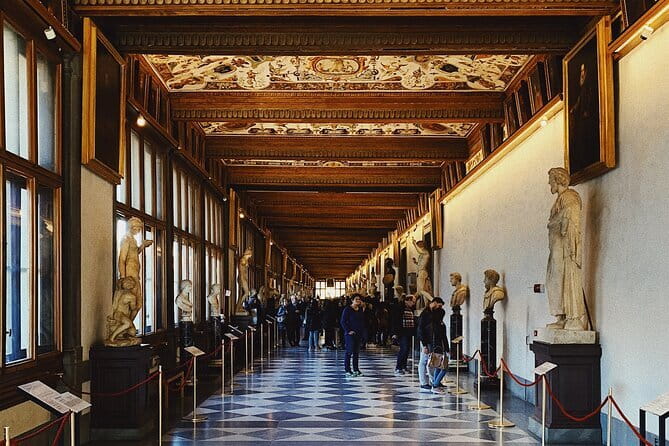
The Uffizi is not a museum you should treat like a quick checklist. Its rooms hold centuries of Italian painting, and the famous works are spread across different periods and galleries. Without a plan, you can spend too much energy finding the best-known pictures and too little time understanding why they matter.
This tour gives you a clear route through several key stages of Renaissance art. You begin with the grotesques and the Giotto Room, then move toward early Renaissance painting before reaching Filippo Lippi, Botticelli, Leonardo, and Michelangelo. That progression gives the visit shape instead of leaving you to wander from one famous name to another.
I especially like the group limit of nine people. A large guided group can turn a museum visit into a hearing test, with visitors clustered around a guide and straining to catch every word. A smaller party should make the explanations easier to follow, although the quality of the experience will still depend on the guide assigned that day.
The two available ratings are both five out of five, and the praise centers on the guide’s explanations and friendly manner. One guide named Jeny is singled out for making the visit work even for two teenagers. That detail matters if you are visiting with young people who may not be eager to spend nearly two hours looking at paintings.
More Art Museum Tours in Florence
- Florence: Skip-The-Line Uffizi Gallery Timed Entry Ticket
★ 4.5 · 27,832 reviews - Florence: Uffizi Priority Ticket & Masterpieces Audio App
★ 4.2 · 6,402 reviews - Florence Accademia Gallery Tour with Entrance Ticket Included
★ 4.5 · 6,148 reviews
Starting at Piazzale degli Uffizi at 4:15 pm
You meet at Piazzale degli Uffizi, 6, in Florence’s historic center. The meeting point is near public transportation, and the activity ends back at the same meeting point.
The 4:15 pm start creates a useful rhythm for a busy Florence day. You can spend the morning and early afternoon elsewhere, then make the Uffizi your main cultural stop later in the day. The tour lasts about 1 hour and 45 minutes, so the guided visit should finish around 6 pm, though the exact end can vary.
The timing is also the main practical concern. Florence can be hot, and one visitor found the tour hour challenging because of the heat. That issue is less about the museum itself than about getting to the meeting point and waiting outdoors before entry. If you are visiting during a hot period, plan your afternoon so you are not rushing across the city in the sun.
Your mobile ticket is an important convenience. Keep it ready on your phone, and make sure your device has enough battery for the meeting, ticket display, and any photos you take. The supplied details do not specify a separate meeting procedure beyond the address, so allow enough time to identify the meeting spot without arriving at the last second.
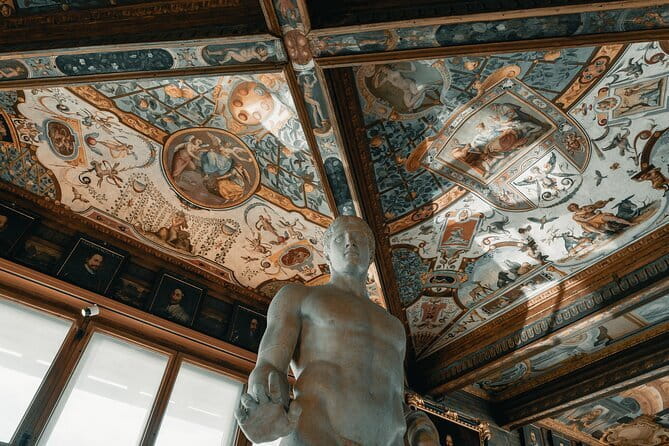
Grotesques and the Giotto Room
The route begins with the grotesques and the Giotto Room. These early galleries help set the stage for the works that follow.
Giotto is a key figure in the move toward more natural-looking figures and clearer emotional expression in Italian painting. You do not need a long art lecture to benefit from this stop. A guide can point out the changes in faces, gestures, and composition that make the later Renaissance paintings easier to understand.
The grotesques offer a different visual experience. Their decorative forms can be easy to pass without context, especially when your attention is fixed on famous paintings. Here, an explanation can show you why these details belong in the story of the museum rather than treating them as mere decoration.
This part of the tour is valuable because it slows you down before the best-known rooms. You begin by seeing how artistic ideas developed, rather than meeting Botticelli without any sense of what came before him.
Early Renaissance painting and Filippo Lippi
The next section brings you toward the early Renaissance and Filippo Lippi’s Lippina. This is one of the places where a guide’s explanation can add real value.
Lippi’s work helps connect religious subject matter with more personal human detail. The title Lippina is commonly used for the Madonna and Child painting associated with Filippo Lippi, and it is one of the works highlighted on this route. Look closely at the way the figures are arranged and at the balance between formal devotion and human tenderness.
You will get more from this room if you resist the urge to photograph every painting and instead give one or two works your full attention. The tour is short enough that you need to keep moving, but the guided format should help you understand which details deserve a closer look.
This portion may appeal most to visitors who want more than a greatest-hits tour. You still reach the famous names, but you also get a little of the artistic path that leads to them.
More semi-private gallery tours in Florence:
- Exclusive Early Morning Uffizi: Semi-Private with Private Option
★ 5.0 · 107 reviews - Florence City Tour, David & Uffizi Gallery Semi-Private 8ppl Max
★ 5.0 · 70 reviews - Michelangelo’s David Early Viewing Semi-Private Accademia Tour
★ 5.0 · 52 reviews - Uffizi Gallery Small group semi private tour max 15 people
★ 4.5 · 43 reviews
Botticelli’s Primavera and Birth of Venus
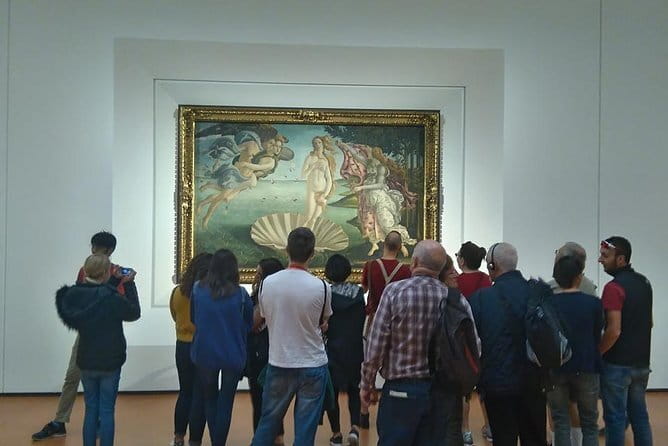
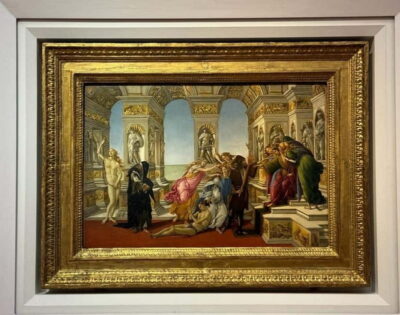
Botticelli is the headline stop for many people, and this tour includes both Primavera and The Birth of Venus. Seeing the two works on the same visit lets you compare Botticelli’s line, figures, and mythological themes rather than treating each painting as an isolated image.
The Birth of Venus is famous before you even enter the room. That fame can work against you. You may arrive with a fixed idea of the painting from books, screens, and souvenirs, then miss the details that make the original worth seeing. A guide can direct your attention to the composition and the figures instead of letting the painting become just a quick photo stop.
Primavera is more complex and can take longer to sort out. Its crowded arrangement of figures and symbols rewards explanation, especially if you are seeing it for the first time. The value of the guided visit here is not just identifying the painting. It is having someone show you where to look and give you a way into the scene.
These rooms can be busy, and the tour’s nine-person limit should help, but it cannot guarantee a quiet viewing. Give yourself time to look beyond the central figures. The paintings are large, detailed, and easy to reduce to a single familiar image if you hurry.
Leonardo’s Annunciation
Leonardo da Vinci’s Annunciation is another major stop. It offers a chance to see Leonardo before the works most people know best from popular culture.
The painting rewards close attention to its setting and figures. Leonardo’s handling of space and observation is part of what makes the work important, and a guide can help you notice those qualities without requiring a technical art background.
This is also a useful pause after the visual drama of Botticelli. The two artists offer different moods and different ways of organizing a religious subject. Moving between them lets you compare their approaches while the details are still fresh.
If Leonardo is your main reason for booking, check your expectations. The experience includes The Annunciation, but the information provided does not promise a private viewing or extra time at that painting. You will see it as one stop within a broader route through the Uffizi.
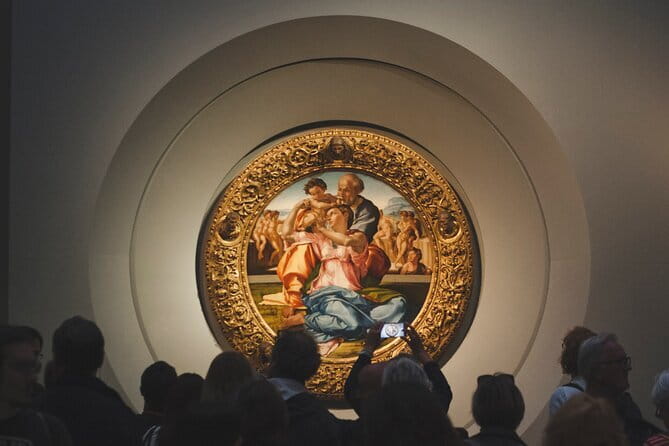
Michelangelo’s Doni Tondo and the Ponte Vecchio view
The route also includes Michelangelo’s Doni Tondo, one of the museum’s major works. A tondo is a round painting, and its shape alone makes it different from many of the rectangular works around it.
The painting gives you another point of comparison. After Botticelli’s flowing lines and Leonardo’s careful observation, Michelangelo’s approach feels distinct. You can use the guide’s commentary to connect the work to the larger progression from early Renaissance painting toward the more forceful style associated with the High Renaissance.
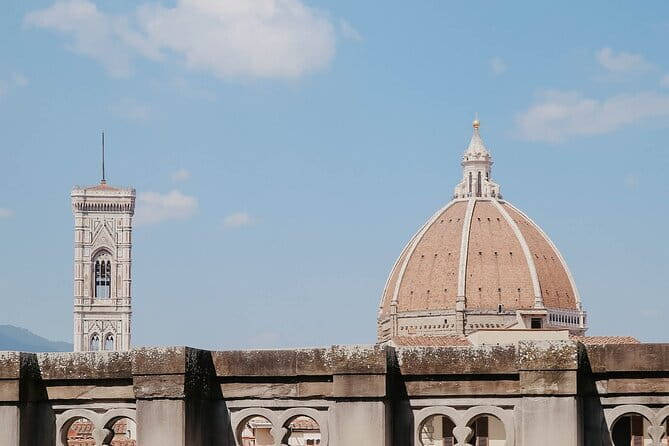
Between the art rooms, you also get a panoramic view of Ponte Vecchio. This is a welcome change of pace. Florence’s famous bridge is a sight many people seek out from street level, but viewing it from the Uffizi gives you a different angle and a short break from close museum viewing.
Do not treat the panorama as a separate sightseeing stop with a long viewing period. It is included within the museum route, so the amount of time you spend there depends on the guide and the movement of the group.
Staying inside after the guided hour and 45 minutes
One of the most useful features is the option to remain in the museum rooms after the guided tour ends. This changes the value of the experience for a visitor who wants both structure and freedom.
The guide gives you a route through key works, then you can continue looking at the displays on your own. You might return to Botticelli, spend more time with Leonardo, or see works that were not part of the main explanation.
That extra museum time is especially helpful because the guided portion is focused. No 1-hour-45-minute tour can cover every important work in a major museum. Staying afterward lets you slow down and fill in the gaps.
The supplied details do not state how long you may remain after the guide finishes, so do not plan your entire evening around an unlimited stay. Still, the ability to continue inside is a clear advantage over a tour that sends you out as soon as the commentary ends.
Is $147 a fair price?
At $147, this tour is priced for guidance, a small group, and a more organized visit rather than basic entry alone. The admission ticket is included, and the mobile ticket makes access simpler. The question is not simply if the price is low. It is if you will use the guide’s help.
I see the strongest value for first-time Uffizi visitors, people who want the major works explained, and families who may need a clear route through the museum. The comments about Jeny making the visit appealing to teenagers are useful here. A good guide can turn a difficult museum stop into something your whole group can follow.
The value is weaker if you already know the Uffizi well, prefer to read labels at your own pace, or want to spend most of your time with lesser-known works. You are paying for a set route and commentary, so independent museum lovers may prefer a standard admission option if one is available for less.
Two five-star ratings suggest a strong early impression, especially around the guide’s explanations and friendly service. That is encouraging, but the small number of ratings means you should keep expectations sensible. The experience has clear strengths, yet much depends on the guide assigned to your date.
Who should book this Uffizi experience?
I would choose this tour if you want the museum’s main Renaissance paintings placed in a clear order. It is a good fit for first-time visitors, couples who want a short cultural stop, and families with older children or teenagers.
The small group suits anyone who dislikes crowded guided tours. The ability to remain inside afterward also helps if you want a balance between expert direction and personal browsing.
I would think twice if your priority is the lowest possible price, a completely private visit, or long uninterrupted time in one room. The tour covers many important works, so the pace may feel quick if you want to study every painting in detail.
The activity allows service animals, is near public transportation, and says most people can participate. Free cancellation is available if you cancel at least 24 hours before the local start time. Inside the final 24 hours, cancellation and changes are not accepted, and no refund is provided.
Final call: a focused way to see the Uffizi
Book this tour if you want Botticelli, Leonardo, Michelangelo, and the early Renaissance explained by a guide in a group capped at nine people. The route is focused, the admission ticket is included, and you can continue exploring after the guided portion.
Skip it if $147 feels high for a short museum visit or if you would rather set your own route from start to finish. For most first-time visitors who want help making sense of the Uffizi, the structure and guide-led explanations make this a sensible, though not cheap, choice.
FAQ
Where does the Uffizi tour start?
The tour starts at Piazzale degli Uffizi, 6, 50122 Firenze FI, Italy.
What time does the tour begin?
The scheduled start time is 4:15 pm.
How long does the experience last?
The guided experience lasts approximately 1 hour and 45 minutes.
Where does the tour end?
The activity ends back at the meeting point.
How many people can join the tour?
The group has a maximum of nine travelers.
Is admission to the Uffizi included?
Yes. An admission ticket is included.
What works of art are included?
The route includes the grotesques, the Giotto Room, early Renaissance works, Filippo Lippi’s Lippina, Botticelli’s Primavera and The Birth of Venus, Leonardo da Vinci’s Annunciation, and Michelangelo’s Doni Tondo.
Can I stay in the museum after the guided tour?
Yes. You may remain in the museum rooms after the guided tour to view the displays on your own.
What is the cancellation policy?
You can cancel at least 24 hours before the experience for a full refund. Cancellations or changes made less than 24 hours before the start time are not accepted, and the amount paid will not be refunded.
More Uffizi Tours in Florence
- Uffizi Gallery: Renaissance Masterpieces Guided Tour
★ 4.6 · 6,070 reviews - Uffizi Gallery Small Group Tour with Guide
★ 4.5 · 4,923 reviews - Uffizi & Accademia Timed Entry: Small Group Duomo Walking Tour
★ 4.5 · 3,630 reviews - Florence: Uffizi Gallery Timed Entry Ticket & Audio Guide
★ 4.2 · 2,794 reviews
Just added around Florence
- Skip the line: Uffizi small group and walking tour of Florence★ 4.5 · 17 reviews
- Florence Private Walking Tour Including Uffizi and Accademia★ 3.5 · 4 reviews
- Uffizi Gallery Italian guided Tour semi private★ 4.5 · 9 reviews
- Private Tour: Accademia Gallery and City Tour★ 5.0 · 10 reviews
- Private Tour: The Academy Gallery★ 5.0 · 6 reviews
- Uffizi Express Entrance -private tour★ 5.0 · 9 reviews
- Uffizi and Palazzo Vecchio Combo Private Tour★ 5.0 · 3 reviews
- VIP Priority Access: Uffizi Gallery- Guided Experience★ 4.5 · 94 reviews
Art Museum Tours in Florence, compared.
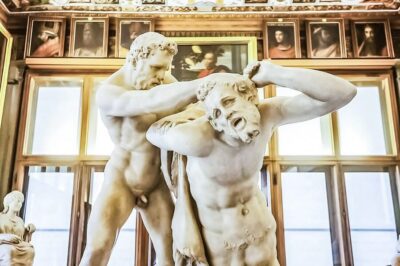
Skip-The-Line Uffizi Gallery Timed Entry Ticket
Read our review →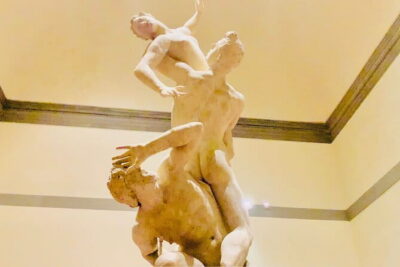
Florence Accademia Gallery Tour with Entrance Ticket Included
Read our review →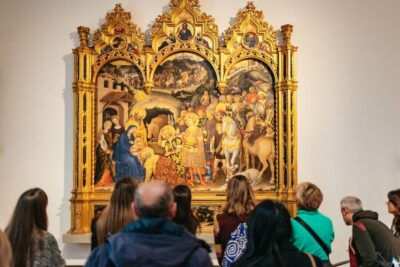
Uffizi Gallery: Renaissance Masterpieces Guided Tour
Read our review →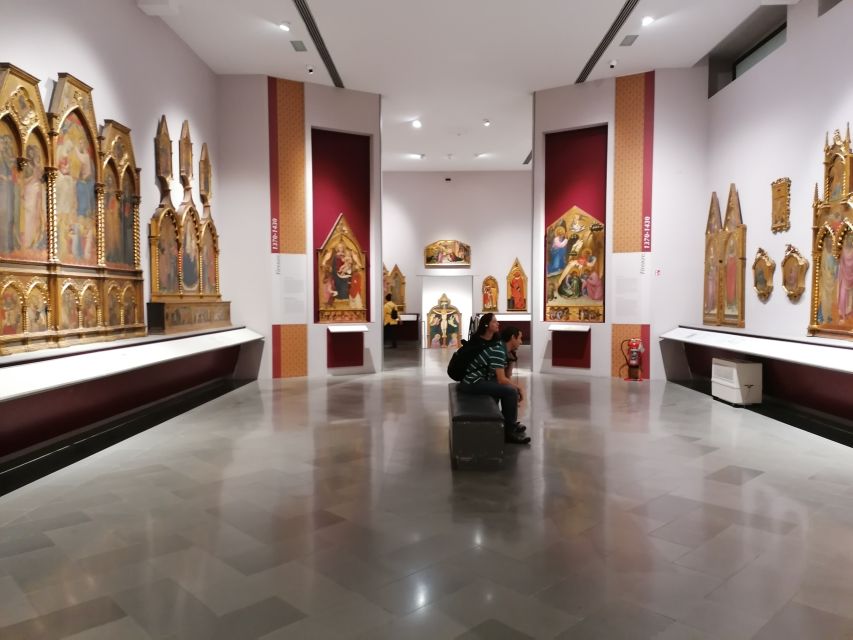
Uffizi Gallery Timed Entry Ticket & Audio Guide
Read our review →
Accademia Gallery Guided Tour with Entry Ticket
Read our review →Browse the lists this tour appears in