
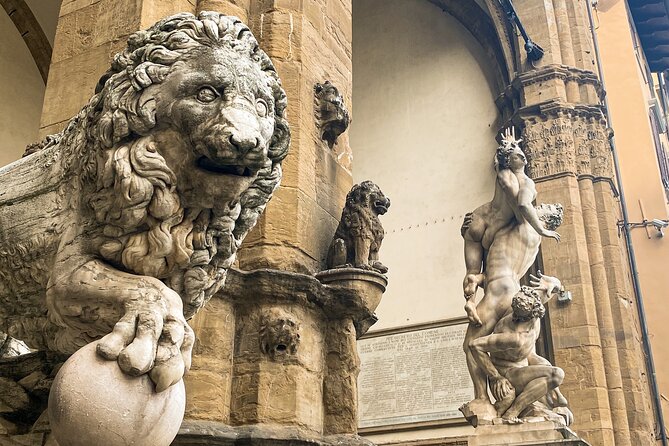
REVIEW · FLORENCE
Private WALKING Tour and ACCADEMIA Gallery in Florence Italy
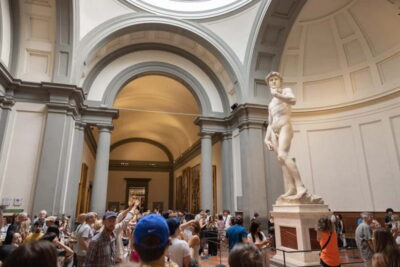
Michelangelo’s David is the star here, but the real strength of this experience is the way Irina links the statue to the streets, churches, and ruling families of Florence. You begin inside the Accademia Gallery, then follow a compact route through the city center to Ponte Vecchio.
I like the private format, since Irina can adjust her explanations to your group. I also like the balance: one hour with Florence’s most famous sculpture, followed by two hours on foot at the Duomo, Medici sights, Piazza della Signoria, and the Old Bridge. The main drawback is that the city walk only covers exteriors, so you will not tour the Duomo, Baptistery, or Medici Palace interiors.
Key points to know before booking
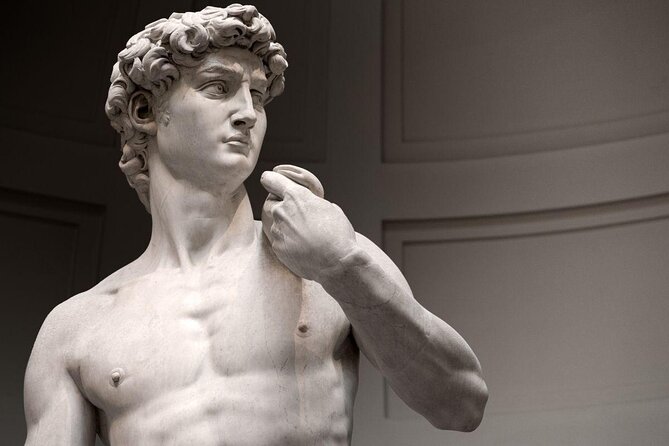
- Michelangelo’s David comes first, with priority entry and a full hour inside the Accademia Gallery.
- Irina leads the tour in English, using stories, humor, and visual help on an iPad to explain Florence’s art and political past.
- The private group format keeps the pace personal, and only your own party takes part.
- The walking route connects major sights, from the Medici quarter and Duomo to Piazza della Signoria and Ponte Vecchio.
- Headsets are included, which matters when Florence’s streets are busy.
- The three-hour length suits a short stay, but it is an overview rather than a full museum-and-church tour.
Why David makes a strong starting point
The tour begins at the Galleria dell’Accademia on Via Ricasoli. That is a practical meeting point, since the gallery sits close to the Duomo and the main historic center. You do not spend the first part of the morning crossing the city or waiting to find the guide elsewhere.
Priority entry is included, saving you the most annoying part of a visit to a famous museum: losing time in the entrance queue. You should still arrive ready for the normal museum procedures, but the included admission and arranged entry make this much easier than turning up without a plan.
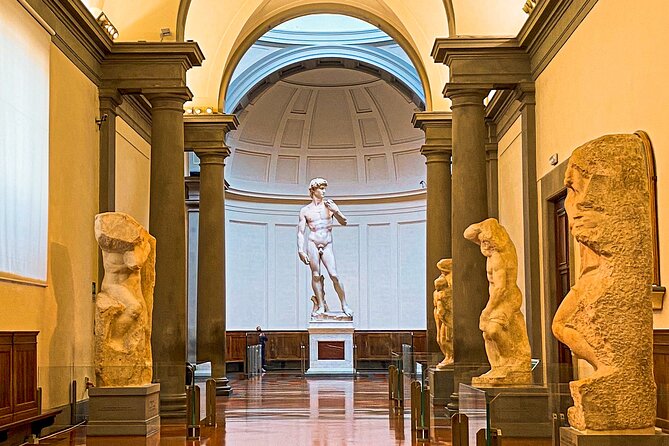
The gallery visit lasts about an hour. That is enough time to focus on Michelangelo without pretending you can see every object in the building. Irina concentrates on David, the unfinished Prisoners, and the story behind Michelangelo’s work for powerful patrons and popes.
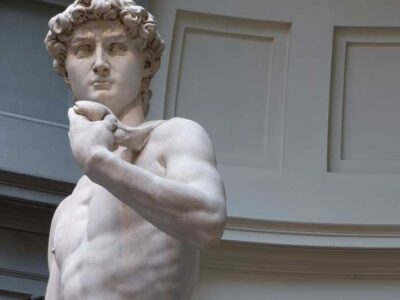
I like this approach. David is often treated as a celebrity statue, admired for a few minutes before visitors move on. A good guide gives you a reason to look again: the scale, the pose, the tension in the body, and the decisions that make the sculpture feel alert rather than merely handsome.
The Prisoners add an important contrast. These figures appear to be struggling out of the stone, and their unfinished state raises questions about Michelangelo’s method and the demands placed on an artist. Irina explains why the sculptures were never completed, giving you more to think about than the usual quick stop in front of David.
The gallery also contains other works, but the schedule gives David and the Michelangelo material most of the attention. If you want a slow, detailed look at every room, this will feel too short. If you want the main artistic story explained clearly before getting out into Florence, the one-hour format works well.
Past visitors have singled out Irina’s storytelling, clear English, humor, and use of images on an iPad. Those details matter. Florence can be easier to understand when you see a face, a building, or an old political arrangement while standing in the place where it mattered.
More Art Museum Tours in Florence
- Florence: Skip-The-Line Uffizi Gallery Timed Entry Ticket
★ 4.5 · 27,832 reviews - Florence: Uffizi Priority Ticket & Masterpieces Audio App
★ 4.2 · 6,402 reviews - Florence Accademia Gallery Tour with Entrance Ticket Included
★ 4.5 · 6,148 reviews
Walking through the Medici quarter
After the gallery, the tour becomes a two-hour walk through central Florence. You will pass the exterior of Palazzo Medici Riccardi, the first great residence of the Medici family. This is where the city’s money, power, and artistic ambition begin to feel connected.
The palace also links directly to Michelangelo. He lived under the protection of Lorenzo the Magnificent, one of the Medici rulers who helped make Florence a center for artists and thinkers. You will not enter the palace on this tour, but Irina uses the building to explain the family that shaped so much of what you see later in the day.
That exterior-only approach keeps the route moving, but it also sets a limit. If you want to see the palace rooms or its famous interior decoration, you will need a separate ticket and visit.
The route continues past San Lorenzo, described as Florence’s first cathedral and a church backed by the Medici clan. You will also see the outside of the Medici Chapels, the burial place of members of the dynasty.
These stops are useful even without interior admission. They show how the Medici family placed its mark on public worship, private power, art, and memorials. You get the framework for understanding Florence as more than a collection of beautiful buildings.
The Baptistery and the Duomo
At the Piazza San Giovanni, Irina explains the Baptistery of San Giovanni, considered the oldest building in Florence. The building is especially famous for its decorated doors, often called the Gates of Paradise.
The stop lasts about ten minutes, so expect a focused explanation and an exterior view rather than a formal visit inside. Tickets are not included, and the tour does not enter the Baptistery. That is worth noting if you had hoped to see the interior mosaics or spend time studying the doors at close range.
Next comes Florence Cathedral, Santa Maria del Fiore. You will have about fifteen minutes to take in its flower-shaped plan, marble exterior, and enormous masonry dome designed by Filippo Brunelleschi.
This is one of the best places for a guide to add context. The dome is not just a giant roof. It represents an extraordinary building challenge and the ambition of a city that wanted its cathedral to reflect Florence’s wealth and confidence.
Again, the visit is outside only. You do not go into the cathedral, climb the dome, or enter the bell tower. The upside is that you avoid turning a short walking tour into a half-day ticketed complex. The downside is that you will need a separate visit if you want the interior, the dome climb, or the cathedral museum.
For a first look at Florence, I think the exterior stop is useful. The cathedral can be hard to read on your own because the details compete for attention. A guide helps you know where to look and why the dome matters.
Orsanmichele and the city’s public art
The stop at Orsanmichele is brief, only about five minutes, but it gives the walk a more distinctly Florentine flavor. The building began as a grain market and later became a church after a miraculous image of the Madonna drew pilgrims.
That change tells you something about how buildings in medieval and Renaissance Florence could shift roles as the city’s needs changed. Orsanmichele also has sculptures connected to the artists who influenced Michelangelo.
Because the stop is so short, think of it as a sharp piece of context rather than a full visit. You will see the exterior and hear the story, but you should not expect time to examine every sculpture or enter the church and museum.
More ways to see the David:
- Florence: Accademia Gallery Guided Tour
★ 4.6 · 4,156 reviews - Uffizi & Accademia Timed Entry: Small Group Duomo Walking Tour
★ 4.5 · 3,630 reviews - Florence: Accademia Gallery Skip-the-Line Guided Tour
★ 4.8 · 3,044 reviews - Florence: Art Tour, Accademia Gallery and David
★ 4.5 · 2,407 reviews
Piazza della Signoria, Florence’s open-air stage
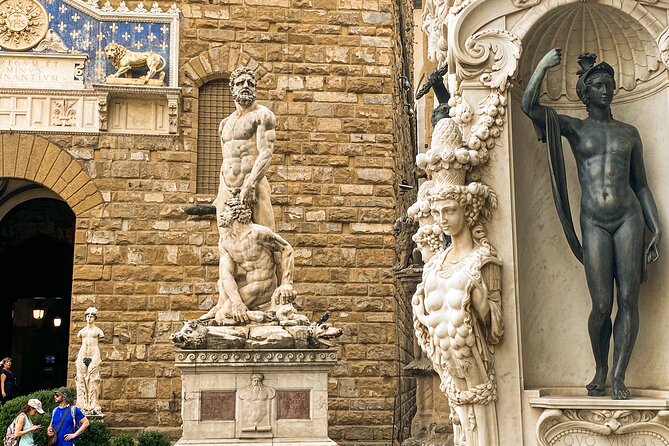
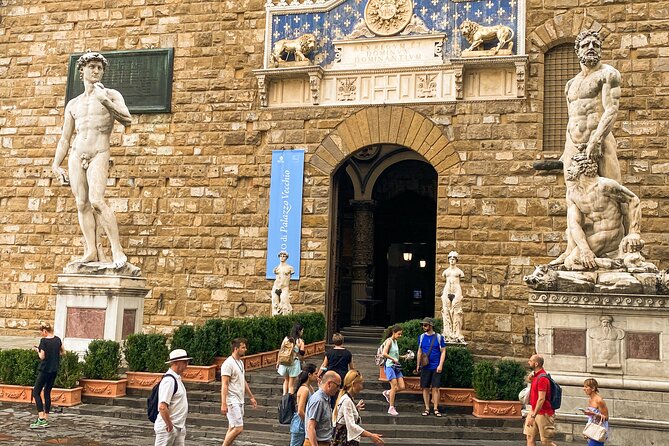
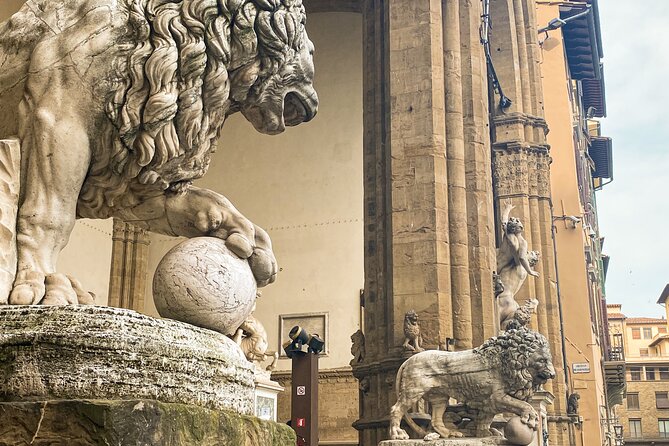
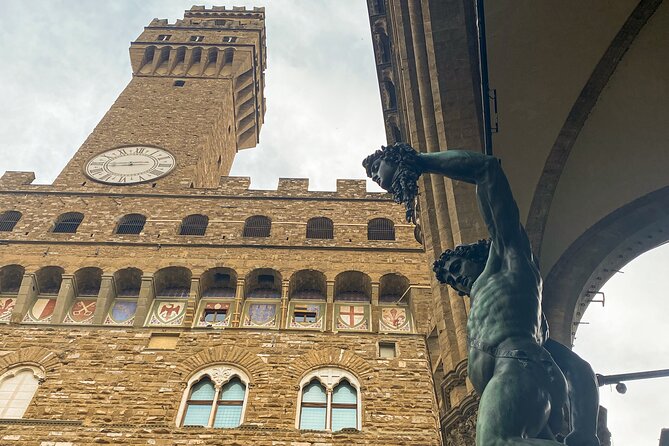
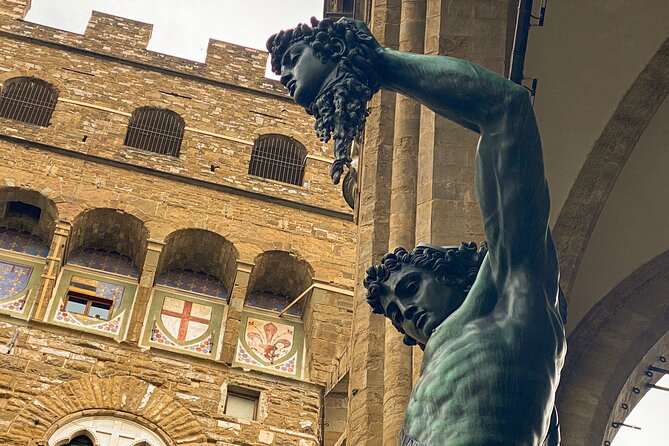
The route then reaches Piazza della Signoria, the political center of old Florence and one of the city’s finest outdoor art settings. You will have about twenty minutes here, enough time to look at the major sculptures and Palazzo Vecchio.
This is where Florence’s art and politics meet most clearly. Palazzo Vecchio has the severe look of a fortress, fitting its role as the city hall. The square once held the original David for almost four centuries, so Irina can connect the statue you saw in the Accademia with the public space where it originally carried political meaning.
That connection is one of the tour’s best features. You are not seeing David as an isolated masterpiece in a museum. You are also learning how the sculpture functioned as a message about Florence, strength, and civic identity.
The square is open and easy to reach, but it can also be crowded and noisy. The included headsets help you follow Irina without having to stand shoulder to shoulder with the guide. They are especially useful if your group is spread out while looking at the sculptures.
Finishing at Ponte Vecchio
The tour ends at Ponte Vecchio, the famous bridge across the Arno. This is a practical finish because you are left in one of Florence’s central areas rather than returned to the starting point.
Ponte Vecchio is a good place to continue on your own. You can pause for views, browse the bridge shops, or use it as a clear landmark for the next part of your day. Since the tour does not include transportation, you should be comfortable walking from stop to stop and arranging your own way back afterward.
The exact walking distance is not provided, but the experience includes two hours on foot through the city center. Wear comfortable shoes. Florence’s historic streets are best covered slowly, and a private guide can make brief pauses when a building or story deserves attention.
What the private format adds
This is not a large group outing. Only your party participates, which changes the feel of the tour. You can ask questions without waiting for a crowd, and Irina can spend more time on the subjects that interest you most.
The private format is particularly useful for families, couples, or friends with different levels of interest in art. One person may want more Michelangelo, another may care about the Medici, and someone else may simply want help finding their way around central Florence. A personal guide can respond to that mix better than a fixed group lecture.
The reviews supplied for this experience repeatedly praise Irina’s ability to bring events and people to life. Her strongest skill seems to be making the history feel connected: Michelangelo leads to the Medici, the Medici lead to churches and public buildings, and those buildings lead back to Florence’s political story.
That is more valuable than a list of dates. You will still hear facts, but the tour’s appeal is the way those facts explain what you are looking at.
Is $266.76 per person good value?
At $266.76 per person, this is not a budget walking tour. The price makes the most sense if you place a high value on private guiding and want priority entry to the Accademia without arranging the museum visit yourself.
The cost includes the Accademia ticket, a one-hour guided visit, a two-hour walking tour, and headsets. It does not include entry to the Baptistery, Duomo, Palazzo Medici Riccardi, or Medici Chapels, since those locations are viewed from outside.
I would compare the price with the cost of a separate museum ticket, a separate city walk, and the convenience of having one guide connect both parts. Group discounts are available, so the total value may improve for larger parties.
The tour is also booked far in advance on average, about 133 days. That does not guarantee that every date will sell out, but it is a clear reason to reserve early if your Florence schedule is fixed.
Timing, weather, and practical details
The full experience lasts about three hours, with one hour in the Accademia and two hours walking. It is offered in English and begins at the Accademia Gallery, Via Ricasoli 58/60. You finish at Ponte Vecchio.
Confirmation is provided at booking. The meeting point is near public transportation, service animals are allowed, and most people can take part. Since the tour includes a sustained city walk, comfortable shoes and a willingness to remain outdoors are sensible.
The experience requires good weather. If poor weather causes a cancellation, you are offered another date or a full refund. You can also cancel for a full refund up to 24 hours before the start time. Changes or cancellations inside that 24-hour window are not accepted.
Who should book this Florence tour?
I would choose this for a first visit, especially if you have only a day or two in Florence and want the main artistic and political landmarks tied together. It also suits anyone who wants David explained rather than simply photographed.
Families and small private groups should find the format helpful. Irina’s use of humor, clear English, and visual material can keep the art discussion lively, while the compact route prevents the day from becoming an exhausting museum marathon.
I would not choose it as your only Florence activity if you want extensive interior visits. You will need separate time for the cathedral, Baptistery, Medici Chapels, Palazzo Medici Riccardi, and any other museums that interest you.
Should you book it?
Book this tour if you want a focused introduction to Florence, priority access to David, and a private guide who can connect Michelangelo with the Medici and the city streets around you.
Skip it if you prefer exploring at your own pace, already have Accademia tickets, or want a full interior tour of the Duomo and Medici sights. For everyone else, the three-hour plan gives you a useful first layer of Florence, with enough art, politics, and local setting to help you make better choices for the rest of your stay.
FAQ
Where does the tour begin?
The tour begins at the Galleria dell’Accademia di Firenze, Via Ricasoli 58/60, 50129 Florence, Italy.
Where does the tour end?
The tour ends at Ponte Vecchio, the Old Bridge and one of Florence’s most famous landmarks.
How long does the experience last?
The experience lasts about three hours, including one hour at the Accademia Gallery and two hours of walking through Florence.
Is the Accademia admission included?
Yes. Priority entrance to the Accademia Gallery and admission are included.
Is entry to the Duomo included?
No. The tour views the Duomo from outside, and no cathedral admission is included.
Is entry to the Baptistery included?
No. The Baptistery is viewed from outside, and its admission ticket is not included.
Is this a private tour?
Yes. Only your own group participates in the activity.
What is the cancellation policy?
You can cancel up to 24 hours before the start time for a full refund. Cancellations or changes made less than 24 hours before the start time are not accepted. If poor weather causes cancellation, you are offered another date or a full refund.
More Art Walks in Florence
- Florence: Uffizi & Accademia Small Group Walking Tour
★ 4.7 · 1,380 reviews - Florence in a Day: Michelangelo’s David, Uffizi and Guided City Walking Tour
★ 4.5 · 1,048 reviews - Florence Walking Tour with Accademia, Uffizi & Lunch
★ 4.0 · 1,033 reviews - Florence: Walking Tour with David, Duomo & Uffizi Gallery
★ 4.7 · 414 reviews
Just added around Florence
- Skip the line: Uffizi small group and walking tour of Florence★ 4.5 · 17 reviews
- Florence Private Walking Tour Including Uffizi and Accademia★ 3.5 · 4 reviews
- Uffizi Gallery Italian guided Tour semi private★ 4.5 · 9 reviews
- Private Tour: Accademia Gallery and City Tour★ 5.0 · 10 reviews
- Private Tour: The Academy Gallery★ 5.0 · 6 reviews
- Uffizi Express Entrance -private tour★ 5.0 · 9 reviews
- Uffizi and Palazzo Vecchio Combo Private Tour★ 5.0 · 3 reviews
- VIP Priority Access: Uffizi Gallery- Guided Experience★ 4.5 · 94 reviews
Art Museum Tours in Florence, compared.
Skip-The-Line Uffizi Gallery Timed Entry Ticket
Read our review →
Florence Accademia Gallery Tour with Entrance Ticket Included
Read our review →
Uffizi Gallery: Renaissance Masterpieces Guided Tour
Read our review →
Uffizi Gallery Timed Entry Ticket & Audio Guide
Read our review →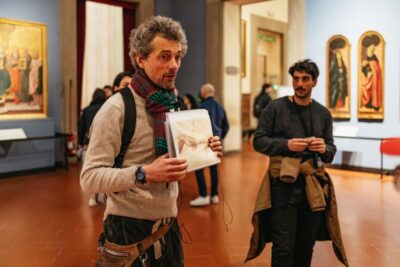
Accademia Gallery Guided Tour with Entry Ticket
Read our review →Browse the lists this tour appears in