
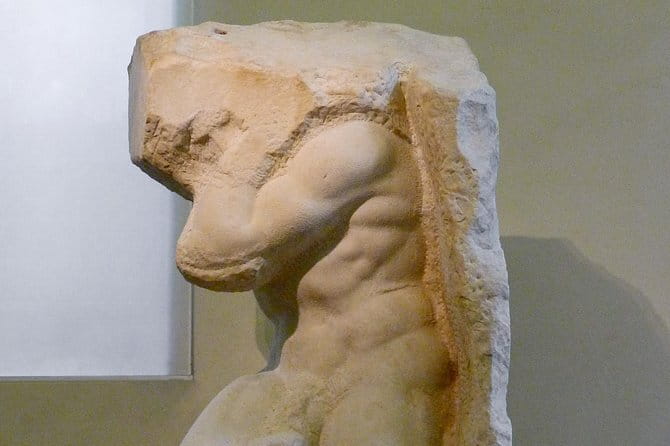
REVIEW · FLORENCE
Michelangelo’s David tour and entry tickets – Small group tour
Michelangelo’s David is the star, but the best part of this tour is having someone explain why the statue mattered to Florence, not just point out its famous hands and face. You’ll see the sculpture from close viewing areas, then learn about other works in the Accademia Gallery.
I like the skip-the-line admission, which can save serious time, and the small group size, capped at 15 people. I also like that the English-speaking guides often bring real enthusiasm to the art, with Julia, Rosa, Francesco, and Raffaello receiving especially warm praise for their clear explanations and friendly style.
The weak point is the meeting arrangement. The red street number at Via Cavour 21R can be confusing, and one person had trouble finding the guide. The tour is also non-refundable, so book only when your Florence plans are firm.
Key points to know before booking
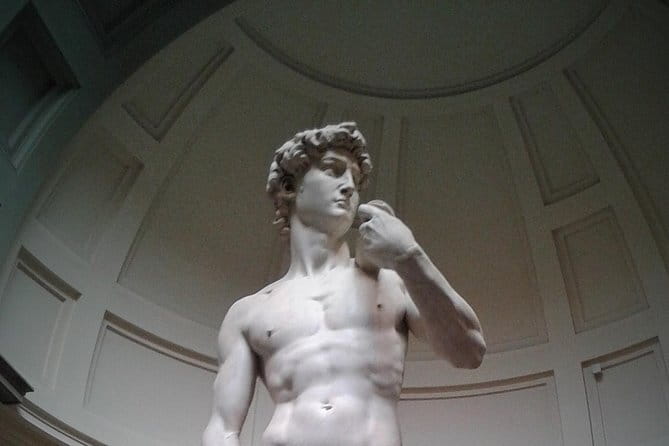
- David is the main event: See Michelangelo’s famous marble sculpture and learn about its political and religious meaning.
- Skip the long public queue: Timed entry helps you get inside faster, though a short wait of around 20 minutes can still happen.
- Small English-speaking group: The group limit is 15 people, a useful size for asking questions and keeping close to the guide.
- More than one statue: The tour also covers paintings, musical instruments, and other works in the Academy Gallery.
- Strong guide element: Julia, Rosa, Francesco, Raffaello, Elia, Elisabet, and Eduardo are among the guides praised for lively art-history talks.
- Stay after the guided hour: Once the tour ends, you can continue exploring the gallery on your own.
Why David deserves more than a quick photograph
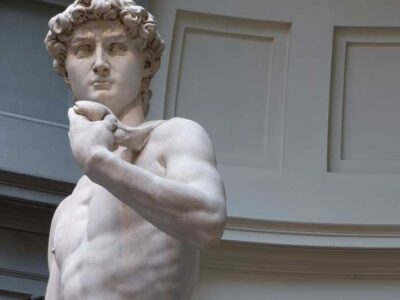
You may think you already know Michelangelo’s David. You have seen the images: the relaxed stance, the oversized hands, the focused face, and the sling resting over one shoulder. Yet the real sculpture has a force that photographs flatten.
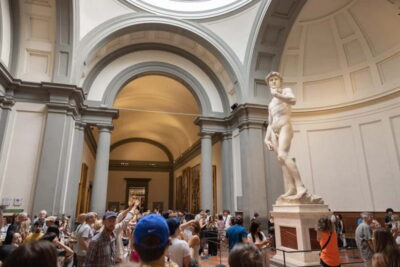
One practical surprise is its scale. The statue is much larger than many people expect, and its anatomical detail rewards a slow look. You can examine the tension in David’s body, the alert expression, and the careful rendering of veins, muscles, and hands. A guide gives you a better chance of noticing these details while also explaining what they meant to Florentines.
David was created as an image of physical strength, courage, and faith. Florence later treated it as a symbol of the republic’s power and independence. That political meaning is important. You are not looking only at a biblical hero. You are looking at a civic emblem placed in a city that wanted its citizens and rivals to see Florence as strong enough to defend itself.
The guided explanation helps connect the statue to Renaissance ideas about the human body, artistic skill, religion, and public life. That context is the main reason to choose this tour instead of simply buying admission and walking straight to the sculpture.
More Art Museum Tours in Florence
- Florence: Skip-The-Line Uffizi Gallery Timed Entry Ticket
★ 4.5 · 27,832 reviews - Florence: Uffizi Priority Ticket & Masterpieces Audio App
★ 4.2 · 6,402 reviews - Florence Accademia Gallery Tour with Entrance Ticket Included
★ 4.5 · 6,148 reviews
Meeting at Via Cavour 21R
The tour begins at Florence Tours, Via Camillo Cavour 21R, with a scheduled start at 2:00 pm. Pay close attention to the address: the number is written as 21 red, and it sits between 11 black and 13 black. Florence uses separate red and black numbering in some streets, so the detail matters.
Give yourself time to find the meeting point. The address is near public transportation, but the supplied directions make clear that the red number is easy to miss. One person found ticket pickup and the guide difficult to locate, even though the guide later proved very helpful.
The first meeting and entry stage is listed as about 15 minutes. This is when you gather with the group, collect or confirm admission, and organize the entry into the gallery. Bring your booking confirmation, which is sent at the time of booking, and do not arrive at the last second.
The tour is offered in English. With a maximum of 15 people, the group is much easier to manage than a large coach tour. You should still stay close to the guide, especially in a crowded museum where it is easy to lose sight of the group.
Entering the Accademia with less waiting
The Accademia Gallery is one of Florence’s busiest art stops because David draws a steady stream of people. A standard public queue can take a large bite out of your day, especially when your Florence schedule includes the Duomo, Uffizi Gallery, churches, and an evening meal.
This tour includes skip-the-line admission, which is its clearest practical benefit. It does not mean every second is guaranteed to be free of waiting. One booking included about 20 minutes in line, but that was still far shorter than the expected wait for people without priority access.
At $70.89 per person, the price is not the cheapest way to enter the Accademia. You are paying for three things together: admission, a timed entry arrangement, and a guided interpretation of the art. The value improves if your time in Florence is tight or if you want help making sense of Renaissance sculpture rather than wandering without context.
If you already know the gallery well and prefer to read labels alone, the extra cost may not suit you. If you have only one opportunity to see David and do not want to gamble on a long queue, the time saved can make the price easier to justify.
The one-hour gallery tour
Inside the Accademia, the guide takes you to David and other important works. The supplied schedule allows about one hour in the gallery, followed by time to continue on your own.
The exact order can vary with crowd conditions. Several guides were praised for finding useful viewing spots near David even when the room was crowded. That matters because your position affects what you can see. A guide who knows how to keep the group together while moving toward a good angle adds real value here.
Expect the guide to focus heavily on Michelangelo and David. You may also hear about other sculptures, paintings, and the gallery’s collection of musical instruments. Julia was especially praised for explaining the instruments, David, and the paintings rather than treating the museum as a one-object visit.
Rosa received strong praise for her lively explanation of Michelangelo and her ability to move the group toward good viewing areas. Raffaello was described as an art-history professor who combined the statue with nearby architecture and Florence’s past. That extra outdoor material is not part of the stated one-hour gallery plan, so you should treat it as a possible guide-specific addition, not a promised feature.
A good guide also leaves room for questions. One guide was praised for welcoming questions, while another was criticized for a flat delivery. That difference is worth noting. The tour depends heavily on the person leading it, and guide quality can vary from one departure to another.
More ways to see the David:
- Florence: Accademia Gallery Guided Tour
★ 4.6 · 4,156 reviews - Uffizi & Accademia Timed Entry: Small Group Duomo Walking Tour
★ 4.5 · 3,630 reviews - Florence: Accademia Gallery Skip-the-Line Guided Tour
★ 4.8 · 3,044 reviews - Florence: Art Tour, Accademia Gallery and David
★ 4.5 · 2,407 reviews
What to look for in David

Start with the overall pose. David is not shown after the fight with Goliath. He is preparing for it, alert and tense. His head turns slightly, and the body suggests controlled readiness rather than a simple display of strength.
Then look at the hands. They are unusually large, which adds to the sense of physical power and may also relate to the importance of action in the story. The scale becomes clearer when you compare the statue with the people around it.
Next, study the face. David’s expression is serious and concentrated. He is not shown as a triumphant conqueror. The moment is full of uncertainty, which gives the sculpture more psychological force than a simple victory scene.
The guide can also explain how the statue became linked with Florence itself. Seeing those details without context is still worthwhile, but the political story gives the room a stronger sense of purpose. You begin to understand why this sculpture became more than a biblical subject.
The other works are worth your time
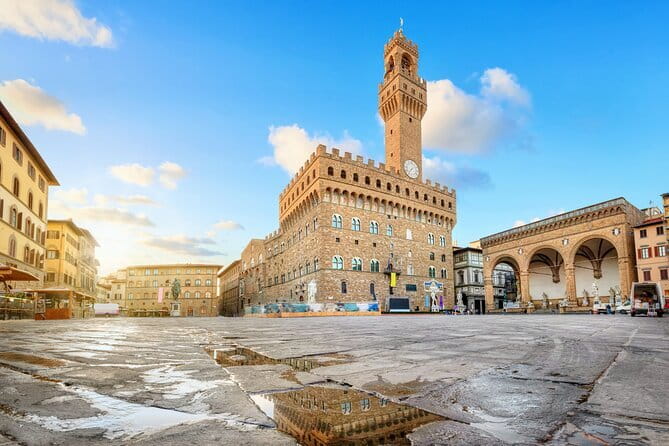
A common mistake is to rush past the rest of the Accademia after seeing David. The gallery contains other important works, and the guided hour gives you a way to notice them without losing your main focus.
The exact works covered depend on the guide and the group’s pace, but the tour can include paintings, religious art, musical instruments, and other sculptures. Eduardo was praised for explaining golden saints and art history, while Elia was praised for giving attention to works beyond David.
This broader look helps you understand the setting. Michelangelo’s statue is the famous centerpiece, but the gallery is not simply a waiting room built around one marble figure. A good guide uses the surrounding collection to show how Florentine art developed and how religious themes shaped the city’s visual culture.
You should expect the guide to concentrate on a selection rather than every room. One hour is enough for a focused introduction, not a complete museum study. That is a sensible tradeoff for most first-time visitors.
Why the small group matters
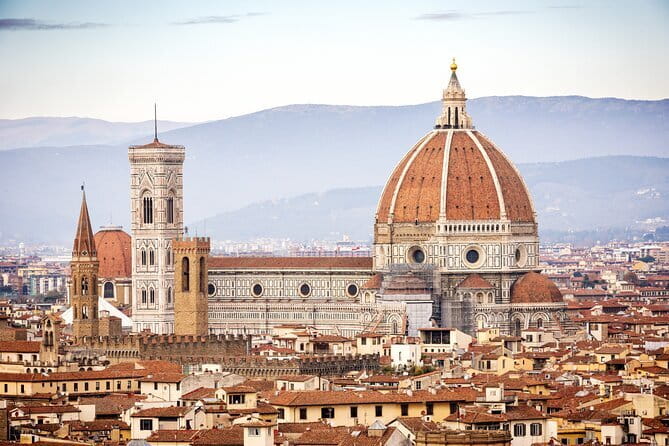
A group limit of 15 is a useful middle ground. You get the structure of a guided visit without the size of a large tour that can make questions awkward and movement slow.
The guide can usually keep the group closer to David and point toward details without shouting across a huge crowd. You are also more likely to hear the explanation clearly, though the equipment still matters.
One person had a radio that did not work because the guide did not check it before starting. The tour had to pause while another radio was brought in. This was an isolated problem in the supplied feedback, but it is a fair reminder to test your device immediately. If you cannot hear, say so at once rather than trying to follow silently.
The guides most often praised were friendly, expressive, and well informed. Julia was described as so thorough that her voice became tired by the end. Francesco was praised for being personable and entertaining. Elisabet was noted for keeping the group engaged, and Rosa for combining strong art knowledge with lively stories.
Timing, pace, and what happens afterward
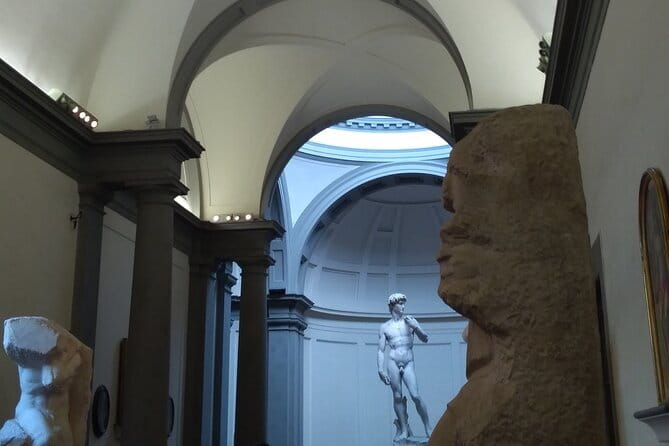
The official duration is about one hour and 15 minutes. The first 15 minutes cover the meeting and entry process, followed by roughly one hour inside the Accademia.
The scheduled departure is at 2:00 pm. That timing gives you a useful afternoon anchor, but it also means you should plan your morning and lunch with enough room to reach Via Cavour without rushing. The tour ends at the Accademia Gallery on Via Ricasoli, not back at the original meeting point.
After the guided portion, you can explore the gallery at your own pace. Use that time to return to David, examine a painting you passed quickly, or look again at the musical instruments and sculptures.
The experience is listed as suitable for most people and near public transportation. No special physical requirements are given. Museum crowds can still make movement slow, and you should be prepared to stand for much of the visit.
Who should book this David tour?
I would choose this tour for a first visit to Florence, especially if David is high on your list and you have limited time. The guide gives you a clear story, while skip-the-line admission reduces the risk of spending half an afternoon outside.
It also suits people who enjoy art more when someone explains the choices behind it. You do not need a background in Renaissance history. The strongest guides make the subject understandable through stories about David, Michelangelo, Florence, religion, and public power.
Families and mixed-age groups may also benefit from the short format. Seventy-five minutes is long enough to feel worthwhile without taking over the day. The small group makes it easier to remain together.
I would be more cautious if you dislike fixed schedules, crowded galleries, or guided commentary. The tour is not private, and the experience depends partly on the guide assigned to your departure. If you want a quiet, solitary museum visit, buy entry on your own instead.
The non-refundable rule is important. You cannot change or cancel for a refund, so check your Florence schedule before paying. Also, arrive early enough to find the red-numbered meeting address and locate the group without stress.
Is the $70.89 price fair?
The answer depends on what you value. The admission itself is only one part of the cost. You are also buying help with entry, a small English-speaking group, and an explanation of David and selected works in the gallery.
For a short visit, that package can be sensible. A long queue is especially costly when you have only a day or two in Florence. Even a 20-minute wait after priority access may feel reasonable if the regular line is much longer.
The price is less attractive for repeat visitors, art students, or independent museum-goers who already understand the collection and do not need a guide. It is also less appealing if your schedule is flexible enough to visit at a quieter time on your own.
The rating is 4.7 from 42 ratings, and 93 percent of people recommend it. Those figures suggest a strong overall result, but they do not erase the practical cautions about finding the meeting point, radio checks, and variation between guides.
Should you book it?
Book this tour if you want to see David without risking a long queue, prefer an English explanation, and would like a compact introduction to the Accademia. The strongest guides, including Julia, Rosa, Francesco, Raffaello, and Elisabet, add much more than basic directions.
Skip it if you want complete freedom, dislike group touring, or already know Michelangelo and the gallery well. For most first-time visitors with a firm afternoon schedule, the combination of guided context, priority entry, and time to look around alone afterward makes this a practical choice.
FAQ
How long does the Michelangelo’s David tour last?
The experience lasts about one hour and 15 minutes. The meeting and entry stage takes about 15 minutes, followed by roughly one hour inside the Accademia Gallery.
What time does the tour start?
The scheduled start time is 2:00 pm.
Where is the meeting point?
Meet at Florence Tours, Via Camillo Cavour 21R, 50129 Florence. The address uses red number 21, located between black numbers 11 and 13.
Is admission to the Accademia Gallery included?
Yes. Admission to the Galleria dell’Accademia is included with the tour.
Is the tour offered in English?
Yes. The experience is offered in English.
Can I stay in the gallery after the guided tour?
Yes. After the guided portion finishes, you can explore the Accademia Gallery at your own pace.
Just added around Florence
- Skip the line: Uffizi small group and walking tour of Florence★ 4.5 · 17 reviews
- Florence Private Walking Tour Including Uffizi and Accademia★ 3.5 · 4 reviews
- Uffizi Gallery Italian guided Tour semi private★ 4.5 · 9 reviews
- Private Tour: Accademia Gallery and City Tour★ 5.0 · 10 reviews
- Private Tour: The Academy Gallery★ 5.0 · 6 reviews
- Uffizi Express Entrance -private tour★ 5.0 · 9 reviews
- Uffizi and Palazzo Vecchio Combo Private Tour★ 5.0 · 3 reviews
- VIP Priority Access: Uffizi Gallery- Guided Experience★ 4.5 · 94 reviews
Art Museum Tours in Florence, compared.
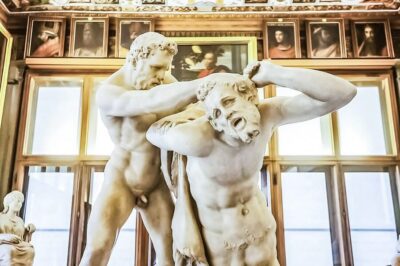
Skip-The-Line Uffizi Gallery Timed Entry Ticket
Read our review →
Florence Accademia Gallery Tour with Entrance Ticket Included
Read our review →
Uffizi Gallery: Renaissance Masterpieces Guided Tour
Read our review →
Uffizi Gallery Timed Entry Ticket & Audio Guide
Read our review →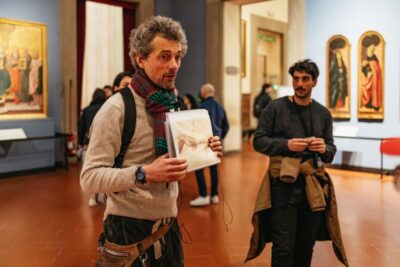
Accademia Gallery Guided Tour with Entry Ticket
Read our review →Browse the lists this tour appears in