
REVIEW · ROME
Borghese Gallery Small-Group Tour with Canova’s Masterpieces
The best reason to book this tour is the gallery itself: a former cardinal’s villa where Bernini’s marble figures and Caravaggio’s paintings sit in rooms small enough to feel personal. I like the reserved entry and the limited visitor numbers, which keep the museum calmer than Rome’s biggest sights.
I also like having an art historian explain the stories, symbolism, and Cardinal Scipione Borghese’s curious collecting habits. The main caution is time. A guide who spends too long on one sculpture may leave you without a proper look at every room, especially if part of the museum is closed.
Key points to know before you book
- See Bernini’s Apollo and Daphne, David, and The Rape of Proserpina in the setting they were made for.
- Reserved entry limits the crowd, giving you a better chance to study the art without shoulder-to-shoulder traffic.
- Guides such as Marta, Emily, Siri, and Laura have been praised for lively explanations, though guide assignments vary.
- The tour lasts about 90 minutes and is conducted in English, with headsets for groups larger than six.
- The gallery’s opening rooms or upper floor can change because of renovation or temporary closure, so check current conditions before you go.
- The tour ends where it begins, at the museum entrance in Villa Borghese.
Why the Borghese Gallery feels different from Rome’s big museums
Rome has museums where you spend half your time finding the art through crowds. The Borghese Gallery takes another approach. Entry is limited to designated time slots, and only a select number of people are admitted each day.
That control changes the mood at once. You can look closely at a Bernini sculpture without a solid wall of people behind you. You can hear a guide explain a painting without constantly shifting aside for passing groups. This is a small museum, but the art carries enormous weight.
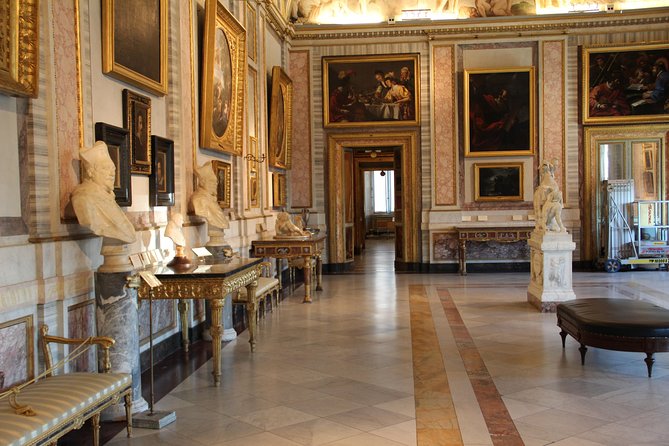
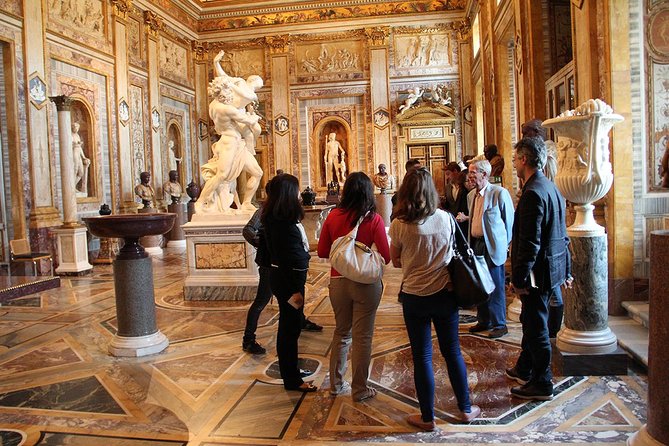
The building was created in the 1600s by Cardinal Scipione Borghese to house his collection. It was once reserved for royals and dignitaries, and the decoration still feels suitably grand. Painted ceilings, polished floors, ornate details, and marble sculpture make the building part of the experience rather than a plain container for art.
I especially like the way the gallery brings together sculpture and painting in the same rooms. You are not only looking at famous names in isolation. You are seeing how patrons used art, architecture, mythology, religion, and family power to create a carefully staged home.
More Art Museum Tours in Rome
- Vatican Museums, Sistine Chapel & St. Peter’s Basilica Tour
★ 4.3 · 73,970 reviews - Vatican Museums, Sistine Chapel & St Peter’s Basilica Guided Tour
★ 4.5 · 39,149 reviews - Rome: Vatican Museums, Sistine Chapel and Basilica Tour
★ 4.3 · 16,039 reviews
Meeting at Piazzale Scipione Borghese
You meet your guide in front of the gallery’s double staircase at Piazzale Scipione Borghese, 5. The tour does not include hotel pickup or drop-off, so you need to make your own way to Villa Borghese.
The meeting point is near public transportation, but allow enough time to find the building. The gallery is in a large park, and the name Villa Borghese refers to both the park and the former villa. Arriving early is sensible, since a late arrival can be especially troublesome when admission is tied to a timed entry.
Once the group is assembled, the guide handles the pre-reserved admission. The tour is capped at 15 people, and headsets are supplied when the group has more than six. That matters here. The rooms are not vast, and a headset helps you listen while standing at a comfortable distance from the sculpture being discussed.
The instructions connected with tickets have caused some confusion for some visitors, particularly over whether a voucher needs to be exchanged at the counter. In practice, bring your confirmation and follow the meeting instructions carefully. The guide is expected to have the group’s admission, but it is wise to read the latest directions before leaving your hotel.
The first rooms: architecture before famous names
The first few minutes are not simply a march toward the most famous sculpture. Your guide introduces the building and explains how Cardinal Borghese’s taste shaped the collection.
That context is useful because the gallery is not a neutral museum built centuries later. Many works were commissioned specifically for this space. Their placement, scale, and subject matter were meant to impress people who entered the cardinal’s home.
A strong guide can make this setting readable. You learn why a sculpture faces a certain direction, how a myth could carry a political message, or how a patron’s personal interests affected what was collected. The best explanations connect the art to the room, rather than treating each object as a separate lecture.
The tour’s strongest guides have included Marta, Emily, Siri, Laura, and others who combine art training with a warm, conversational delivery. One particularly effective style is to ask the group what it sees before explaining the work. That approach makes the art easier to approach if you do not know much about sculpture.
Bernini’s marble figures are the main event
For many people, Bernini is the reason to visit. His sculptures are not meant to be seen from one fixed position. As you move around them, the action changes, expressions shift, and hard marble begins to suggest soft skin, flowing hair, or sudden movement.
Apollo and Daphne is a perfect example. The scene captures the instant Daphne transforms into a laurel tree while Apollo reaches for her. The guide can point out details that are easy to miss at first glance, such as the changing texture of the marble and the way the figures create a sense of motion.
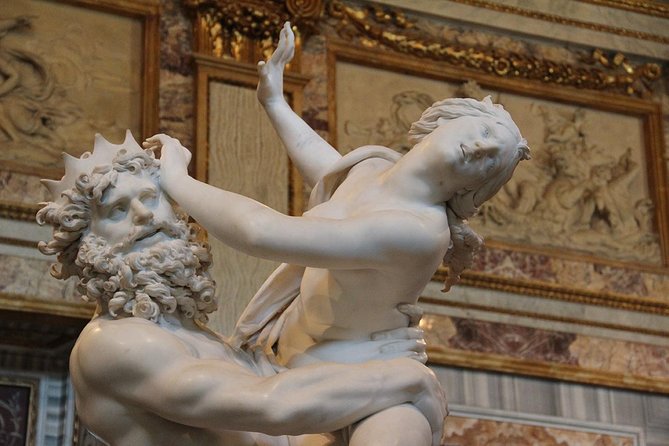
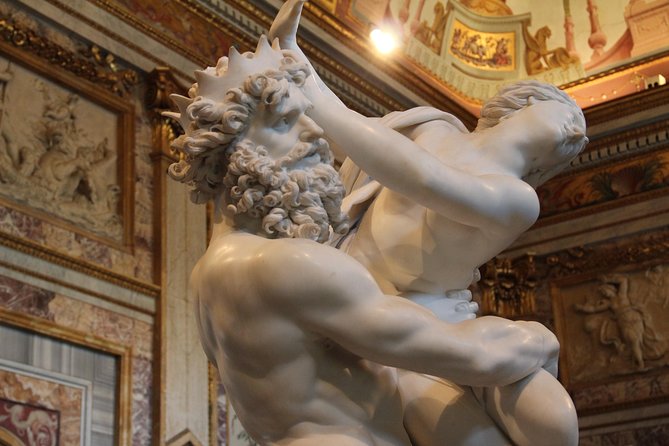
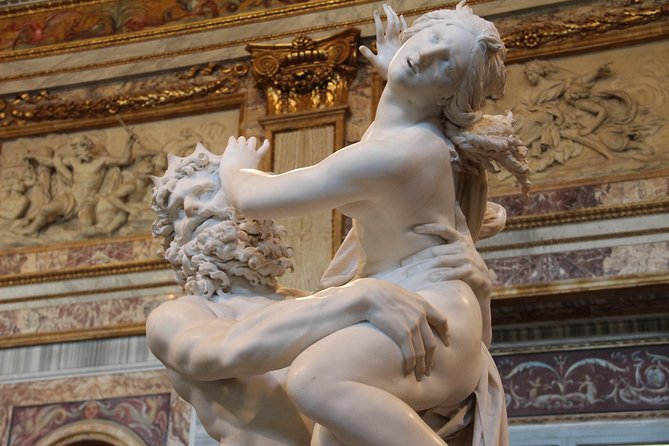
The Rape of Proserpina offers another lesson in Bernini’s skill. The fingers pressing into flesh are famous because the marble appears to yield under Pluto’s grip. A good explanation also gives the myth emotional and political context, rather than reducing the sculpture to a technical trick.
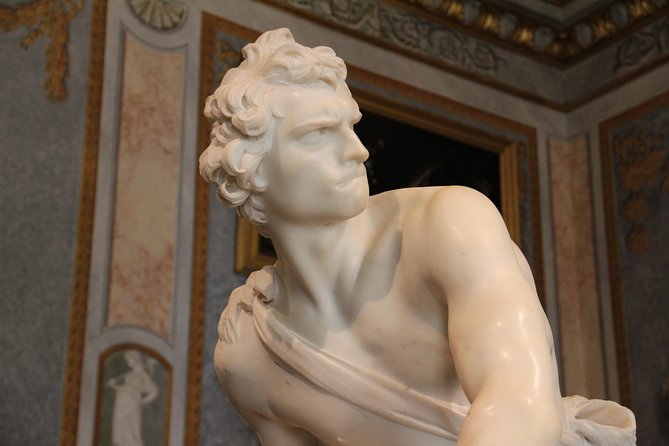
Bernini’s David is different again. This is not a calm portrait of a hero. The body twists as David prepares to launch the stone, making you feel as if the action is taking place in front of you. The guide’s position matters here, since the sculpture rewards a slow look from more than one angle.
Several strong guide accounts focus heavily on Bernini, and that makes sense. His work is unusually easy to bring alive through storytelling. Still, the pacing needs care. One detailed account describes a tour that lingered so long on the opening sculpture that the group did not see every room. I would rather hear a clear explanation of the major works and still have time to look around than receive a perfect lecture on only one piece.
More masterpiece highlights tours in Rome:
- Borghese Gallery, Canova’s Masterpieces Skip-the-Line Guided Tour
★ 4.5 · 1,162 reviews - Borghese Gallery: Canova’s Masterpieces Small Group Guided Tour
★ 4.5 · 47 reviews - Borghese Gallery Private Tour Explore the Masterpieces by Bernini Caravaggio and Raphael
★ 5.0 · 8 reviews - Louvre Museum Masterpieces Guided Tour with Access
★ 4.5 · 12,023 reviews
Canova’s Pauline Bonaparte
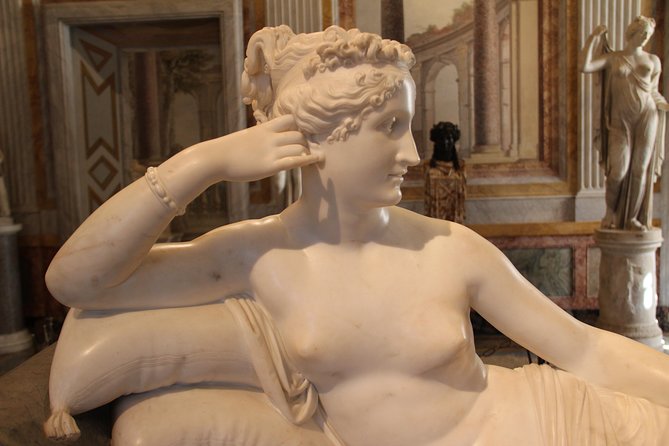
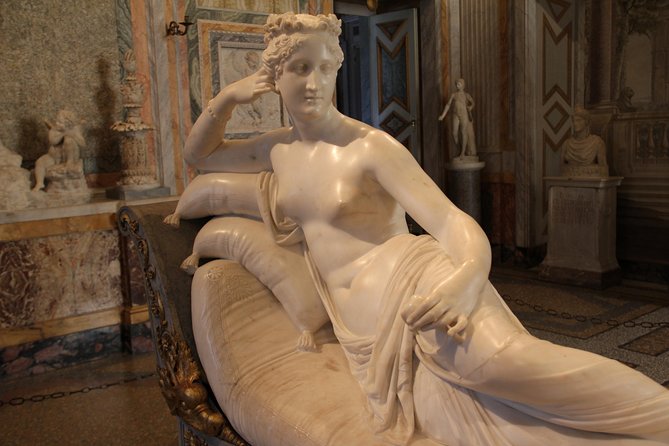
Antonio Canova’s Pauline Bonaparte is one of the gallery’s most memorable sculptures, partly because it looks so different from Bernini’s dramatic mythological scenes.
Pauline is shown reclining as Venus Victrix, holding the apple associated with the goddess. The pose is relaxed, polished, and deliberately elegant. It also carries a personal and political edge, since the sitter was Napoleon’s sister.
Your guide can help you look beyond the smooth surface. Canova’s marble is not merely decorative. The position of the body, the idealized expression, and the choice of mythological identity all contribute to the image Pauline and her family wanted to project.
This is where the tour format earns its price. You can certainly admire Pauline Bonaparte alone, but a guide gives you a reason to look longer. The sculpture becomes a statement about beauty, status, self-presentation, and the power of a famous family.
Caravaggio, Raphael, and the paintings
The Borghese is not only a sculpture museum. Caravaggio’s David and Goliath and Saint John the Baptist are among the paintings that give the visit its darker, more intense side.
Caravaggio’s lighting pulls your attention toward faces, gestures, and key details. His figures feel physical and immediate, but the scenes also carry tension. A guide can explain how the artist used light, shadow, and ordinary-looking people to make religious subjects feel close to real life.
Raphael’s Deposition offers a different experience. Its balanced composition and controlled movement show another approach to religious painting. The contrast between Raphael’s order and Caravaggio’s sharp drama gives the tour a useful range.
The paintings also show why it helps to have someone organize the visit. A short tour cannot cover every object in equal depth. An experienced guide identifies the works that matter most, explains why they matter, and helps you notice connections between artists who worked in very different styles.
What the 90-minute schedule really means
The advertised duration is about one hour and 30 minutes, with the tour ending back at the starting point. That is enough time for a focused introduction to the gallery, not enough for a slow study of every room.
You should expect a highlights visit. The guide leads you through the major works and supplies historical background, symbolism, folklore, and stories about Cardinal Borghese. You also have a chance to ask questions, which is one of the advantages of a group limited to 15 people.
Pacing varies by guide. Some guides make sure the group reaches all the essential works. Others may build a more detailed art lesson around a smaller number of sculptures. I would tell the guide early that seeing the major works matters to you, especially if you are visiting on the last tour of the day.
The museum’s traffic control helps. Since admission is limited, rooms can feel more orderly than those in Rome’s larger museums. Even so, a group of 15 is not the same as a private visit. If you want long stretches of silence with each work, independent visiting may suit you better, assuming you can secure admission.
Renovation and changing access
One practical warning deserves attention: gallery access can change. At one point, the second floor was closed for renovation, and paintings were moved to another museum where the same ticket could provide a discount of five euros.
That situation may not apply on your date, but it shows why you should check current conditions before booking or shortly before your visit. A closure can reduce the number of rooms available while making the open rooms easier to explore in detail.
If an upper floor is closed, the Bernini sculptures on the first floor can still make the visit worthwhile. But you should not assume that every advertised room or painting will be available at every moment. The tour operator has acknowledged that some closures happen with little warning and may be outside its control.
The park after your museum visit
The tour itself focuses on the gallery and returns to the original meeting point. It does not include a guided visit through the Villa Borghese gardens.
Still, plan a little extra time if you can. The park is large, and several people have found the grounds worth exploring at their own pace. This is an easy way to slow down after 90 minutes of concentrated looking.
Do not confuse a walk through the park with an included garden tour. There is no tram or train ride included, and the experience does not promise extra time with a guide outdoors. Think of the gardens as a useful add-on to your Rome day, not part of the paid itinerary.
Price and value at $65.33
At $65.33 per person, this is not the cheapest way to enter an art museum. You are paying for reserved admission, an English-speaking art historian, a guided walking tour, and the convenience of having someone select and explain the key works.
I think the price is reasonable if you want interpretation. The Borghese is compact, but its sculpture can be difficult to read without context. Bernini’s figures are beautiful at a glance, yet the details of gesture, myth, patronage, and technique reward explanation.
The value drops if you mainly want to wander independently or if you dislike being kept to a set route. The 90-minute schedule also means you are paying for a focused visit rather than an entire morning in the museum.
For a first visit to Rome, I would choose this tour over trying to absorb the gallery alone, especially if Bernini and Caravaggio are high on your list. For a returning art specialist who already knows the collection, a self-directed visit may offer more freedom.
Who should book this tour
This experience suits you if you want the major works explained in plain English and prefer a calm, organized museum visit. It is also a good choice if art history is not your strong subject but you want more than a quick photograph of famous sculpture.
Families and mixed-interest groups may benefit from the stories and clear explanations. The guides often use questions, humor, and personal observations to keep the art approachable. The format also works well for people who want to ask questions without joining a very large group.
You need to be able to walk at a moderate pace. The operator can arrange support for people with mobility impairments or wheelchair users, but you must email the Guest Experience team at booking so the right arrangements can be made. One wheelchair user found the building difficult and felt the assistance was not sufficient, so I would discuss your exact needs in advance rather than rely on a general accessibility statement.
The tour is offered in English only. If you are comfortable listening in English but not speaking much, clarify the arrangements for headsets and participation before arrival.
Final verdict: book it for the art, not the checklist
I would book this tour if you want Bernini’s Apollo and Daphne, The Rape of Proserpina, and David to become more than famous names on a phone screen. Canova’s Pauline Bonaparte, Caravaggio’s paintings, Raphael’s Deposition, and the building itself give you plenty to see in a short visit.
Choose it with two expectations: the museum’s available rooms may change, and the quality of the experience depends heavily on pacing and guide assignment. The best guides, including Marta, Emily, Siri, and Laura, have brought humor, strong art training, and real feeling for the collection. Just ask early to see the essential rooms and works.
For most first-time visitors, the limited admission and expert storytelling make the $65.33 worthwhile. If you prefer to set your own pace, or if you need extensive wheelchair assistance, check the practical details first.
FAQ
How long does the Borghese Gallery tour last?
The tour lasts approximately one hour and 30 minutes.
What language is the tour conducted in?
The tour is conducted in English.
What artworks are included?
The visit includes major works such as Bernini’s Apollo and Daphne, The Rape of Proserpina, and David, Canova’s Pauline Bonaparte, Caravaggio’s David and Goliath and Saint John the Baptist, and Raphael’s Deposition.
Is admission to the gallery included?
Yes. An all-inclusive ticket for the Galleria Borghese is included.
Is this a skip-the-line tour?
The tour uses pre-reserved admission with a designated time slot, allowing you to avoid the standard ticket line.
How large is the group?
The maximum group size is 15 people.
Are headsets provided?
Headsets are provided for groups larger than six people.
Where does the tour begin?
The meeting point is in front of the Borghese Gallery’s double staircase at Piazzale Scipione Borghese, 5, Rome.
Where does the tour end?
The tour ends back at the original meeting point.
Can wheelchair users join?
Wheelchair users and people with mobility impairments can be accommodated, but you must email the Guest Experience team when booking to arrange the proper support. The tour requires walking at a moderate pace.
What is not included?
Hotel pickup and drop-off are not included. A guided tour of the Villa Borghese gardens is also not included.
Can I cancel for a full refund?
You can cancel for a full refund up to 24 hours before the experience begins. Cancellations or changes made less than 24 hours before the start time are not accepted for a refund.
More Borghese Gallery Tours in Rome
- Rome: Borghese Gallery Skip-the-Line Ticket & Audioguide
★ 4.3 · 4,318 reviews - Rome: Borghese Gallery Ticket + Audioguide or Guided Tour
★ 4.6 · 3,219 reviews - Rome: Borghese Gallery Guided Tour with Skip-the-Line Entry
★ 4.8 · 2,649 reviews - Rome: Borghese Gallery Skip-the-Line Tickets with Audioguide
★ 4.6 · 2,562 reviews
Just added around Rome
- Colosseum,Vatican Museum & Sistine Chapel in One Day Guided Tour★ 3.5 · 9 reviews
- Vatican Museums and Sistine Chapel last entry Guided Tour★ 5.0 · 3 reviews
- Private Tour Of Rome Highlights And Vatican Museums Skip-The-Line all included★ 5.0 · 4 reviews
- Borghese Gallery Admission Ticket with Audioguide★ 4.0 · 64 reviews
- Caravaggio Art Walking Tour of Rome with Pantheon Visit★ 4.5 · 35 reviews
- Borghese Gallery Skip the Line Guided Tour★ 4.5 · 23 reviews
- Borghese Gallery Ticket with Audioguide★ 3.5 · 51 reviews
- Borghese Gallery VIP Tour – Skip the Line Tickets★ 5.0 · 2 reviews
Art Museum Tours in Rome, compared.
Vatican Museums, Sistine Chapel & St. Peter’s Basilica Tour
Read our review →
Vatican Museums, Sistine Chapel & St Peter’s Basilica Guided Tour
Read our review →
Vatican Museums, Sistine Chapel and Basilica Tour
Read our review →
Vatican Museums & Sistine Chapel Skip-the-Line Entry Ticket
Read our review →
Vatican Museums, Sistine Chapel & Basilica Tour
Read our review →
Vatican Museums & Sistine Chapel Guided Tour
Read our review →
Vatican Museums & Sistine Chapel Skip-the-Ticket-Line Tour
Read our review →
Vatican Museums, Sistine Chapel and St. Peter’s Basilica Tour
Read our review →Browse the lists this tour appears in