
REVIEW · PARIS
The Musée d’Orsay Guided Tour Orsay Museum Semi-Private 6ppl Max
The best thing about this Musée d’Orsay tour is its small group size. With no more than six people, you can hear the guide, ask questions, and keep a sensible pace through one of Paris’s most rewarding but easily overwhelming museums. Guides such as Liliya, Christophe, Ivana, Ana, and Eduardo are praised for turning art history into clear stories rather than a list of dates and names.
I like the reserved entry and the way the tour follows the development of modern painting, from Millet and Manet to Monet, Degas, Renoir, and Van Gogh. I also like the choice of morning, afternoon, or evening departures, plus the option of a private or family-focused version. The main drawback is the price, $144.21 per person, and the fact that temporary exhibitions, hotel transport, and gratuities are not included.
Key points at a glance
- Maximum six people: The semi-private format gives you room to ask questions and hear the guide without a large crowd.
- A clear artistic timeline: You see how Realism and earlier movements helped lead to Impressionism and later Post-Impressionism.
- Reserved museum entry: Entry is included, though security checks and lines can still occur.
- About two and a half hours: The visit covers major works while leaving some time for your own look around.
- English-speaking guides: Guides including Liliya, Ivana, Ana, Christophe, Eduardo, and Daniel have led engaging tours.
- Useful for families: Kid-friendly options are available, and guides have experience keeping children and teenagers involved.
Why the Musée d’Orsay works so well with a guide
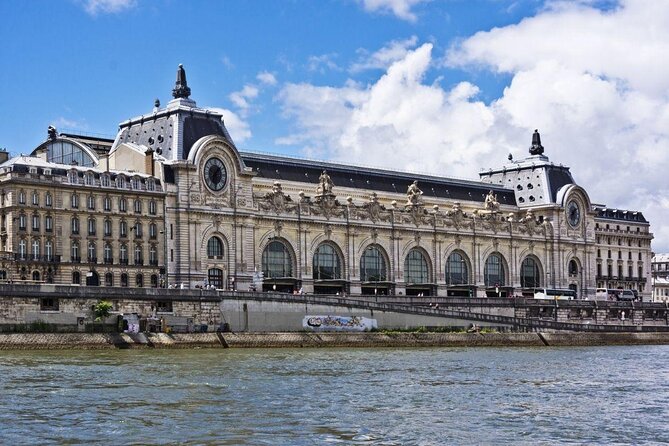
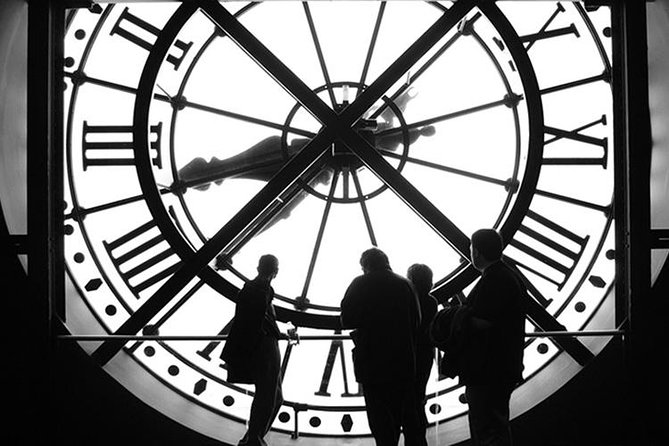
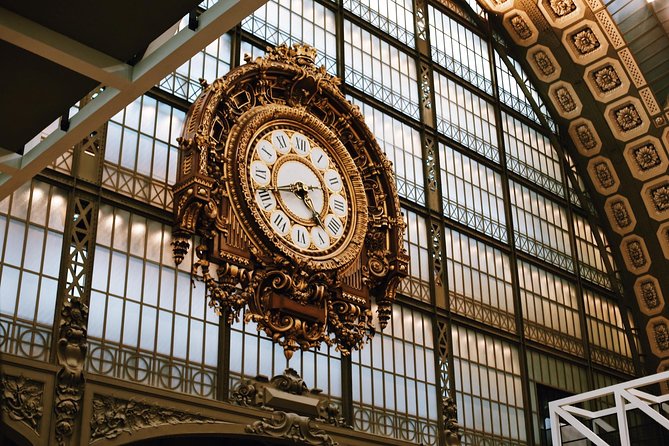
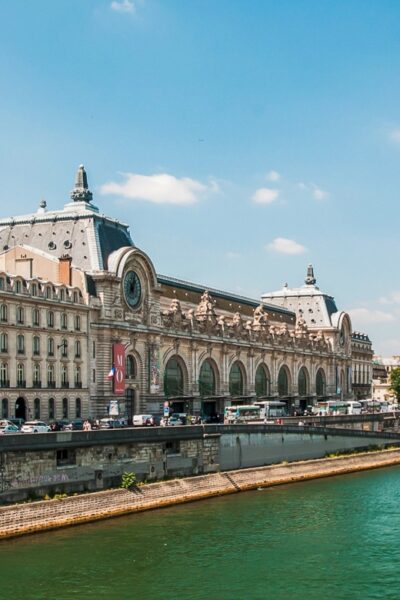
The Musée d’Orsay is not just a collection of famous paintings. It occupies a former railway station, a grand Beaux-Arts building with a very different feel from the Louvre. The setting matters. You are looking at paintings inside a place built for movement, crowds, and modern technology, which fits the museum’s focus on artists who helped change how people saw the world.
You can certainly visit alone, but the collection is large enough to make your priorities unclear. A guide helps you avoid spending too long on the first room and then rushing past the works you came to see. This tour gives you a route through the collection and explains how one artistic change led to another.
I especially like the historical order. Instead of treating Impressionism as an isolated style, the guide places it between earlier academic traditions, Realism, and later movements such as Neo-Impressionism and Cubism. That approach helps you understand why a scene that now seems familiar could once look startling or even improper.
The small group is important here. In a large group, you may spend your time trying to stand in the right place or hear the guide over other voices. With six people or fewer, you can stop at a painting, ask why a figure is posed a certain way, or request more detail about a technique.
More Art Museum Tours in Paris
- Paris: Louvre Museum Timed-Entrance Ticket
★ 4.6 · 71,977 reviews - Paris: Orsay Museum Entry Ticket
★ 4.7 · 25,647 reviews - Paris: Louvre Guided Tour with Reserved Access & Boat Cruise
★ 4.3 · 16,353 reviews
Entering the former railway station
The meeting point is outside the Musée d’Orsay at 75007 Paris. The tour ends back at the museum, and the site is near public transportation. You arrange your own way there, so plan on using the Metro, a taxi, or a ride service if that suits your route.
Reserved entry is included in the tour price. That is useful at a museum where the entrance area can become slow, especially at popular times. Still, reserved entry does not mean that every step is instant. Security checks remain, and the museum can form lines during periods of heavier demand.
Bring only what you need. Large bags and suitcases are not allowed inside, while handbags and small, thin backpacks can pass through security. This is an easy detail to overlook in Paris, so leave bulky luggage at your accommodation or arrange another storage option before arriving.
The museum can occasionally close or delay opening without much warning. If opening is delayed by more than an hour, an alternative may be offered. The stated terms do not promise a refund or discount for every museum disruption, so keep your schedule flexible.
Following the road to Impressionism
The opening section of the visit generally looks at artists who came before the Impressionists. Millet’s The Gleaners is a useful example because it treats rural laborers as serious subjects rather than as background decoration. A guide can show you how subject matter itself became part of the argument.
The tour then moves toward Manet, whose Luncheon on the Grass is one of the museum’s essential stops. The painting caused a stir not simply because of its subject, but because of its blunt handling of space, figures, and modern life. Your guide explains why the work challenged the accepted rules of painting and why Manet helped prepare the way for the artists who followed.
This is where the tour’s chronological structure earns its keep. Instead of saying that Impressionists suddenly appeared and painted outdoors, the guide can connect their work to the arguments already taking place in French art. You get a sense of change rather than a string of disconnected masterpieces.
The exact route can vary. Paintings may be on loan, under restoration, or temporarily inaccessible, and museum collections change during the year. The listed works are intended highlights, not an absolute guarantee that every painting will be on the wall.
Monet, Renoir, and the Impressionist breakthrough
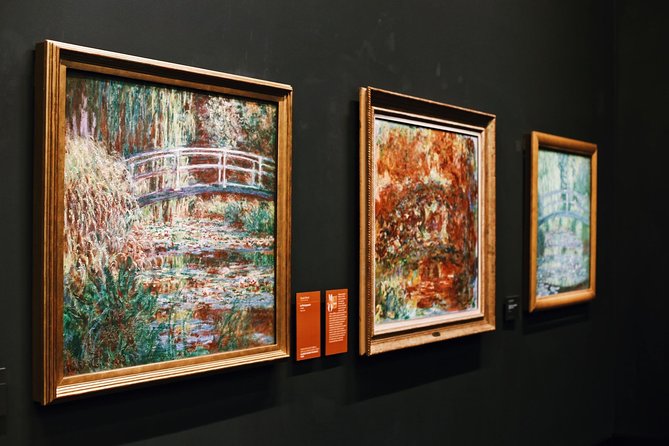
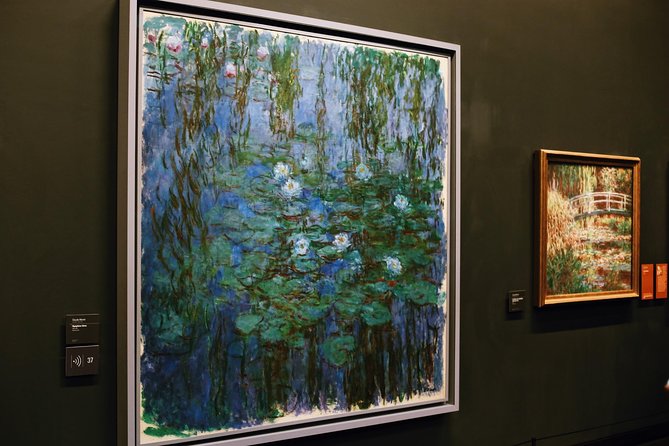
Monet’s Poppy Field and his Waterlilies are central to the tour. These works give you a chance to look closely at color, broken brushwork, light, and the way an artist can suggest rather than spell out a scene. A good guide will help you notice what Monet leaves unfinished or indistinct, and why that lack of hard detail was so new.
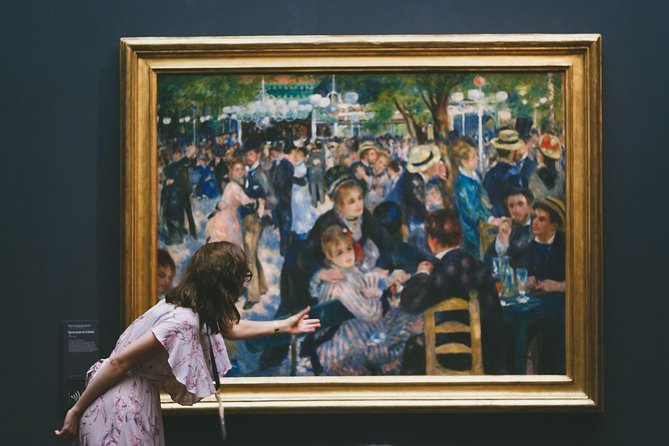
Renoir’s Dance at Le Moulin de la Galette offers a different kind of experience. The painting is crowded with people, sunlight, movement, and social energy. It is easy to admire it from a distance, but the tour encourages you to look at how the brushwork handles faces, clothing, shadows, and shifting light.
The guide also discusses the techniques used by Renoir, Monet, Van Gogh, and other artists. You do not need formal art training to follow along. The strongest guides on this tour, including Ivana, Hugo, Liliya, and Beatrice, have been praised for explaining the period in plain English and for showing how the style developed.
This part of the tour is especially helpful if you know the paintings but not the ideas behind them. You leave with more than a checklist of names. You understand why color, outdoor light, visible brushstrokes, and ordinary modern subjects mattered.
More semi-private gallery tours in Paris:
- Louvre Museum Paris Essential Guided Tour Semi-Private 6ppl Max
★ 5.0 · 3,807 reviews - Louvre & Musée d’Orsay Guided Museum Tour Semi-Private 6ppl Max
★ 5.0 · 619 reviews - Exclusive Semi-Private Louvre Tour with Mona Lisa, Max 6 People
★ 5.0 · 126 reviews - Musée d’Orsay & Montmartre Tour Semi-Private Guided Tour 8ppl Max
★ 5.0 · 95 reviews
Degas and the people behind the pictures
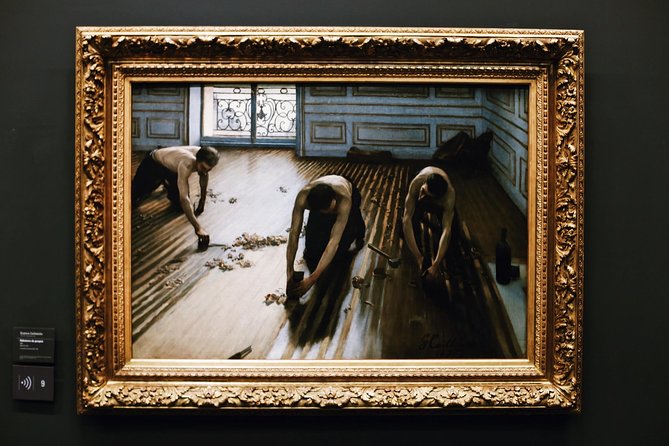
Degas’s ballerinas are another likely stop. They are a good reminder that Impressionist subjects were not limited to landscapes or garden scenes. Degas often made you feel as if you had caught a moment rather than watched a carefully arranged performance.
Your guide may use the ballerinas to discuss framing, movement, and unusual viewpoints. The museum’s large rooms can make it tempting to move quickly from one famous work to the next. Stopping for a few minutes to study the angle of a figure or the cropped edge of a composition makes the visit more rewarding.
The guides bring different strengths. Some focus on artists’ personal stories, rivalries, and scandals. Others place more weight on technique and chronology. Names associated with particularly praised tours include Daniel, Kotryna S, Valerie, Achille, Florent S, Zdravko, Alexandra, and Sunday.
You cannot select a particular guide with certainty unless the operator confirms it, but the repeated praise for individual guides suggests that the experience can vary with the person leading it. If you have a strong preference, you can ask about the guide when booking, but treat any request as a request rather than a guarantee.
Van Gogh and the artists who followed
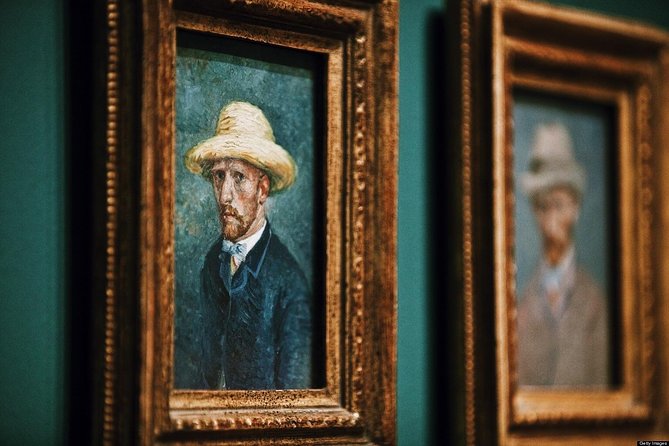
Van Gogh’s Bedroom in Arles gives the tour a clear shift in mood and style. The painting is familiar, but seeing its unusual perspective, strong outlines, and intense color in the museum makes it more than a famous image on a postcard.
The guide connects Van Gogh to the Impressionists while explaining that Post-Impressionism moved in different directions. This helps you see that the period was not one uniform style. Artists borrowed ideas from one another, then pushed them toward personal forms of expression.
This is one of the tour’s most valuable teaching points. You are not simply told that Van Gogh came after Monet. You are shown how artists took the Impressionist interest in light and color and used it for different goals.
The route may also touch on artists and styles beyond the best-known names. The museum has more to offer than its headline paintings, and the guide can point out less familiar works when time and crowd levels allow. The balance between famous paintings and lesser-known pieces is one reason a small group is useful.
How much can you see in two and a half hours?
The stated duration is about two hours to two hours and thirty minutes, with the tour description specifying approximately two and a half hours. That is enough for a focused introduction, not enough for every gallery.
Expect the guide to select key works and explain them in depth. You will probably see more than the six highlighted paintings, but the precise number depends on the route, crowd levels, museum access, and the pace of your group.
I like that the tour leaves some time at the end for your own exploration. Several guides have been praised for allowing independent viewing after the main route. Use that time to return to a painting that caught your eye or visit a nearby room that was not part of the guided path.
Do not book this if your plan is to spend an entire day examining every section. It is better for getting your bearings, understanding the major movements, and learning how to look at the collection with more confidence.
Family visits and different guide styles
The tour can work well for families, especially when children or teenagers might lose interest in a long lecture. Guides such as Lilly, Christophe, and Alexandra have been praised for adjusting their explanations and keeping younger people involved.
A family-friendly version is available as an upgrade. That may be worth considering if your group includes children with different attention spans or if you want the guide to make the visit more interactive.
The tour is also suitable for first-time visitors who feel unsure about art museums. You do not need to recognize every artist before arriving. The guide supplies the order and context, while you decide which works appeal to you.
Those who already have a strong background in Impressionism may want a private tour instead. A private format gives you more control over the route and questions, though it will likely cost more than the semi-private option.
Is $144.21 per person good value?
At $144.21 per person, this is not a budget museum visit. The standard museum admission is included, along with reserved entry and a professional English-speaking guide, but you pay mainly for time saved and interpretation.
The value is strongest for a first visit, a short stay in Paris, or a family that wants the museum to feel manageable. A six-person maximum means you receive far more attention than on a large group tour. If the guide is a strong fit, two and a half hours of clear explanation can change how you see the entire collection.
The value is less clear if you prefer to wander alone, already know the museum well, or want to spend most of the day inside. You may prefer ordinary admission and a self-guided visit.
Gratuities are optional and not included. Hotel pickup and drop-off are also not included, and temporary exhibitions require separate planning. Add those costs and limits to your calculation before booking.
Practical details before you reserve
The experience is offered in English, with morning, afternoon, and evening choices. It is usually booked well ahead, with an average booking time of 49 days in advance, so popular dates may not remain open close to your trip.
You need to provide a mobile phone number with the country code. Keep your phone available on the day of the tour in case the operator needs to reach you.
A minimum of two people is required for the tour to run. If that minimum is not met, you can be offered another date or experience, or receive a full refund. The supplied information also repeats a maximum of six people, although one general note refers to eight, so confirm the final group limit when booking if that detail matters to you.
The tour requires a moderate level of physical fitness and is not available for people with walking disabilities or wheelchair users. Some rooms require very quiet behavior or limit speaking, and the guide will explain those rules before you enter.
Free cancellation is available up to 24 hours before the start time. Changes or cancellations inside that window are not accepted for a refund.
Should you book this Musée d’Orsay tour?
Book it if you want the museum’s major paintings explained in a clear sequence, especially on your first Paris visit. The small group, reserved entry, and strong focus on Impressionism make it a sensible choice for couples, families, and art lovers who want personal attention without paying for a fully private guide.
I would be most inclined to book it for a family with children or teenagers, since several guides have shown a knack for keeping younger people involved. I would also choose it if I had only a few hours and wanted to understand why Manet, Monet, Renoir, Degas, and Van Gogh changed painting.
Skip it if you prefer a slow, independent museum day or if $144.21 feels too high for guided interpretation. Before paying, check the date, the accessibility limits, the bag rules, and whether your preferred time is available. For many first-time visitors, this is a practical way to turn a famous museum into a readable story rather than a long march past paintings.
FAQ
How long does the Musée d’Orsay tour last?
The tour lasts about two hours to two hours and thirty minutes. The listed duration is approximately two and a half hours.
How many people are in the group?
The semi-private tour is described as having no more than six people. One general note refers to a maximum of eight, so confirm the final group limit when booking if this is important to you.
Is museum admission included?
Yes. Museum entrance and reserved entry are included in the tour price.
Is the tour offered in English?
Yes. The experience is offered in English.
Which artworks are usually included?
The route generally includes Manet’s Luncheon on the Grass, Renoir’s Dance at Le Moulin de la Galette, Monet’s Poppy Field and Waterlilies, Van Gogh’s Bedroom in Arles, Degas’s ballerinas, and Millet’s The Gleaners, provided the works are not on loan or being restored.
Does the tour include temporary exhibitions?
No. Temporary exhibitions are not included.
Does the tour include hotel pickup?
No. Hotel pickup and drop-off are not included. You meet at the Musée d’Orsay.
Is the tour suitable for wheelchair users?
No. The tour is not available for people with walking disabilities or those using a wheelchair.
Can I bring a large bag or suitcase?
No. Large bags and suitcases are not allowed inside. Handbags and small, thin backpacks are permitted through security.
Can I cancel for a full refund?
Yes, if you cancel at least 24 hours before the experience starts. Cancellations or changes made less than 24 hours in advance are not refunded or accepted.
More Orsay Tours in Paris
- Paris: Orsay Museum Entry Ticket and Digital Audio Guide App
★ 4.4 · 3,170 reviews - Paris in a Day: Louvre or Orsay, Eiffel Tower, City Walk & Cruise
★ 5.0 · 1,956 reviews - Paris: Musée d’Orsay Skip-the-Line Tour with Expert Guide
★ 4.5 · 1,145 reviews - Musée d’Orsay Skip-the-Line Tour with Expert Guide
★ 4.8 · 1,088 reviews
Just added around Paris
- Paris Day Tour with Eiffel Tower, Louvre and Cruise Max 6 People★ 4.5 · 29 reviews
- d’Orsay Museum Paris entry ticket★ 3.5 · 31 reviews
- visiting the masterpieces of impressionists at Orsay museum★ 5.0 · 7 reviews
- PRIVATE Louvre Wonders & Hidden Treasures Visit★ 5.0 · 65 reviews
- Louvre Museum with private guide★ 5.0 · 3 reviews
- Louvre Wheelchair-Accessible Private Tour – Stress-Free & Easy★ 5.0 · 16 reviews
- LOUVRE, Small Group Guided Tour in French (TOP SALES)★ 4.5 · 9 reviews
- Musée d’Orsay Highlights Tour with Gourmet Lunch★ 4.5 · 11 reviews
Art Museum Tours in Paris, compared.
Louvre Guided Tour with Reserved Access & Boat Cruise
Read our review →
Louvre Overview, Exploration tour and Reserved Entry
Read our review →
Louvre Museum Entry Ticket With Host and River Cruise
Read our review →
Mona Lisa & Louvre Masterpieces Tour with Reserved Access
Read our review →
Louvre Museum – Exclusive Guided Tour (Entry Included)
Read our review →
Louvre Museum Hosted Entry and Mona Lisa Audioguide
Read our review →Browse the lists this tour appears in