REVIEW · PARIS
Greek Mythology at the Louvre. Private tour.
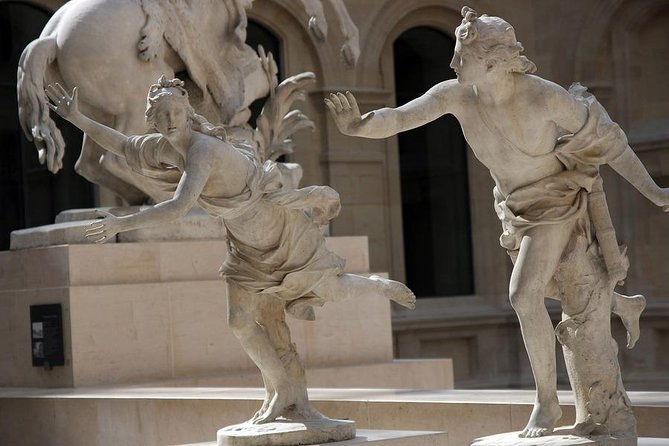
The Louvre becomes easier to grasp when you follow one clear thread. This private tour uses Greek mythology to connect famous sculptures and stories, from Venus de Milo and Venus of Arles to Artemis, Apollo, Eros, Psyche, and the Trojan War.
I like the private format, since your guide can keep the focus on your group and adjust the storytelling to your interests. I also like the range of subjects: love, hunting, art, kingship, and war all appear within three hours.
The main drawback is time. The Louvre is enormous, and three hours can only cover a carefully chosen selection. At $347.28 per person, this is a serious splurge, especially for a solo booking or a very small group.
Key points to know before booking

- Greek mythology gives the Louvre a clear path: You will focus on gods, heroes, love stories, and the Trojan War rather than trying to see the whole museum.
- The private guide is the main value: Only your group takes part, so the experience can feel more personal than a standard group visit.
- Famous works are included: The route features Venus de Milo and Venus of Arles, along with themes tied to Artemis, Apollo, Eros, and Psyche.
- The tour lasts about three hours: That is enough for a focused introduction, but not enough for every mythology-related work in the museum.
- Vincent is one named guide: One five-star review praises Vincent for his commitment and says the group would request him again.
- Admission and mobile ticket are included: Meet at the Arc de Triomphe du Carrousel at 2 pm, and the activity returns to that meeting point.
Why Greek mythology works so well at the Louvre
Greek mythology is a smart way to approach the Louvre. The museum covers far more art than anyone can absorb in one visit, and a theme gives you a reason to move from one work to the next.
Here, the stories provide the structure. You are not simply stopping at famous statues because they are famous. You are looking at how European artists returned to the same gods, heroes, and tales over many centuries.
That matters because mythology is more than a set of old stories. The gods carried ideas about beauty, power, desire, war, nature, art, and fate. A guide can point out how these subjects gave artists a common visual language.
I especially like the balance between familiar names and less obvious connections. Venus offers beauty and love. Artemis brings the hunt and the independence of a goddess linked with the natural world. Apollo adds music, art, the sun, and royal image-making. Eros and Psyche bring a tender love story, while the Iliad brings conflict and heroic struggle.
A focused theme also helps families. If your child already loves Greek mythology, the statues and paintings have a story behind them. The five-star feedback from a parent makes one useful point: three hours may pass quickly for a young mythology fan who wants more tales.
More Art Museum Tours in Paris
- Paris: Louvre Museum Timed-Entrance Ticket
★ 4.6 · 71,977 reviews - Paris: Orsay Museum Entry Ticket
★ 4.7 · 25,647 reviews - Paris: Louvre Guided Tour with Reserved Access & Boat Cruise
★ 4.3 · 16,353 reviews
Starting at the Arc de Triomphe du Carrousel
The meeting point is the Arc de Triomphe du Carrousel, at Place du Carrousel, 75001 Paris. This places you by the Louvre complex rather than asking you to find a distant neighborhood meeting point.
The scheduled start is 2 pm. That afternoon timing can fit well into a Paris day, especially if you want a slower morning before heading to the museum. You should still arrive with enough time to identify the meeting point and have your mobile ticket ready.
The activity ends back at the same meeting point. That is useful if you have plans nearby afterward, though the exact finishing time can vary slightly because the tour is listed as approximately three hours.
The area is near public transportation, so you do not need to build a complicated transfer into your day. The tour information does not specify a particular station or route, so check your own transit plan before setting out.
Venus de Milo and Venus of Arles
Venus is one of the strongest starting points for a mythology tour because the goddess appears in several forms. The tour includes both Venus de Milo and Venus of Arles, two names that many people recognize before they enter the Louvre.
A guide can help you look beyond the fame of Venus de Milo. The statue is often treated as a must-see image, but a mythology-focused visit gives it a role in a larger story about beauty and the goddess associated with love.
Venus of Arles adds a useful comparison. Seeing two depictions of Venus lets you consider how artists handled the same mythological figure in different ways. The experience is not just a checklist of celebrated objects. It is a chance to compare how beauty was presented through sculpture.
You should expect these stops to be popular parts of the route. The supplied information does not promise a particular viewing position, crowd level, or amount of time at each work, so keep your expectations flexible. The private format does not mean the museum will be quiet, but it does mean your questions stay within your own group.
Artemis, Diana, Apollo, and the Sun King
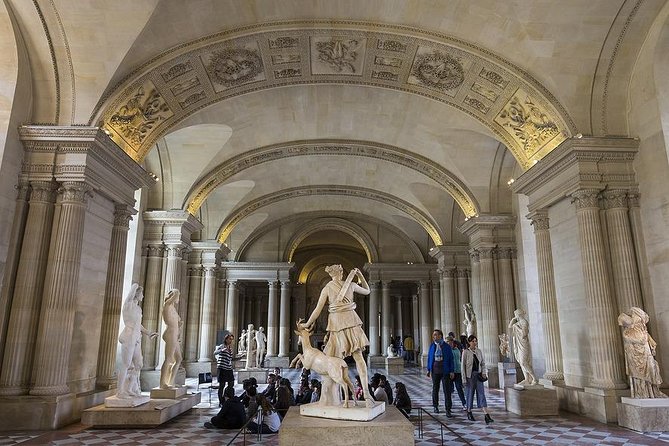
The tour then widens its view from love and beauty to the gods of the hunt and the arts. Artemis, also known as Diana in Roman mythology, is presented as a goddess connected with hunting. Her brother Apollo is linked with the arts and the sun.
These are useful figures for understanding how mythology changed names and meanings across Greek and Roman traditions. You will hear Artemis and Diana used together, which helps explain why a work may be labeled with a Greek name in one context and a Roman name in another.
Apollo offers an especially interesting bridge between ancient myth and French royal power. The tour connects him with Louis XIV, the Sun King. That link shows how an ancient god could be used to shape the image of a much later ruler.
This is one of the tour’s best historical ideas. Mythology did not remain locked in the ancient world. It continued to give artists and rulers a set of symbols they could use for their own time.
The information provided does not name every artwork or gallery on this part of the route. That is worth keeping in mind if you are hoping for a precise room-by-room plan. The strength here is the theme and the guide’s explanation, not a published list of every stop.
More Louvre tours and timed tickets:
- Louvre Museum Masterpieces Guided Tour with Access
★ 4.5 · 12,023 reviews - Paris: Louvre Overview, Exploration tour and Reserved Entry
★ 4.1 · 10,145 reviews - Paris: Louvre Museum Entry Ticket With Host and River Cruise
★ 4.6 · 9,926 reviews - Mona Lisa & Louvre Masterpieces Tour with Reserved Access
★ 4.6 · 6,812 reviews
Eros and Psyche bring the love story forward
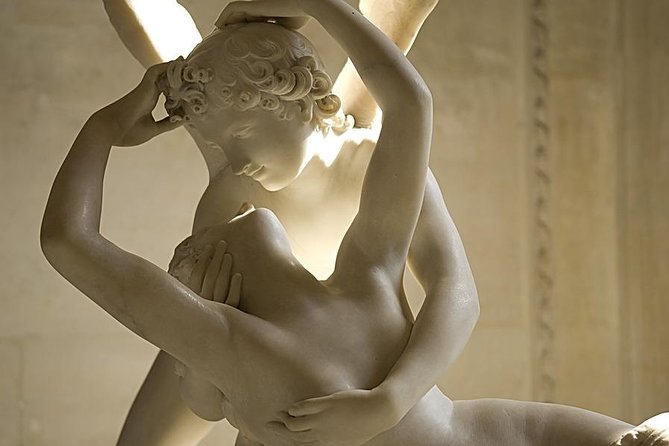
Eros and Psyche offer a different mood from the grander subjects of gods and kings. Their story centers on love, trust, and human weakness, giving the tour a more intimate middle section.
The guide will tell the story rather than simply point to an artwork and move on. That storytelling matters at the Louvre, where labels can provide basic facts but rarely explain why a myth kept attracting artists.
For families, this may be one of the most memorable parts. It gives younger visitors a clear narrative to follow. For adults, it shows how myth can be both romantic and difficult, with love tested by doubt and curiosity.
Again, the tour description does not identify a specific Eros and Psyche work or state exactly how long the group spends with it. You should see this as a themed stop rather than a promise of one named masterpiece. If this is your main interest, mention it when you meet the guide so it receives the attention you want.
Homer’s Iliad and the Trojan War
The final major theme is Homer’s Iliad and the Trojan War. This moves the tour from individual gods and love stories into a large cycle of conflict, heroes, loyalty, and loss.
The Trojan War is one of the most useful stories for making sense of classical art. It gave artists scenes of battle and heroism, but it also raised harder questions about pride, revenge, fate, and the cost of war.
You may already know names from the story, or you may know only the broad outline. Either way, a guide can connect the myth to the artworks you see and explain why the tale has remained so powerful.
Do not expect a complete retelling of the Iliad in one short museum visit. Three hours must cover several major themes, and the Louvre contains much more than this route can include. The benefit is a guided selection that keeps the war story tied to the larger mythology theme.
What a private three-hour visit gives you

The private structure is important here. Your group is the only group taking part, so the guide is not balancing your questions against a large crowd of strangers.
That can make a major difference with a story-heavy subject. You may want more time on Eros and Psyche, while another member of your group may care more about Apollo or the Trojan War. A private guide has a better chance of adjusting the emphasis than a fixed public tour.
One five-star review names Vincent and praises his investment in the experience. The French-language feedback says the group would choose the same guide again if returning to Paris. Vincent may be the guide for your booking, but the supplied details do not guarantee a particular guide, so confirm that directly if his participation matters to you.
The private format also helps if your group includes different ages. A child can ask basic questions without feeling out of place, while an adult can ask about artistic or historical connections.
Still, private does not mean unlimited. The tour remains about three hours, and the museum is vast. You will get a focused visit, not a full survey of every Greek or Roman work in the building.
Is $347.28 per person a fair price?
At $347.28 per person, this tour costs much more than a basic museum admission. You are paying for a private guide, a planned theme, admission, and the ability to keep the experience within your own group.
The value depends heavily on group size. If several people share the booking, the private format may make more sense because the guide fee is spread across the group. Group discounts are listed, so check how the price changes for your party before deciding.
For a solo visitor or a couple, the cost is harder to justify unless Greek mythology is a major reason for visiting the Louvre. You should choose this experience for the focused interpretation and private attention, not simply to gain entry to the museum.
I would also compare the price with your priorities. If you want to see many famous Louvre highlights quickly, this is not the most direct choice. If you want one subject explained in detail and prefer not to join strangers, the price may feel more reasonable.
The five-star feedback is encouraging, but the rating comes from only two reviews. That means the praise for the guide, especially Vincent, is useful but not a broad measure of every possible departure.
Who will enjoy this Louvre experience most?
I would recommend this tour most strongly to:
- Families with a child or teenager who already loves Greek mythology
- Couples or friends who want a private museum visit with one clear subject
- First-time Louvre visitors who feel overwhelmed by the museum’s size
- Art lovers interested in how ancient stories shaped later European art
- Visitors who want to ask questions and control the pace within their group
It may be less suitable if you want a broad introduction to the Louvre, a full day inside the museum, or a low-cost way to see the main highlights.
The tour also suits people who enjoy stories more than lists of dates and names. You will hear about gods, lovers, heroes, rulers, and war, then see how those stories appear in art.
Practical details that affect your day
Confirmation is sent at booking, and a mobile ticket is available. Admission is included, so you are not buying a separate museum ticket for this activity.
The tour starts at 2 pm and runs for about three hours. Plan your day around that fixed start time. The exact itinerary within the Louvre is not fully listed, so you should ask your guide at the beginning if there is one particular myth or artwork you especially want to cover.
Most people can participate, and the meeting area is near public transportation. The information does not provide more specific accessibility details, so contact the provider before booking if you need particular arrangements.
Free cancellation is available if you cancel at least 24 hours before the local start time. A cancellation made less than 24 hours ahead is not refunded, and changes within that window are not accepted. The experience also requires a minimum number of participants. If the provider cancels because that minimum is not met, you can receive a different date or experience, or a full refund.
Should you book Greek Mythology at the Louvre?
Book it if mythology is one of your main interests, you value a private guide, and you are comfortable paying a premium for a three-hour focus. The selection of Venus, Artemis, Apollo, Eros, Psyche, and the Trojan War gives the visit a strong narrative shape.
I would be especially inclined to recommend it for a family with a mythology-loving child. The only clear complaint in the feedback is that the visit could have been longer, which is a good sign for someone who wants stories rather than a rushed list of objects.
Skip it if your goal is simply to see as many Louvre highlights as possible for the lowest price. The tour cannot cover the whole museum, and $347.28 per person is a lot for a short visit.
If you book, arrive ready to tell the guide what interests you most. Ask for extra attention to Eros and Psyche, Apollo, or the Trojan War if one of those subjects is your priority. That small bit of planning can help you get the most from the private format.
FAQ
Where does the Greek Mythology at the Louvre tour start?
It starts at the Arc de Triomphe du Carrousel, Place du Carrousel, 75001 Paris, France.
What time does the tour begin?
The scheduled start time is 2 pm.
How long does the Louvre mythology tour last?
The experience lasts approximately three hours.
Is Louvre admission included?
Yes. The admission ticket is included in the activity.
Is this a private tour?
Yes. Only your group participates in this private activity.
Does the tour end at the Louvre meeting point?
Yes. The activity ends back at the meeting point.
Can I cancel for a full refund?
Yes, if you cancel at least 24 hours before the experience start time. Cancellations made less than 24 hours in advance are not refunded.
Just added around Paris
- Paris Day Tour with Eiffel Tower, Louvre and Cruise Max 6 People★ 4.5 · 29 reviews
- PRIVATE Louvre Wonders & Hidden Treasures Visit★ 5.0 · 65 reviews
- d’Orsay Museum Paris entry ticket★ 3.5 · 31 reviews
- visiting the masterpieces of impressionists at Orsay museum★ 5.0 · 7 reviews
- Louvre Museum with private guide★ 5.0 · 3 reviews
- Louvre Wheelchair-Accessible Private Tour – Stress-Free & Easy★ 5.0 · 16 reviews
- LOUVRE, Small Group Guided Tour in French (TOP SALES)★ 4.5 · 9 reviews
- Louvre Museum Private 2-h Tour on Italian Art and masterpieces★ 5.0 · 51 reviews
Art Museum Tours in Paris, compared.



Louvre Guided Tour with Reserved Access & Boat Cruise
Read our review →
Louvre Overview, Exploration tour and Reserved Entry
Read our review →
Louvre Museum Entry Ticket With Host and River Cruise
Read our review →
Mona Lisa & Louvre Masterpieces Tour with Reserved Access
Read our review →
Louvre Museum – Exclusive Guided Tour (Entry Included)
Read our review →