
REVIEW · FRANCE
Arles Vincent Van Gogh Self Guided Walking Tour with an APP
Van Gogh’s Arles comes alive best when you stand where he once stood. This self-guided route takes you from the ancient Alyscamps cemetery to the Rhône, the Roman arena, Place du Forum, and the Old Hospital where he recovered after his breakdown. You follow the paintings on foot, rather than viewing them only behind museum glass.
I like the freedom to walk at your own speed, and I like the mix of Roman monuments, old streets, cafés, and Van Gogh sites. The price is modest at $12.99 per person, but the app needs to work properly. A failed update or confusing map can spoil the experience, so prepare your phone before you set out.
Key points at a glance
- Start at Alyscamps: Begin beside an ancient Roman necropolis that inspired four Van Gogh paintings.
- Follow a compact Arles route: The walk ends at L’espace Van Gogh after roughly 2 to 3 hours.
- Use GPS-triggered audio: The app supplies English narration and more than 20 listening points.
- See famous painting locations: The route includes the Yellow House, Café Terrace at Night, Starry Night Over the Rhône, and the Trinquetaille Bridge.
- Walk independently: You control the pace, can pause for photos, and can skip stops when the heat or your energy runs low.
- Plan for extra costs: Entry to Musée Réattu, Fondation Vincent van Gogh Arles, and the Yellow House site is not included.
What this Van Gogh walk is really like
This is not a live guided tour with a person leading you through Arles. It is a private experience for your group, delivered through the Trippy Tour Guide app in English. GPS prompts and directions are meant to carry you from one location to the next, while audio explains the connection between each place and Van Gogh.
The route is more than a string of Van Gogh photo stops. Arles itself is part of the story. You pass Roman remains, handsome squares, old streets, the Rhône, and the former hospital. That wider setting helps you understand why Van Gogh found the town so powerful in 1888.
The stated walking time is about 2 to 3 hours, with short stops ranging from 5 to 15 minutes. I would not treat that as a strict schedule. You may want extra time for photographs, a museum visit, a drink, or simply finding the next point on the map. One user found that seeing Arles properly could take more than six hours, especially for older walkers who stop often. That is useful advice, even if the actual audio route is shorter.
More Van Gogh Museum tickets:
- Giverny Monet’s Garden & Auvers-sur-Oise with Van Gogh House Full Day From Paris
★ 5.0 · 369 reviews - Hiking Adventure in Van Gogh’s Footsteps with 6 miles walk
★ 5.0 · 239 reviews - Small-Group Giverny and Van Gogh’s Room in Auvers from Paris
★ 4.9 · 168 reviews
Starting among the tombs at Alyscamps
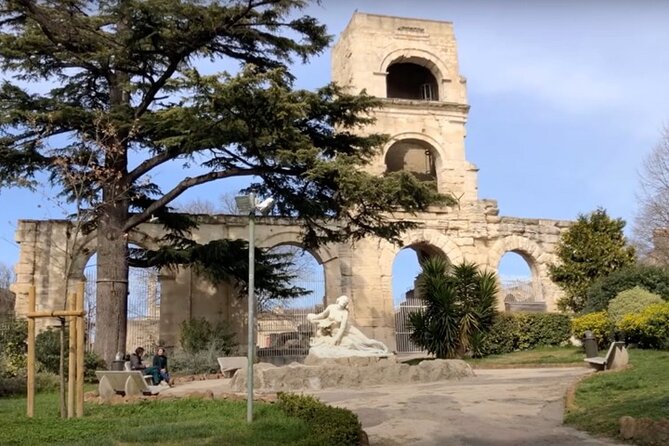
Your walk begins on Avenue des Alyscamps at Les Alyscamps, an ancient Roman necropolis. The long, atmospheric site is one of Arles’ major historic areas and is listed as a UNESCO World Heritage site.
Van Gogh painted Alyscamps four times. The location gives you an early sense of how he worked: he did not need a grand view in the usual sense. Old stone, cypress trees, paths, and shadows could become powerful subjects when seen through his eyes.
The suggested stop is about 10 minutes, with no admission charge included for this tour. You may want to spend longer if the site is open and you are interested in Roman Arles. Since this is the starting point, make sure the app and route are ready before you begin. A phone problem here can leave you trying to troubleshoot before you have even reached the center.
Jardin d’Été and the Roman arena
The next stop is Jardin d’Été, a small urban park with fountains and playgrounds. The Roman amphitheatre forms the backdrop, creating a pleasant contrast between everyday city life and the remains of ancient Arles.
The stop is only about five minutes, so the app treats it as a quick orientation point rather than a major visit. I like this kind of pause because it connects Van Gogh’s poetic view of the town with the practical Arles you see today. You can stop for a photo, listen to the narration, and continue without losing much time.
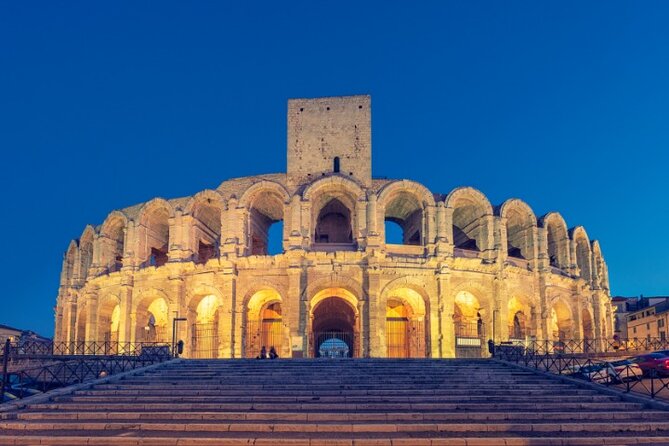
Nearby, the Arles Amphitheatre takes you much further back, roughly 2,000 years. The arena is still used today, and Van Gogh painted it in Arena in Arles. The audio helps you picture the crowds and activity that gave the scene its force.
The visit here is also listed as five minutes. That is enough for a quick look, but not enough for a full exploration of the monument. If you want to go inside, check the admission arrangement separately, since the tour does not list an included entry ticket.
Rue Voltaire and the everyday streets of Arles
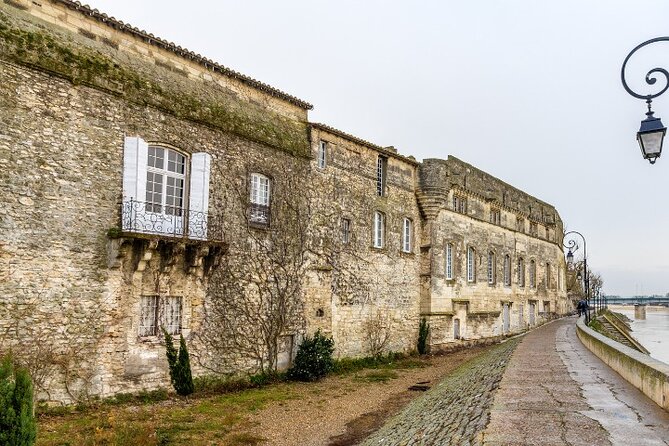
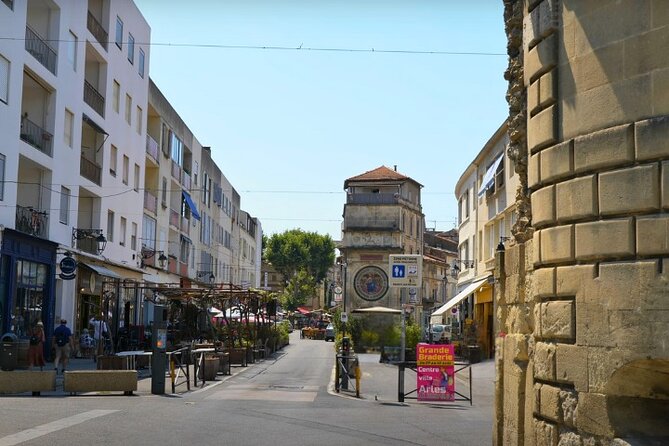
Rue Voltaire is a short stop, but it shows why a walking route can add something that a museum cannot. You see shutters, awnings, cafés, and the warm, close streets of the old town. The route presents the street as part of the visual world that attracted Van Gogh.
The narration at this point is useful for setting the mood, though it may feel brief if you are hoping for a detailed art lecture. One useful way to approach the stop is to look closely at color and proportion rather than expecting the street to match a painting exactly. Arles has changed, and the value is in seeing the town that fed Van Gogh’s imagination.
More art walks around France:
- Paris in a Day: Louvre or Orsay, Eiffel Tower, City Walk & Cruise
★ 5.0 · 1,956 reviews - Montmartre for Art Lovers – Walking tour with Expert Guide
★ 5.0 · 456 reviews - Paris: Louvre Museum Entry Ticket and Garden Walking Tour
★ 4.2 · 326 reviews - Arles Vincent Van Gogh Walking Tour with an APP
★ 3.8 · 64 reviews
The Yellow House and the missing original
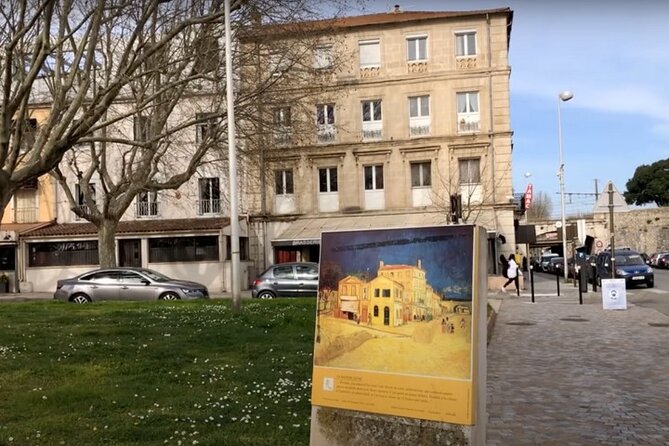
The Yellow House is one of the most important Van Gogh locations on the route. Van Gogh lived at the building, and the yellow façade became one of his best-known subjects. The original house is gone. The site is now connected with a restaurant and a secondhand shop.
That distinction matters. You are not entering Van Gogh’s preserved home, and you are not seeing the exact building from the painting. You are standing at the place where it once stood, then using the painting and narration to reconstruct the scene.
The suggested stop lasts about 15 minutes, longer than most of the short street viewpoints. Admission is not included, and the place is listed as a secondhand shop rather than a dedicated Van Gogh attraction. Keep your expectations grounded, but do not dismiss the stop. For many people, the absence of the original building is part of the story. It reminds you that historic cities are living places, not outdoor museums frozen in 1888.
The Rhône and Starry Night Over the Rhône
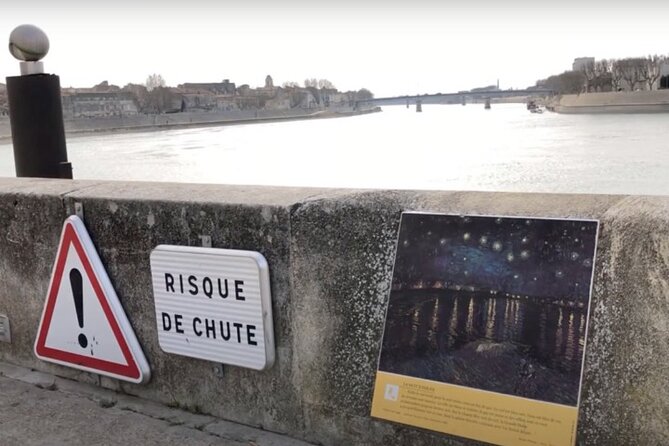
The route then leads to the easel location associated with Starry Night Over the Rhône. Here Van Gogh painted the river at night, focusing on reflections, dark water, and points of light.
This is a good place to slow down. The scene differs from the more famous Starry Night, and the audio encourages you to consider that difference. You are looking at a calm river view rather than a swirling imaginary sky. The connection between the real place and the finished painting becomes clearer when you compare the river, the banks, and the night colors in front of you.
The stop lasts about 10 minutes and is free. Bring patience rather than expecting a dramatic monument. The appeal is visual and reflective, especially if you enjoy matching a painted composition with the actual view.
Musée Réattu and Van Gogh’s sharp opinion
Musée Réattu adds an interesting wrinkle to the tour. Van Gogh criticized the museum, which is a reminder that he did not admire every artistic institution or local display in Arles. The narration places that opinion beside his appreciation for the women of Arles, giving you a more complicated picture of his relationship with the town.
The museum visit is listed at about 10 minutes, and admission is not included. You can treat it as an exterior stop if you do not want to pay for another museum, or enter separately if its collections interest you.
I appreciate this part of the route because it avoids presenting Van Gogh as someone who loved every corner of Arles equally. His reactions could be harsh, personal, and shaped by his own struggles. That makes the walk feel less like a simple pilgrimage and more like a look at a difficult artist living in a real town.
Le Café Van Gogh and Place du Forum
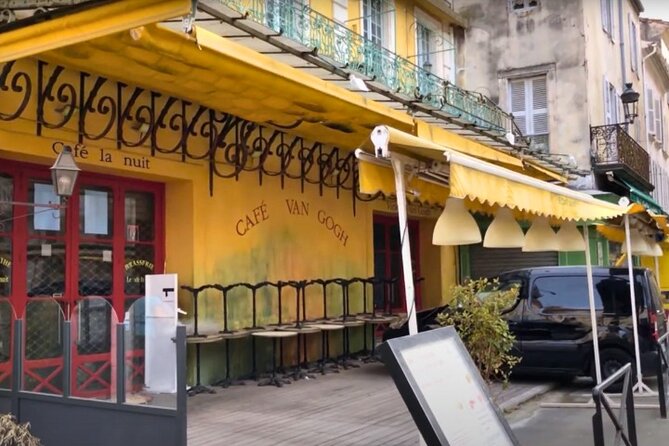
Le Café Van Gogh is a modern recreation of the café shown in one of his most famous paintings. It is not the original site, so you should see it as a themed modern setting rather than an untouched Van Gogh location.
Still, the stop can help you understand how the painting became part of Arles’ public identity. The bright café setting is easy to recognize, and it gives you a natural pause before Place du Forum.
At Place du Forum, you reach the location associated with Café Terrace at Night. Van Gogh used the square’s nighttime lighting and café scene to push beyond the usual dark palette of night painting. The Roman past is still present here, including an ancient column associated with the Nord-Pinus Hotel.
The stop lasts about five minutes and costs nothing as part of the walking route. If you want to sit at or near the café, allow more time and budget for your own food or drink. Snacks are not included anywhere on the tour, so carry water, especially during hot weather.
Fondation Vincent van Gogh Arles
The Fondation Vincent van Gogh Arles occupies the Hôtel Léautaud de Donines. Its focus is Van Gogh’s influence on modern artists, rather than a permanent display of his most famous original paintings.
That makes this a useful stop for understanding his legacy, but it may disappoint you if you expect to see the major Arles canvases in person. The visit is listed at about 15 minutes, and admission is not included.
I would decide in advance if you want to enter. The foundation adds a museum element to an otherwise outdoor route, but it also adds time and cost. If your main goal is to see the actual places in Van Gogh’s paintings, you can keep the stop brief. If you want more context about how later artists responded to him, plan for a longer visit.
Trinquetaille Bridge and Van Gogh’s intense color
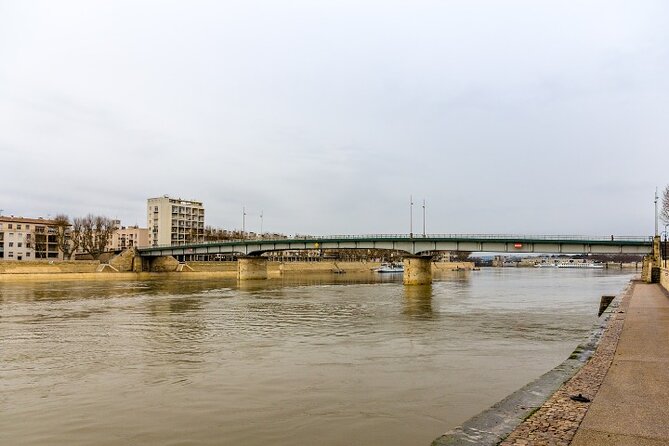
The route continues toward the Trinquetaille Bridge. A stairway viewpoint is connected with The Bridge of Trinquetaille, one of the works Van Gogh painted in Arles.
The narration draws attention to his unusual color descriptions: an absinthe-colored sky and river, lilac quays, and a blue bridge. You can use the viewpoint to compare those written color ideas with what you see now. The scene may not look exactly like the painting, but the exercise helps you understand how freely Van Gogh reshaped ordinary places.
The stairway stop and Pont de Trinquetaille itself are each listed at about five minutes. Together, they are quick but worthwhile. The bridge is not just another photo point. It shows how Van Gogh could turn infrastructure, water, and evening light into an emotionally charged subject.
Ending at L’espace Van Gogh
The final stop is L’espace Van Gogh, the former Arles hospital. Van Gogh stayed there after the crisis that led to the famous injury involving his ear. The courtyard offered him a place to work and recover during a troubled period.
The setting brings the route back to the human story behind the paintings. Earlier stops focus on streets, buildings, and light. Here, the subject is resilience and the way he continued to work during a period of serious personal difficulty.
The tour ends at the Old Arles Hospital, at Place Félix Rey. The stated opening hours for the end location are 6:00 a.m. to 6:00 p.m., Monday through Sunday, for the listed operating period. Since the route ends here, it is sensible to begin early enough that you are not arriving after the site closes.
How good is the app?
The app is the tour’s greatest strength and its main weakness. When it works, GPS-triggered narration lets you move independently. You can pause for a photograph, stop at a café, skip a museum, or cut the route short if the day becomes too hot.
One particularly useful feature is the ability to prepare the app and directions before walking. This can help limit roaming and mobile data use. Do not wait until you are standing at Alyscamps to download or set up the tour. One person had an app update appear during the walk, with no Wi-Fi available, and could no longer use the tour. Another found the map difficult to follow and had to rely on personal map-reading skills.
My practical advice is simple:
- Install the app before arriving in Arles.
- Open the tour and test the audio.
- Complete any update while you have reliable Wi-Fi.
- Confirm that the route and narration are available on your phone.
- Bring a backup map app or printed orientation details.
- Keep your phone charged.
The audio is described as easy to follow by some users, while the route directions have not worked equally well for everyone. That makes this best for someone comfortable with a phone and willing to check the next stop independently.
Price, pace, and who gets good value
At $12.99 per person, this is inexpensive compared with a private live guide. You are paying for a prepared route, narration, GPS points, and the convenience of a Van Gogh-focused plan. The value is strongest if you want a clear introduction to Arles and do not need a person beside you.
The price is less convincing if you are already confident with maps, have researched Van Gogh’s Arles, and plan to visit only two or three sites. The route information is useful, but some narration may feel basic or overly romantic rather than analytical. You are paying for structure and convenience more than for a specialist art seminar.
The 2 to 3 hour estimate suits a steady walker who keeps moving. You should add time for the foundation, Musée Réattu, photographs, food, and the Roman sites. Older walkers or anyone affected by heat may need much longer. One person completed the route at an easy pace on a very hot day by skipping stops when tired, which is exactly how I would use the format.
The tour suits:
- Independent visitors who dislike fixed group schedules.
- Van Gogh fans who want to connect paintings with real places.
- Couples and families who want a private route.
- People who prefer English audio.
- Visitors who want Roman Arles and Van Gogh in one walk.
It is less suitable if you need a live guide, dislike phone-based tours, or want guaranteed museum entry. The route is listed as accessible to most participants, allows service animals, and is near public transportation, but it remains a walking experience with several stops across town.
Should you book this Arles Van Gogh tour?
Book it if you want a low-cost introduction to Van Gogh’s Arles and like choosing your own pace. The strongest parts are the range of locations, the freedom to skip or linger, and the way the route joins art with Roman monuments and daily city streets.
I would not book it without preparing the app first. Download what you need, test the narration, and have a backup way to find the next stop. If the app works, $12.99 is fair for a private self-guided route. If you want detailed art history or reliable personal navigation, pay for a live guide instead.
FAQ
Where does the Arles Van Gogh walking tour begin?
It begins at Avenue des Alyscamps, 13200 Arles, France, beside Les Alyscamps.
Where does the tour end?
The final stop is L’espace Van Gogh, the former Old Arles Hospital, at Place Félix Rey, 13200 Arles.
How long does the walking tour take?
The estimated duration is 2 to 3 hours. You may need longer if you enter museums, stop for food, take photographs, or walk at a slower pace.
Is the tour guided by a person?
No. It is a self-guided tour delivered through the Trippy Tour Guide app with GPS-triggered audio narration.
What language is available?
The tour is offered in English.
Is the tour private?
Yes. Only your group participates in the private activity.
Are museum admission fees included?
No. Admission is not included for the Yellow House site, Musée Réattu, or Fondation Vincent van Gogh Arles.
Can I skip stops or walk at my own pace?
Yes. The self-guided format allows you to pause, continue when ready, or skip stops if you are tired.
What is the cancellation policy?
You can cancel at least 24 hours before the local start time for a full refund. Cancellations or changes made within 24 hours are not refunded or accepted.
More Self-Guided Tours in France
- Paris: Orsay Museum Entry Ticket and Digital Audio Guide App
★ 4.4 · 3,170 reviews - Louvre Museum Timed Entrance Ticket with Audio Guide
★ 3.0 · 453 reviews - Paris Louvre Museum Entry Ticket for Self Guided Tour
★ 3.5 · 383 reviews - Paris: Louvre Museum Hosted Entry & Masterpieces Audio Guide
★ 4.2 · 281 reviews
Just added around France
- Paris Day Tour with Eiffel Tower, Louvre and Cruise Max 6 People★ 4.5 · 29 reviews
- PRIVATE Louvre Wonders & Hidden Treasures Visit★ 5.0 · 65 reviews
- d’Orsay Museum Paris entry ticket★ 3.5 · 31 reviews
- visiting the masterpieces of impressionists at Orsay museum★ 5.0 · 7 reviews
- LOUVRE, Small Group Guided Tour in French (TOP SALES)★ 4.5 · 9 reviews
- Louvre Museum with private guide★ 5.0 · 3 reviews
- Louvre Wheelchair-Accessible Private Tour – Stress-Free & Easy★ 5.0 · 16 reviews
- Musée d’Orsay Highlights Tour with Gourmet Lunch★ 4.5 · 11 reviews
Art Museum Tours in France, compared.
Louvre Guided Tour with Reserved Access & Boat Cruise
Read our review →
Louvre Overview, Exploration tour and Reserved Entry
Read our review →
Louvre Museum Entry Ticket With Host and River Cruise
Read our review →
Mona Lisa & Louvre Masterpieces Tour with Reserved Access
Read our review →
Louvre Museum – Exclusive Guided Tour (Entry Included)
Read our review →
Louvre Museum Hosted Entry and Mona Lisa Audioguide
Read our review →Browse the lists this tour appears in