REVIEW · PARIS
Private Tour with Tickets to the Louvre Museum & Crepes
The clever part of this Paris tour is its broad sweep. In about four hours, you move from the medieval heart of Île de la Cité through the Latin Quarter, past grand royal buildings and covered passages, and finish at the Louvre. Timed Louvre admission and a private guide help keep the day moving.
I like the mix of famous sights and smaller details, especially Place Dauphine, Saint-Séverin, Galerie Vivienne, and the Stravinsky Fountain. I also like the practical break for one savory crepe, one sweet crepe, and a drink, plus metro tickets that help cover the long route.
The main point to check before booking is the Louvre portion. The inclusions specify timed entry and an audio guide, but several comments describe an outside-focused Louvre visit. Confirm exactly how much time you will spend inside the museum and how the audio guide is provided.
Key points to know before booking
- A private route through central Paris: Only your group joins the walking tour, so the pace can be more personal than on a large city walk.
- Nineteen stops in roughly four hours: You see a remarkable number of landmarks, but most stops are brief photo and explanation breaks rather than full visits.
- The Louvre ticket matters: Timed entry is included, along with an audio guide in your language, but there is no guide inside the museum.
- Crepes break up the sightseeing: The meal includes both a savory and a sweet crepe, plus a drink.
- Metro tickets are included: This helps connect the western Île de la Cité route with sights farther east and north.
- Strong practical praise for the guide service: The available comments repeatedly point to punctual pickup, good organization, useful photo spots, and attentive staff.
A four-hour Paris route with a lot packed in
This is not a slow museum seminar or a single-neighborhood stroll. It is a fast-moving introduction to central Paris, built around short stops and a private guide. You get the city’s medieval island, the Left Bank, the Marais edge, grand Parisian avenues, historic passages, and the Louvre in one outing.
I would think of the tour as three parts:
- A walk through Île de la Cité and the Latin Quarter.
- A move toward the Hôtel de Ville, Centre Pompidou, Palais-Royal, and nearby arcades.
- The Louvre, with timed admission and an audio guide, plus the crepe stop along the way.
The listed stop times add up to just under four hours, before allowing much time for walking between them. That tells you something important: you will see many places, but you will not linger long at each one. If you want a relaxed visit inside Sainte-Chapelle, a full look at Notre-Dame, or several hours with the Louvre paintings, this tour is not designed for that.
For a first afternoon in Paris, though, I like the logic. You keep moving, get your bearings, hear stories that connect the monuments, and finish near one of the world’s great museums.
More Art Museum Tours in Paris
- Paris: Louvre Museum Timed-Entrance Ticket
★ 4.6 · 71,977 reviews - Paris: Orsay Museum Entry Ticket
★ 4.7 · 25,647 reviews - Paris: Louvre Guided Tour with Reserved Access & Boat Cruise
★ 4.3 · 16,353 reviews
Pont Neuf and Place Dauphine: Paris begins on the river
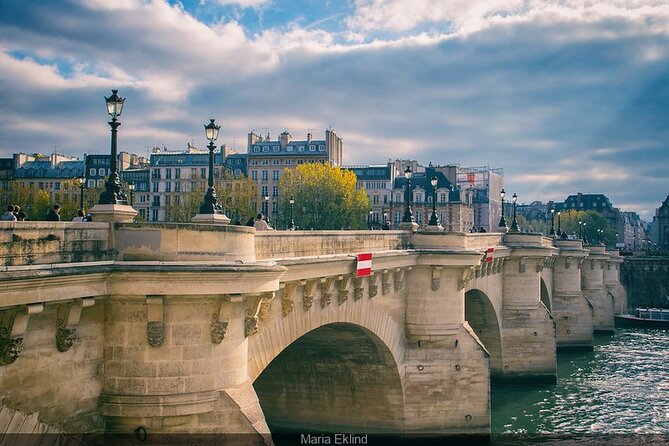
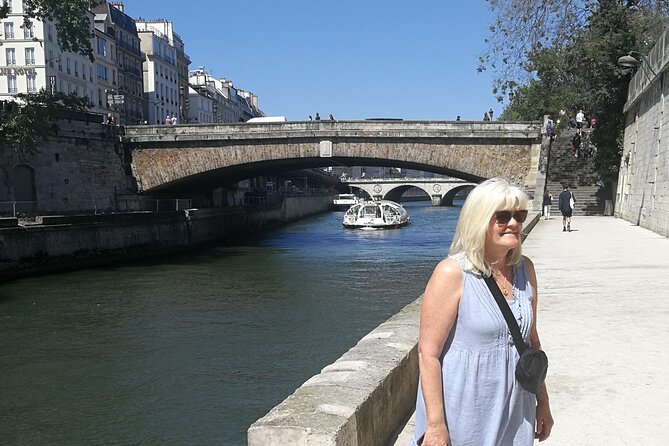
The meeting point is in the Île-de-France area of central Paris, with the route beginning around Île de la Cité. The first stop is Pont Neuf, despite its name the oldest surviving bridge across the Seine.
Your guide can use this bridge to explain why the island matters. Paris began here as Lutetia, and the island remained the city’s political and religious core through the Middle Ages. The bridge also gives you an immediate sense of Paris as a river city, with views along the Seine and toward both banks.
Nearby Place Dauphine is a quieter, triangular square begun under Henry IV in 1607. It is a pleasant contrast to the traffic and crowds around the bridge. I would enjoy this stop for its shape and calm rather than expect a major monument. Ten minutes is enough to hear the story and take a look, but not enough to linger over a café.
Conciergerie and Sainte-Chapelle: two powerful medieval neighbors
The route passes the Conciergerie, part of the old royal palace and later a prison during the French Revolution. Marie-Antoinette was held here, along with thousands of other prisoners. The building’s surviving medieval halls give the stop real weight, even though this tour does not include admission.
Sainte-Chapelle is close by. Built for Louis IX and consecrated in 1248, it was made to hold important Passion relics, including the Crown of Thorns. Its great appeal is the upper chapel’s colored glass, but the schedule lists only a short outside stop with no admission included.
That distinction matters. If Sainte-Chapelle is high on your Paris wish list, you may want a separate ticket and more time. The same applies to the Conciergerie. Here, they function as landmarks and story points, not full museum visits.
The Latin Quarter: fountains, churches, books, and narrow streets
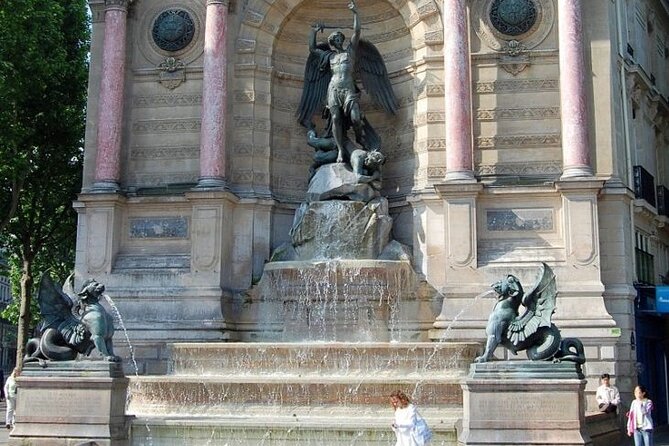
Crossing toward the Left Bank, the tour reaches Fontaine Saint-Michel, a large 19th-century fountain in the lively Place Saint-Michel. It is an easy meeting point and a useful marker for the Latin Quarter.
Rue de la Huchette follows. This narrow pedestrian street is lined with restaurants, bars, and tourist traffic. The route description notes its strong Greek presence and busy nightlife. I would treat it as a quick look at the entertainment side of the Latin Quarter, not as the place to choose a quiet Parisian meal. The included crepe stop comes later and is a better fit for the tour’s schedule.
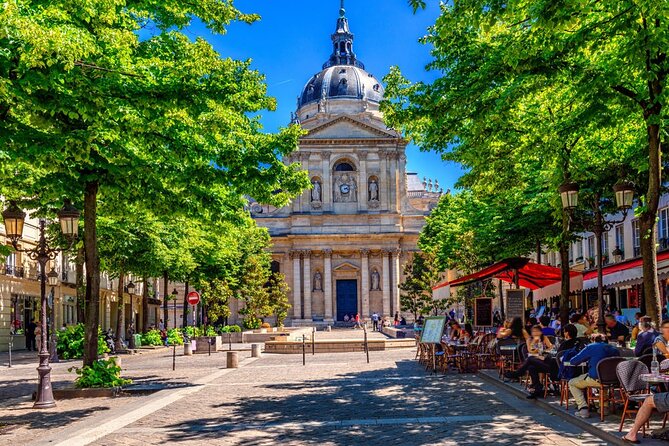
Saint-Séverin provides a more serious pause. This church began in the 13th century and was rebuilt and enlarged after a fire, with later Flamboyant Gothic work. It was once the parish church for students at the University of Paris and remains one of the oldest churches on the Left Bank.
The ten-minute stop will likely focus on the exterior and a short explanation. If the doors are open, you might get a glimpse inside, but the tour information does not promise an interior visit.
Shakespeare and Company is one of the route’s most recognizable small stops. The English-language bookshop at 37 rue de la Bûcherie was opened by George Whitman in 1951 and took its current name in 1964, honoring Sylvia Beach’s earlier shop. It continues to sell new and used books and offers a public reading library.
Ten minutes is enough for a photo and perhaps a quick look, but it is not enough for serious browsing. If you enjoy bookshops, note the address and return later. That is one of the benefits of a private route: your guide can point out places you may want to revisit after the formal tour.
Saint-Julien-le-Pauvre brings another layer of Paris history. It is one of the city’s oldest religious buildings, begun in the 12th century and shaped by Romanesque and early Gothic work. Today it belongs to the Melkite Greek Catholic community. Its smaller scale makes it a nice counterpoint to Notre-Dame nearby.
More Louvre tours and timed tickets:
- Louvre Museum Masterpieces Guided Tour with Access
★ 4.5 · 12,023 reviews - Paris: Louvre Overview, Exploration tour and Reserved Entry
★ 4.1 · 10,145 reviews - Paris: Louvre Museum Entry Ticket With Host and River Cruise
★ 4.6 · 9,926 reviews - Mona Lisa & Louvre Masterpieces Tour with Reserved Access
★ 4.6 · 6,812 reviews
Notre-Dame, the flower market, and Paris City Hall
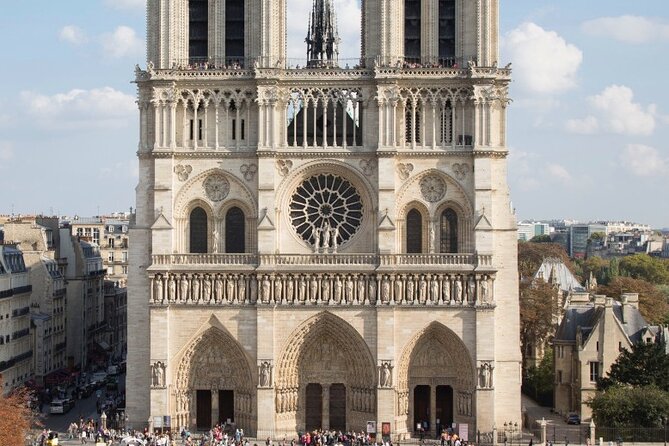
Notre-Dame is the major sight on Île de la Cité. From outside, you can study the Gothic facade, flying buttresses, rose windows, bells, and sculptural details. The cathedral suffered the 2019 fire but survived, and this route gives you a chance to appreciate its place in the city even if the schedule allows only fifteen minutes.
Do not expect a full cathedral visit from this stop. The description lists it as an exterior sightseeing point, and no interior admission is included here.
The Marché aux fleurs Reine-Elizabeth-II adds a lighter note. The flower market occupies a historic corner of the island, and its name was changed after Queen Elizabeth II’s 2014 state visit. The former bird trade is also part of its recent story, though animal welfare rules have changed what is sold there.
At Hôtel de Ville, you see Paris’s city hall, whose origins reach back to the 16th century. The building was burned during the Paris Commune in 1871 and rebuilt between 1874 and 1882. Its scale and ornate exterior help explain how Paris used architecture to project civic power.
The Tour Saint-Jacques is another quick but worthwhile sight. This 52-meter Gothic tower is the remaining piece of the former Church of Saint-Jacques-de-la-Boucherie, demolished during the French Revolution. It is a good example of how much of old Paris has disappeared, leaving one striking fragment behind.
The crepe stop near the Stravinsky Fountain
The meal break comes at a crepe house near the Stravinsky Fountain and the Centre Pompidou. You receive one savory crepe, one sweet crepe, and a drink.
I like this arrangement because it is more useful than a vague promise of a snack. You know what is included, and the two-course format gives you a proper pause after a long walk. Crepes are also a very Parisian way to eat without losing much time.
The Stravinsky Fountain itself is worth a look. Created in 1983 by Jean Tinguely and Niki de Saint Phalle, it uses sixteen colorful sculptures linked to the music of Igor Stravinsky. The moving water and playful shapes make a welcome break from Gothic churches and royal facades.
The meal is not described as a private dining experience, and the tour does not give a choice of fillings. If you have dietary restrictions, ask before booking. The supplied details confirm the two crepes and drink, but they do not specify ingredients or substitutions.
Palais-Royal, the Richelieu Library, and Galerie Vivienne
After the meal, the route moves toward the Palais-Royal. This former palace began as Cardinal Richelieu’s residence in the 17th century before passing to the royal family. Today, government institutions use much of the complex, while the central garden and arcades remain open to the public.
The garden is a good place to slow down for fifteen minutes. Its arcades, formal layout, and position opposite the Louvre make it one of the most rewarding short stops on the tour. You may also get useful advice from your guide about returning later for a quieter walk.
The Bibliothèque nationale de France’s Richelieu site follows. It is one of the main locations of France’s national library, with collections of books, manuscripts, objects, and art. The route does not include access to research rooms or a museum visit, so think of this as an architectural and cultural landmark.
Galerie Vivienne is a covered passage dating from the 19th century and now protected as a historic monument. At 176 meters long and only three meters wide, it has a very different feel from the broad avenues nearby. Shops and patterned details make it a pleasant place for photos.
These three stops are useful because they show Paris beyond its headline monuments. You see how the city’s old palaces, libraries, shopping passages, and gardens continue to shape daily life.
Avenue de l’Opéra and the Louvre Pyramid
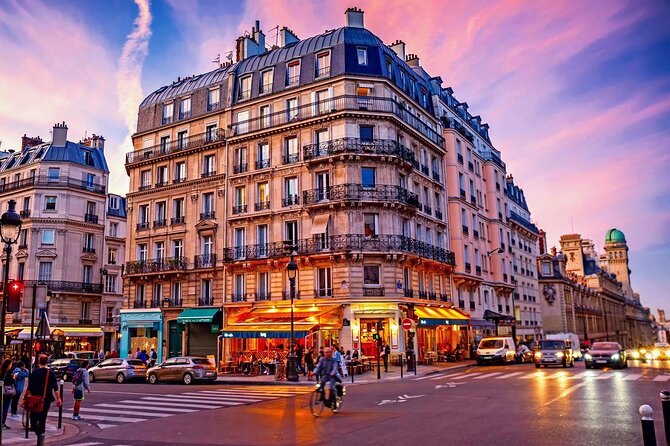
Avenue de l’Opéra leads toward the Louvre and the Palais Garnier. The avenue was created during Haussmann’s rebuilding of Paris between 1864 and 1879. Its broad, straight form gives you a clear example of the grand urban planning that changed the city in the 19th century.
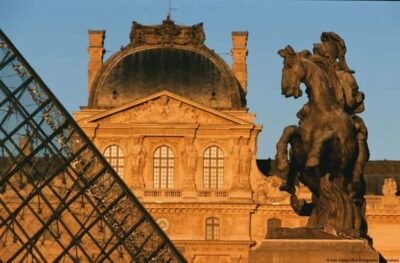
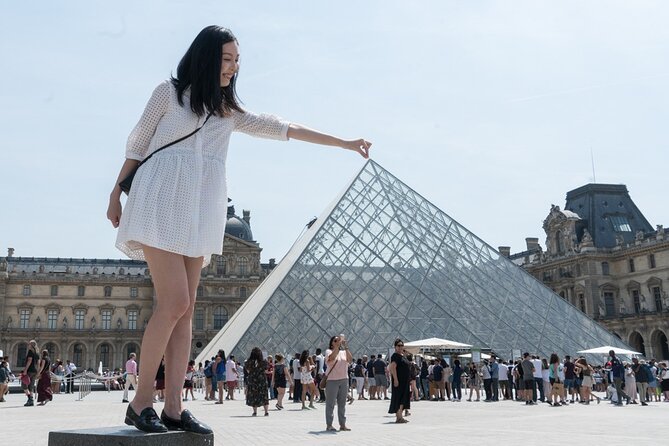
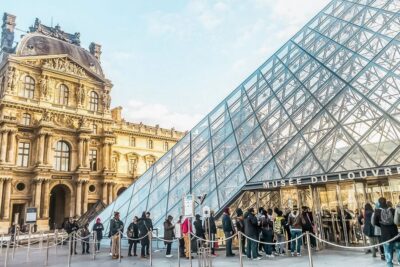
The tour finishes at the Louvre Pyramid, designed by I. M. Pei and completed in 1988. The glass structure once divided opinion, but it is now one of Paris’s most familiar images. The pyramid also serves as the museum’s main entrance, so it is both a photo stop and a practical arrival point.
Here the tour’s most important inclusion comes into play: timed-entry Louvre tickets and an audio guide in your language. Timed admission can save you from an open-ended wait, especially when the museum is busy. The audio guide gives you structure once inside, but you will not have the private walking guide with you in the galleries.
There is a small inconsistency in the information provided for this experience. The inclusions clearly say tickets to the Louvre and an audio guide, while several supplied comments describe an outside Louvre visit and praise the architecture without mentioning time inside. I would contact Bonjour Local Tours before paying and ask three direct questions:
- Is admission inside the Louvre guaranteed?
- How much time is reserved for the museum?
- Does the guide leave you at the entrance, and how do you receive the audio guide?
That quick check can prevent disappointment. For some people, seeing the Louvre exterior and then entering independently is fine. For others, the entire reason to book is access to the collection.
What the private format is worth at $174.60
The price is $174.60 per person. That is a serious price for a four-hour outing, but it includes more than a basic walking tour: a private guide, timed Louvre admission, an audio guide, two crepes, a drink, and metro tickets.
The value improves if you are a small group that wants control over the pace. You are not joining a large party, and the guide can focus on your interests, explain details at the right level, and help keep the route organized. The available feedback places special emphasis on punctual pickups, attentive staff, useful photo locations, and guides who kept groups safe and on schedule.
The value is weaker if your main goal is a long Louvre visit. The route covers so many outdoor sights that the museum may receive limited time. Group discounts are listed, but no discount amount is given, so you should check the final price for your party.
The tour is offered in English, with a private guide in your language listed among the inclusions. Because the main product information says English, confirm the language arrangement if you need something else.
Who will enjoy this Paris tour most?
I would recommend it to a first-time visitor who wants a fast orientation to central Paris. It suits people who prefer a guide to connect the dots rather than spend the whole day in one museum.
It is also a good match for a family or small group that values privacy, built-in food, and a route that covers many major sights. The crepe stop gives children a clear reward, while the short stops reduce the chance of spending hours at one place they may not enjoy.
You should be comfortable walking for much of the four hours. The route includes a long chain of outdoor stops, city streets, and connections by metro. Most people can participate, and the tour is near public transportation, but the information does not give a detailed accessibility plan.
I would not choose it if you want a slow architectural tour, a dedicated Latin Quarter food walk, or a full guided Louvre experience. The private format cannot change the basic fact that nineteen stops require a brisk pace.
Cancellation is flexible up to 24 hours before the start time for a full refund. Changes or cancellations inside that window are not accepted for a refund.
Should you book it?
Book this tour if you want a well-organized first look at Paris, especially if the combination of Notre-Dame, the Latin Quarter, the Seine, Palais-Royal, and the Louvre appeals to you. The private guide, metro tickets, and crepe break make the packed route easier to manage.
Before booking, settle the Louvre question in writing. If timed entry really means you enter the museum and receive the promised audio guide, the $174.60 price can make sense for a private half-day with food and transport included. If the Louvre is mainly an exterior stop, choose this for the city walk, not for the museum.
FAQ
How long does the tour last?
The experience lasts approximately four hours.
What language is the tour offered in?
The tour is offered in English. The inclusions also refer to a private guide in your language, so confirm the language arrangement if you need a language other than English.
Is the Louvre admission included?
Yes. Timed-entry tickets to the Louvre Museum are listed as included, along with an audio guide in your language.
Is there a guide inside the Louvre?
No private guide inside the Louvre is included. The package lists an audio guide instead.
What food is included?
You receive one savory crepe, one sweet crepe, and a drink.
Are metro tickets included?
Yes. Metro tickets are included in the tour price.
Is this a private tour?
Yes. Only your group participates in the private activity.
Where does the tour end?
The tour ends at the Louvre Museum in central Paris.
What sights are included on the walking route?
The route includes Pont Neuf, Place Dauphine, the Conciergerie, Sainte-Chapelle, the Latin Quarter, Notre-Dame, Hôtel de Ville, Tour Saint-Jacques, the Stravinsky Fountain, Palais-Royal, Galerie Vivienne, Avenue de l’Opéra, and the Louvre Pyramid.
Can I cancel for a full refund?
Yes, if you cancel at least 24 hours before the experience start time. Cancellations made less than 24 hours in advance are not refunded.
Just added around Paris
- Paris Day Tour with Eiffel Tower, Louvre and Cruise Max 6 People★ 4.5 · 29 reviews
- PRIVATE Louvre Wonders & Hidden Treasures Visit★ 5.0 · 65 reviews
- d’Orsay Museum Paris entry ticket★ 3.5 · 31 reviews
- visiting the masterpieces of impressionists at Orsay museum★ 5.0 · 7 reviews
- Louvre Museum with private guide★ 5.0 · 3 reviews
- Louvre Wheelchair-Accessible Private Tour – Stress-Free & Easy★ 5.0 · 16 reviews
- LOUVRE, Small Group Guided Tour in French (TOP SALES)★ 4.5 · 9 reviews
- Visit to the Louvre Paris museum★ 5.0 · 2 reviews
Art Museum Tours in Paris, compared.
Louvre Guided Tour with Reserved Access & Boat Cruise
Read our review →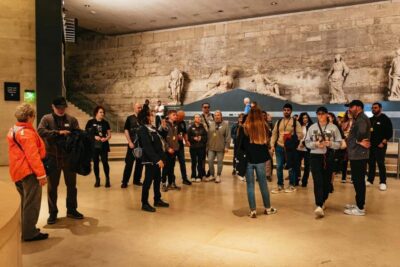
Louvre Overview, Exploration tour and Reserved Entry
Read our review →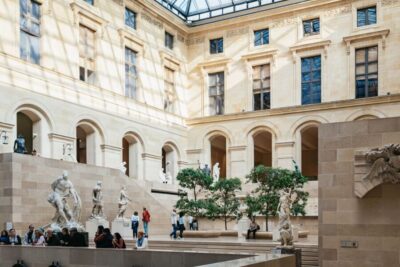
Louvre Museum Entry Ticket With Host and River Cruise
Read our review →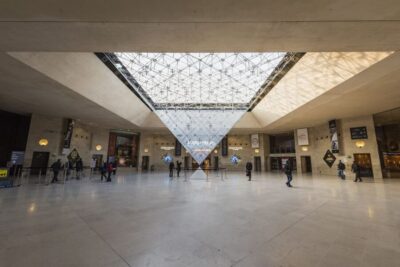
Mona Lisa & Louvre Masterpieces Tour with Reserved Access
Read our review →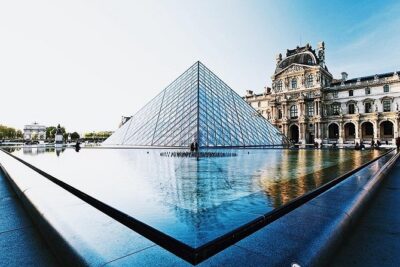
Louvre Museum – Exclusive Guided Tour (Entry Included)
Read our review →