REVIEW · PARIS
Paris Louvre Museum: Small Group Guided Highlights Tour
The best thing about this Louvre visit is its maximum group size of six. That matters in a museum where a large tour can leave you straining to hear while the crowd presses toward the Mona Lisa. I like the direct route to the major works, and I like that the guide adds stories about the art instead of simply pointing at it. Past guides named in feedback include Megan, John, Claire, Caroline, Will, and Christina.
I also like the chance to see more than the three famous names on the poster. The route can include Michelangelo’s sculptures, French crown jewels, royal apartments, and the Louvre itself as a former royal setting. The main drawback is that the published details conflict on timing and wheelchair access: the activity is listed as 90 minutes in one place and two hours in another, while it is described as both wheelchair accessible and unsuitable for wheelchair users. Confirm those points before paying.
Key points to know before booking
- Six participants maximum: A genuinely small group makes it easier to hear the guide and ask questions.
- Three essential works: The route focuses on the Mona Lisa, Venus de Milo, and Winged Victory of Samothrace.
- More than a greatest-hits dash: You may also see Michelangelo, French crown jewels, and royal apartments.
- Pre-reserved admission: Your entry ticket is arranged in advance, though security can still cause delays.
- English only: The tour includes a live English-speaking guide.
- Plan for extra Louvre time: After the guided portion, you can continue through the galleries independently.
Why a small Louvre group makes such a difference
The Louvre is not a tidy museum that you can understand by wandering through one handsome hall. It is vast, crowded, and filled with far more art than you can absorb in one visit. Even deciding where to go first can eat into your time.
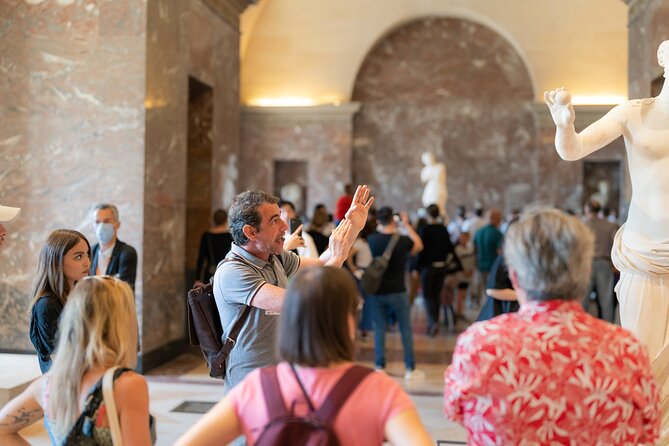
This tour gives you a clear path. You meet at the Arc de Triomphe du Carrousel, near the Louvre, then enter with a pre-reserved ticket and follow an English-speaking guide toward the museum’s major works. The small group is the real selling point. With only six participants, you are not one face in a crowd of 20 or 30 people.
That size also changes the tone. You can ask why a work matters, how a sculpture was made, or what you should notice in a crowded gallery. Guides who led earlier visits, including Megan, John Edward, Claire, Astrid, Will, Christina, and Caroline, were praised for making art history friendly and easy to follow.
I would not book this expecting a quiet museum. The Louvre can still be very crowded, especially around the Mona Lisa. The advantage is not that the crowds disappear. It is that a good guide helps you handle them without losing the thread of the visit.
More Art Museum Tours in Paris
- Paris: Louvre Museum Timed-Entrance Ticket
★ 4.6 · 71,977 reviews - Paris: Orsay Museum Entry Ticket
★ 4.7 · 25,647 reviews - Paris: Louvre Guided Tour with Reserved Access & Boat Cruise
★ 4.3 · 16,353 reviews
Beginning at the Arc de Triomphe du Carrousel
The meeting point is the Arc de Triomphe du Carrousel, 75001 Paris. This is a practical starting place because it puts you close to the Louvre entrance, but you should arrive with enough time to find the exact meeting spot.
Your passport or ID card is required. Large bags and luggage are not allowed, and any item larger than 55 by 35 by 20 centimeters cannot enter the museum. That is easy to overlook if you are coming straight from a hotel or train station, so pack lightly.
The pre-reserved ticket is meant to help you avoid the regular ticket line. It does not mean you can ignore security. Increased security measures can still create lines, and the earlier experience of getting inside may vary with the day and crowd level.
This is not a hotel pickup tour. You make your own way to the meeting point and leave independently after the guided portion. That works well if you are already exploring central Paris, but it adds a small planning task if the Louvre is your first stop of the day.
The Mona Lisa, with context instead of a quick snapshot
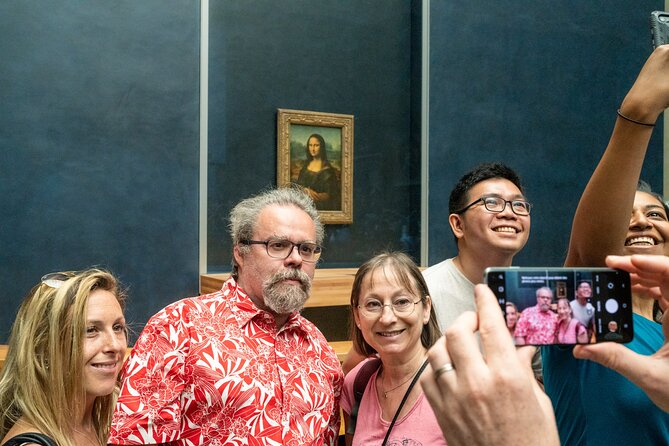
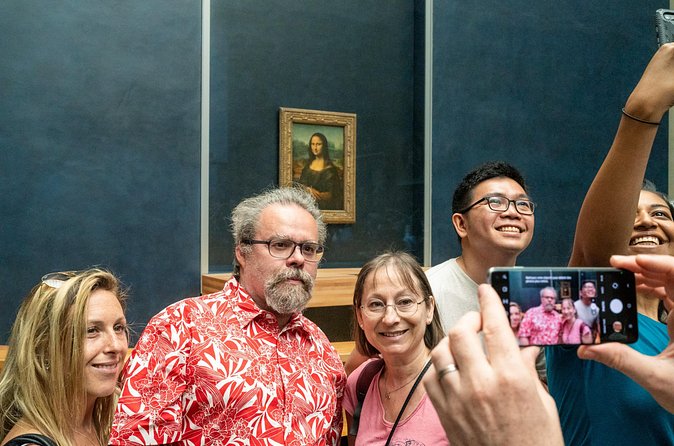
The Mona Lisa is the work most people expect to see, and it is usually the point where the Louvre feels most crowded. You may need to wait within the museum even after entering through the reserved admission route.
A good guide uses that waiting time well. John Edward, for example, was praised for explaining the art and history while the group waited, rather than letting the line become dead time. That is a useful detail because the Mona Lisa itself is often a brief viewing experience. You are likely to share the room with many other people, move toward the painting, and get a short look before the crowd carries you onward.
The guide’s role here is to give the painting a place in the wider story of Renaissance art. Instead of treating it as a celebrity object, you get help noticing the details and understanding why it became so famous. The small group also means you can hear the explanation without fighting a wall of voices.
If your main goal is a long, quiet look at the Mona Lisa, this is not the right expectation. If you want the famous painting placed in context and do not want to waste your visit navigating alone, the stop makes much more sense.
Venus de Milo and Winged Victory of Samothrace
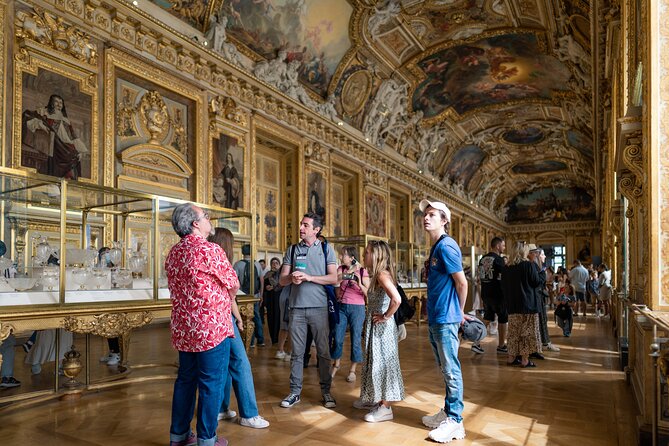
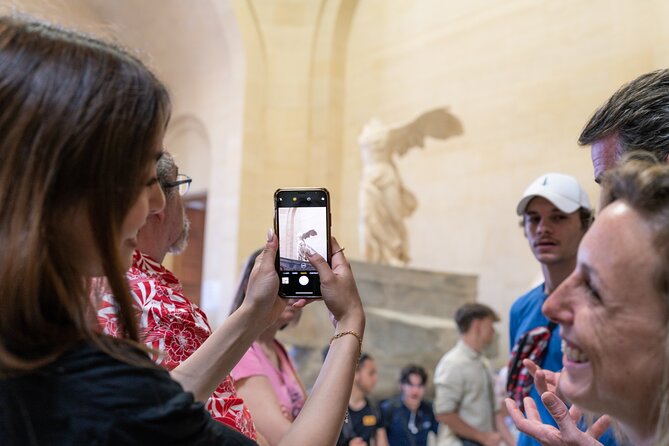
The Venus de Milo and Winged Victory of Samothrace give you two very different encounters with ancient sculpture. The Venus is familiar from countless reproductions, but seeing the scale and surface in person is different from seeing an image in a book. The Winged Victory makes its impression through movement, height, and placement on the grand Daru staircase.
The route gives you a chance to compare how each work presents the human figure. The Venus is calm and balanced, while Winged Victory suggests motion and arrival. You do not need an art degree to enjoy that contrast, but a guide can point out details that are easy to miss when you are focused on taking a photograph.
This part of the tour also shows why a guided route helps inside a huge museum. You are not simply ticking off names. You are moving between works that belong to different periods and cultures, with someone explaining why each one has earned its place on the essential list.
Crowds remain part of the experience. The tour does not promise an empty staircase or private access to the sculptures. Its value is in reaching the works efficiently and giving them meaning once you arrive.
More Louvre tours and timed tickets:
- Louvre Museum Masterpieces Guided Tour with Access
★ 4.5 · 12,023 reviews - Paris: Louvre Overview, Exploration tour and Reserved Entry
★ 4.1 · 10,145 reviews - Paris: Louvre Museum Entry Ticket With Host and River Cruise
★ 4.6 · 9,926 reviews - Mona Lisa & Louvre Masterpieces Tour with Reserved Access
★ 4.6 · 6,812 reviews
Michelangelo, royal apartments, and the Louvre beyond the famous three
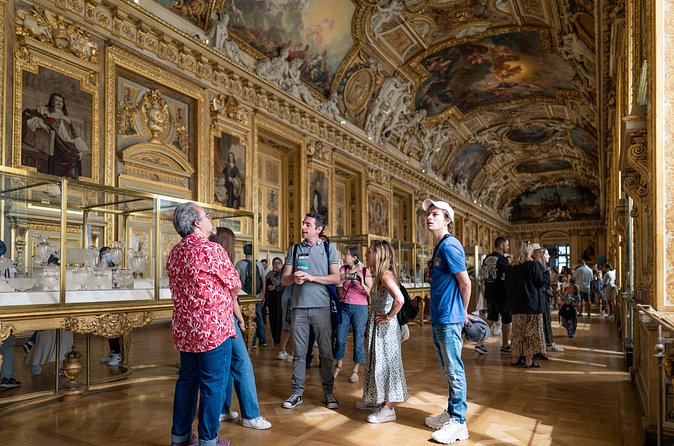
The tour is designed around the main highlights, but the route can include important works that many people miss. The supplied details specifically mention Michelangelo’s sculptures, French crown jewels, and richly decorated royal apartments.
These stops broaden the visit. Michelangelo gives you a chance to see sculpture beyond ancient Greece and Rome. The crown jewels and royal rooms shift your attention from individual artworks to wealth, ceremony, and the people who shaped the building. You begin to understand the Louvre not only as an art museum but also as a place tied to French royal power.
That variety is especially useful if you are visiting Paris for the first time and do not yet know what you like. You might arrive expecting only paintings and leave with a stronger interest in sculpture, decorative art, or palace interiors.
The exact sequence can vary, and you should not assume every guide will spend identical time at each stop. A small group helps here because the guide can respond to questions and adjust the explanation. Feedback about guides such as Claire, Caroline, and Will repeatedly emphasized personal attention, interesting facts, and an ability to keep families and teenagers engaged.
How much time should you allow?
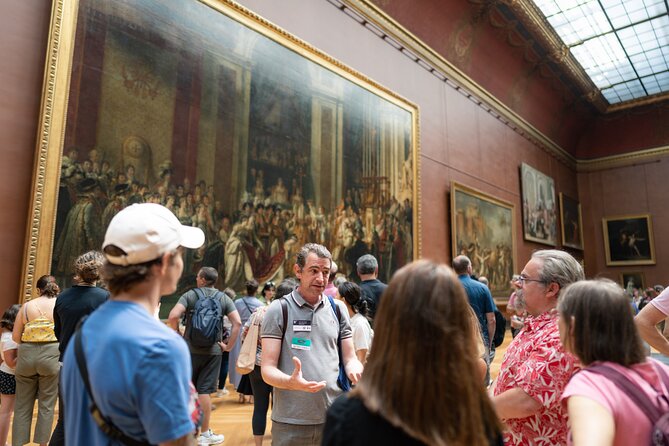
The activity is advertised with conflicting durations. The main information gives 90 minutes, while the tour description and included features refer to a two-hour guided visit. Several past comments also describe the experience as three hours, although that may reflect a longer session or time spent continuing through the museum.
I would plan around the shorter published time unless the booking page confirms otherwise. Then leave extra room for security, crowds, and the possibility of staying in the Louvre independently.
The guided portion is meant to cover the essentials rather than every gallery. That is sensible. Trying to see the entire museum in one sitting would turn art into a race, and you would remember little beyond sore feet and a long list of rooms.
After the guide finishes, you are free to explore the Louvre on your own for as long as you wish. This is one of the strongest features of the arrangement. You get a framework first, then you can return to an area that caught your interest or continue at your own speed.
If you have only a short window in Paris, reserve at least the tour period plus time for entry and security. If you have a full afternoon, use the guided visit as your orientation and treat the independent time as the second half of your Louvre day.
Is $129 a fair price?
At $129 per person, this is not a budget museum visit. The basic Louvre admission is only one part of the cost here. You are also paying for a pre-reserved entry, a live guide, a small group, and the time saved by not planning your own route.
The price makes the most sense for first-time visitors who want the major works explained and do not want to spend their limited Paris time figuring out the building. It is also more appealing for families, since the guide can keep the route moving and answer questions without the stiffness of a large organized group.
I would be less quick to recommend it to an experienced art lover who already knows the Louvre well and prefers to wander alone. You may find better value in buying admission and choosing your own rooms. The tour is selling guidance and efficiency, not exclusive access to the art.
The group limit is important to the value. A six-person visit feels closer to a conversation than a lecture. Several past sessions had only three participants, though you should book expecting up to six rather than assuming a private tour.
The booking terms add flexibility: you can cancel up to 24 hours before the activity for a full refund, and you can reserve now while paying later. Those terms are useful when Paris plans are still shifting, but they do not change the central price question. Pay for this if the guide’s interpretation and route planning will make your Louvre visit easier and more rewarding.
Practical cautions about access and comfort
The information about wheelchair access needs clarification. One part says the activity is wheelchair accessible, while another says it is not suitable for wheelchair users. Since those statements conflict, contact the provider before booking if you use a wheelchair or have limited mobility.
The Louvre can involve long distances, crowds, and busy passageways even on a well-planned route. The tour is also not suitable for large luggage, so do not arrive with suitcases or oversized bags.
The experience is offered in English only. That is ideal if you want an English explanation, but it will not suit you if you need a French-language or another-language guide.
Wear something comfortable and keep your belongings compact. The museum visit may be short on paper, but security, movement between galleries, and time spent exploring afterward can make it a substantial outing.
Who will get the most from this Louvre tour?
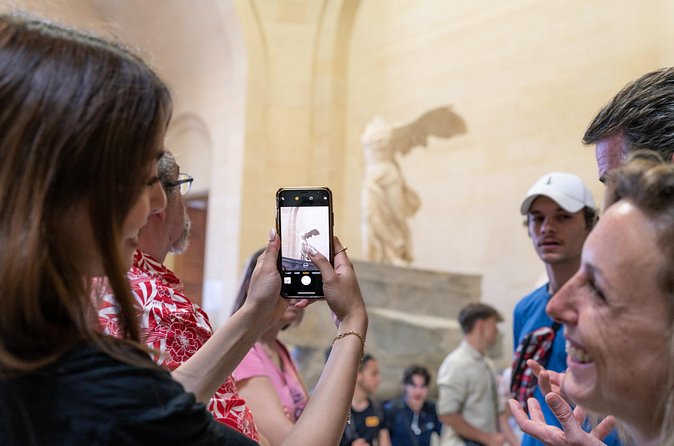
I would choose this for a first Louvre visit, a family that wants structure, or anyone who feels uneasy about the museum’s size. The guides have been praised for turning complex art history into stories, and for keeping younger participants interested.
It also works for a return visit. One earlier participant had already seen the Louvre and still found that a guide added fresh understanding. That is the point of guided interpretation: familiar objects can look different when you know what to notice.
The tour is less useful if you want a slow study of one department or a highly specialized art history lesson. Its purpose is the Louvre’s greatest hits, supported by a wider look at sculpture, royal decoration, and the building’s past.
I would also be cautious if your schedule is tight down to the minute. Security and crowds are outside the guide’s control, and the published timing is inconsistent. Build in a cushion rather than arranging a train departure immediately afterward.
Should you book this small-group Louvre visit?
Book it if you want to see the Louvre’s essential works with a real guide, prefer a group of no more than six, and value a clear route through an enormous museum. The repeated praise for guides such as Megan, John, Claire, Will, and Christina points to the strongest part of the experience: personal, engaging explanations that make the art easier to understand.
Skip it if you prefer complete independence, already know the Louvre well, or object to paying $129 for guided access rather than admission alone. Before booking, confirm the actual tour length and wheelchair arrangements. For a first visit, though, this is a sensible way to get your bearings, see the Mona Lisa without wasting your whole morning, and still have time to explore on your own.
FAQ
How long does the Louvre tour last?
The information gives conflicting times. It is listed as 90 minutes in one place and as a two-hour guided tour elsewhere. Some past experiences also describe three hours. Confirm the current duration when booking.
What works of art are included?
The tour focuses on the Mona Lisa, Venus de Milo, and Winged Victory of Samothrace. It may also include Michelangelo’s sculptures, French crown jewels, and the royal apartments.
How many people are in the group?
The group is limited to six participants. Some past sessions had only three people, but you should plan for a maximum of six.
Is the tour offered in English?
Yes. The activity includes a live English-speaking guide, and English is the listed language.
Are Louvre tickets included?
Yes. Pre-reserved entry tickets are included with the small-group guided tour.
Can I skip the ticket line?
The tour includes skip-the-ticket-line entry through pre-reserved admission. Increased security measures can still affect the time you spend waiting to enter.
Can I stay in the Louvre after the tour?
Yes. After the guided portion, you can continue exploring the Louvre galleries independently for as long as you wish.
What should I bring?
Bring your passport or ID card. Do not bring luggage or an oversized bag. Items larger than 55 by 35 by 20 centimeters are not permitted.
Is the tour wheelchair accessible?
The information is inconsistent. One section says it is wheelchair accessible, while another says it is not suitable for wheelchair users. Contact the provider for a current accessibility confirmation before booking.
Just added around Paris
- Paris Day Tour with Eiffel Tower, Louvre and Cruise Max 6 People★ 4.5 · 29 reviews
- PRIVATE Louvre Wonders & Hidden Treasures Visit★ 5.0 · 65 reviews
- d’Orsay Museum Paris entry ticket★ 3.5 · 31 reviews
- visiting the masterpieces of impressionists at Orsay museum★ 5.0 · 7 reviews
- Louvre Museum with private guide★ 5.0 · 3 reviews
- Louvre Wheelchair-Accessible Private Tour – Stress-Free & Easy★ 5.0 · 16 reviews
- LOUVRE, Small Group Guided Tour in French (TOP SALES)★ 4.5 · 9 reviews
- Visit to the Louvre Paris museum★ 5.0 · 2 reviews
Art Museum Tours in Paris, compared.

Louvre Guided Tour with Reserved Access & Boat Cruise
Read our review →
Louvre Overview, Exploration tour and Reserved Entry
Read our review →
Louvre Museum Entry Ticket With Host and River Cruise
Read our review →
Mona Lisa & Louvre Masterpieces Tour with Reserved Access
Read our review →
Louvre Museum – Exclusive Guided Tour (Entry Included)
Read our review →