
REVIEW · AMSTERDAM
Van Gogh Museum Private Tour
Van Gogh’s paintings are easy to recognize, but much harder to understand well. This private two-hour tour gives you a clear route through his life, from dark Dutch farm scenes to the bright, restless paintings of Arles and the final works from Auvers.
I like the personal attention and the way the visit follows Van Gogh’s artistic changes rather than simply pointing at famous pictures. I also like the short format: you get a focused museum visit without giving up half a day of Amsterdam sightseeing. The main drawback is the price, $263.20 per person, which makes the tour best for visitors who truly want guided interpretation.
- Follow Van Gogh’s changing style: Move from the Potato Eaters through Paris, Arles, Saint-Rémy, and Auvers.
- See major works in context: Sunflowers, The Bedroom, Almond Blossoms, Iris, and Wheatfield with Crows fit into a larger story.
- Ask questions as you go: A private guide can adjust the pace and explain details that a standard audio guide may skip.
- Use the whisper system: You can hear the guide clearly while moving through the galleries.
- Plan for a strict two-hour visit: The route is focused, with roughly 15 to 20 minutes at each main section.
- Pack lightly: After the tour, you cannot remain in the museum with thick jackets, suitcases, large bags, or liquids.
Why This Private Van Gogh Tour Works
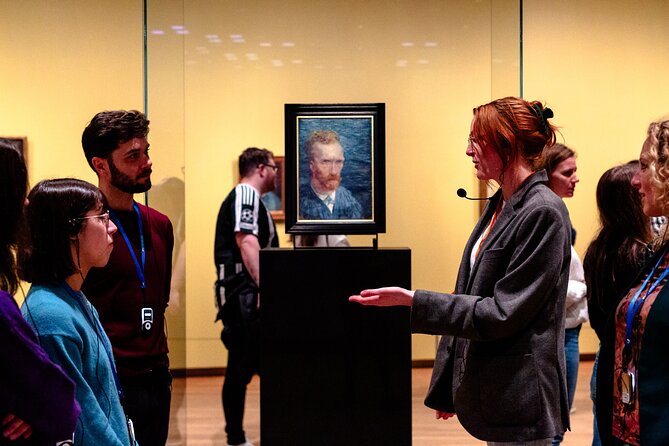
I like this experience because it treats the museum as a story, not a checklist. You begin with Van Gogh’s self-portraits, then follow his move from the Netherlands to Paris, Arles, Saint-Rémy-de-Provence, and Auvers-sur-Oise.
That order matters. Van Gogh did not suddenly become the painter of swirling skies and strong yellow fields. His style developed through changes in place, mood, subject, and technique. A guide can point out those links while you are looking at the actual paintings.
The private format is especially useful if you have questions. You are not tied to a large group’s interests, so you can ask about color, brushwork, Van Gogh’s family, his influences, or the story behind a particular painting.
The tour is offered in English, and the listed guides include Sylvia, Giulia, and Kiran. Their approach, based on the supplied tour details, is lively and interactive rather than formal or stiff. Kiran is described as keeping the group moving while still allowing questions, while Giulia is associated with an easy pace and clear explanations. Sylvia’s style is presented as warm and engaging.
This is not a free-form museum visit. The two-hour length means the guide will choose a route and keep you moving. That is useful when you have limited time, but you will not study every room or every painting at leisure.
Meeting at Cobra Café and Entering Museumplein
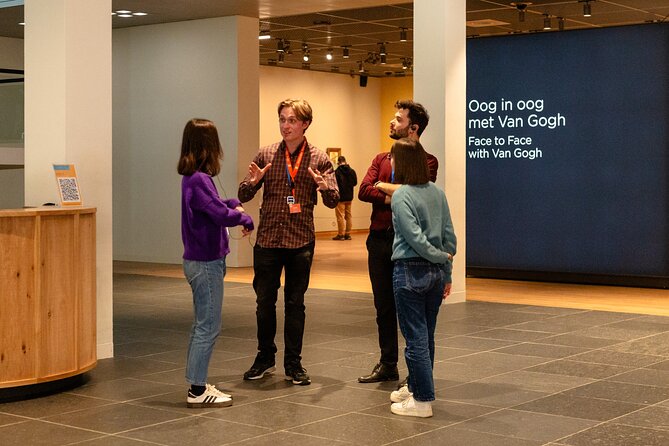
The tour begins at Cobra Café, Hobbemastraat 18, near Museumplein. The end point is Van Gogh Museum, Museumplein 6. The area is close to public transport, so it is practical to reach from other parts of Amsterdam.
Give yourself enough time to find the café and meet the guide. The tour is private, meaning only your own group participates, but the supplied information does not state the maximum group size. If you are booking for a larger party, confirm the details before paying.
The museum visit lasts about two hours. Admission is included, as is the whisper system. That listening equipment matters in a busy gallery, since you can hear the guide without standing shoulder to shoulder around a single painting.
Pack with care. Thick winter coats, suitcases, large bags, and liquids create a problem after the visit. You cannot remain in the museum after the tour if you are carrying those items. With only a small jacket and small handbag, you may stay until closing time, which is a useful option if you want to look again at a favorite work.
More Art Museum Tours in Amsterdam
- Amsterdam: Rijksmuseum Entry Ticket
★ 4.7 · 29,512 reviews - Amsterdam: Van Gogh Museum Ticket and City Canal Cruise
★ 4.6 · 3,899 reviews - Amsterdam: Van Gogh Museum Ticket & Canal Cruise
★ 4.5 · 3,304 reviews
Starting with Self-Portraits and Van Gogh’s Face
The first stop focuses on Van Gogh’s self-portraits and lasts about 20 minutes. This is a smart starting point because his face becomes a visual thread through the museum.
You see how he used himself as a subject while testing color, line, and brushwork. The paintings are not simply records of appearance. They show an artist examining his own image and changing the way he presents it.
A guide can help you compare the self-portraits instead of treating them as separate pictures. Look for differences in background, clothing, direction of the brushstrokes, and the handling of light. You may find that one portrait feels calm while another looks tense or sharply observed.
Twenty minutes is enough for a guided introduction, but not enough for a slow personal study of every self-portrait. If one catches your attention, note its location so you can return later, provided you are not carrying restricted items after the tour.
The Dutch Years and The Potato Eaters
The next section moves to Van Gogh’s early Dutch period. You see works connected with Jean-François Millet and Jules Breton, along with Woman Lifting Potatoes, the wall of portraits titled Head of a Peasant Woman, and The Potato Eaters.
This part is essential for understanding what Van Gogh was trying to do before the bright colors arrived. His early subjects are workers and rural families. The mood is sober, and the figures are tied to physical labor and daily life.
The Potato Eaters is the key work here. Its dark tones and sturdy figures can feel far removed from the yellow sunflowers most people picture first. That contrast is exactly why the stop is valuable. It shows that Van Gogh’s art began with close attention to ordinary people, not with decorative color.
Paintings by Millet and Breton help place his early work in context. Van Gogh admired artists who treated rural workers with seriousness. A guide can show you how those influences appear in pose, subject, and mood.
This section also rewards questions. You can ask why Van Gogh chose such dark colors, why peasant faces appear so often, and how his early work differs from the later paintings. The stop lasts about 20 minutes, so the guide will focus on the main links rather than every detail.
Paris, New Color, and the City
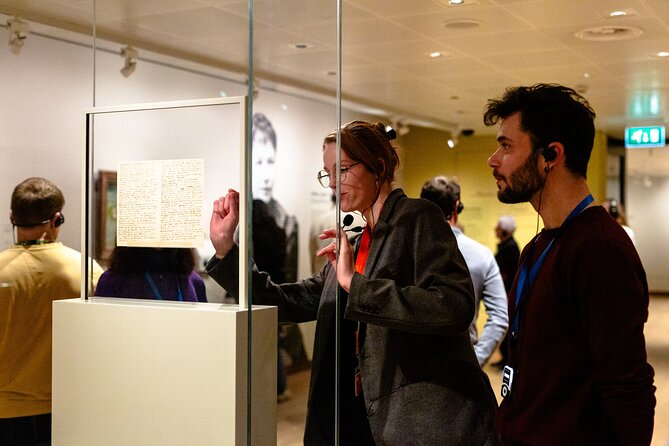
The third stop covers Van Gogh’s time in Paris from 1886 to 1888. Here, the mood changes. You see Self Portrait with Felt Hat, Still Life with Absinthe, In the Café: Agostina Segatori in Le Tambourin, and Garden with Courting Couples.
Paris brought Van Gogh into contact with new artistic ideas and brighter color. His self-portraits from this period are useful for seeing the change directly. The brushwork becomes more active, and the colors are less tied to the dark earth tones of his Dutch years.
Still Life with Absinthe introduces a different kind of subject. The café painting, featuring Agostina Segatori, points to city life and the social world around him. Garden with Courting Couples adds another change in subject and atmosphere.
I find this section one of the most useful parts of the route because it bridges the familiar early and late Van Gogh. You can see that the later style was built through experiments, not created overnight.
The guide’s job here is to keep the visual changes clear. Without help, you might simply notice that the paintings are brighter. With a good explanation, you can look for the methods behind that change: short strokes, stronger color contrasts, and a wider range of modern subjects.
More Van Gogh Museum tickets:
- Van Gogh Museum Amsterdam Exclusive Tour w/ Reserved Entry
★ 5.0 · 1,760 reviews - Van Gogh Museum Tour Reserved Entry Semi Private
★ 5.0 · 1,437 reviews - Amsterdam: Van Gogh Museum Entry Ticket and Guided Tour
★ 4.9 · 681 reviews - Combo Ticket: Van Gogh Museum Ticket and 1-Hour Canal Cruise
★ 4.0 · 676 reviews
Arles and the Sunlit Paintings
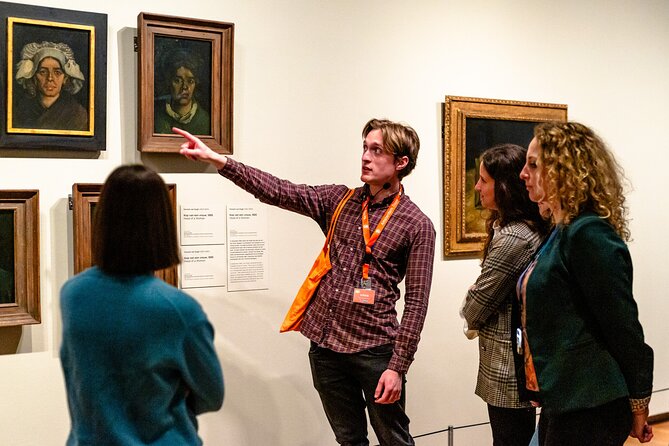
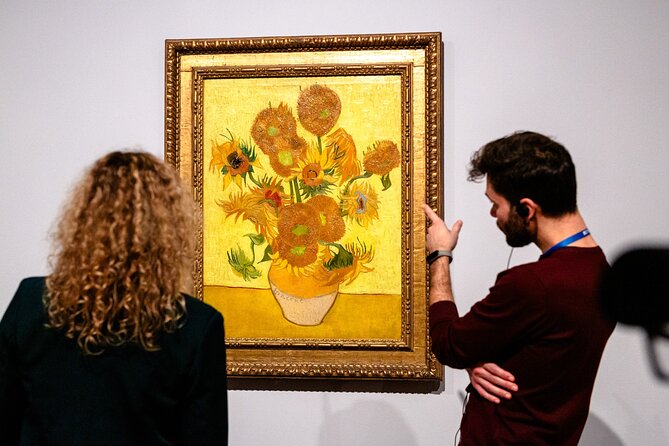
The fourth stop covers Arles in the south of France, where Van Gogh moved in 1888. This is likely the most familiar portion of the tour, with Sunflowers, Almond Blossoms, The Bedroom, Japanese paintings copied from prints, and The Yellow House.
Sunflowers are famous, but the value of seeing them in this route is knowing what they represent. They belong to Van Gogh’s effort to make color carry emotion and structure. The strong yellows are not just cheerful decoration. They organize the painting and give the flowers a forceful presence.
The Bedroom offers a quieter comparison. Its simple furniture and unusual perspective make an ordinary room feel personal and slightly unstable. You can ask the guide to explain how the room’s colors and lines affect your sense of space.
The Japanese paintings, copied from prints, reveal an influence that is easy to miss if you rush toward the famous works. Van Gogh looked closely at Japanese art and adapted elements of its flat areas, outlines, and bold composition.
The Yellow House connects art with the place Van Gogh hoped to make into a working home for artists. It is a useful stop for understanding his plans and ambitions in Arles.
This portion lasts about 20 minutes. You will not have time to linger equally over every painting, so listen for the links between them. If Sunflowers or The Bedroom is a personal priority, tell the guide early in the visit.
Saint-Rémy and the Power of Repetition
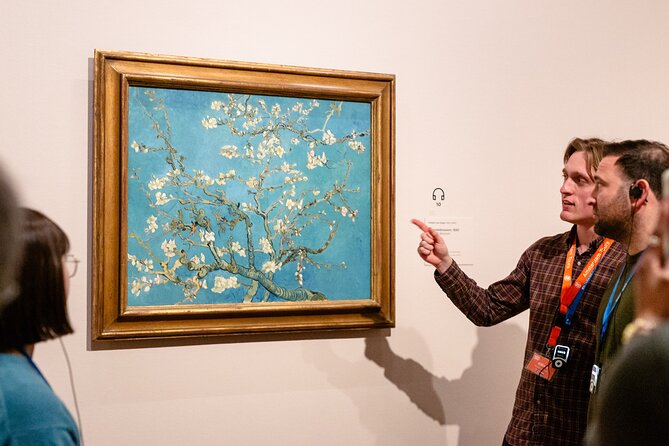
The fifth stop takes you to level three and Van Gogh’s period in Saint-Rémy-de-Provence. The works listed here include Almond Blossoms, Wheatfield with a Reaper, Iris, and Pieta after Delacroix.
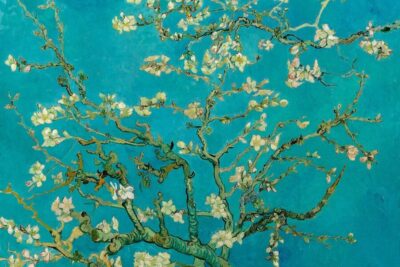
The repeat appearance of Almond Blossoms gives you an interesting chance to compare works with similar subject matter across Van Gogh’s career. Instead of seeing one painting as an isolated masterpiece, you can think about how he returned to nature, seasonal change, and symbolic subjects.
Iris shows his ability to make a single natural subject carry the whole picture. The strong outlines and color contrasts reward close looking. Wheatfield with a Reaper has a different weight, with the worker and field tied to ideas of labor, nature, and mortality.
Pieta after Delacroix also shows how Van Gogh responded to other artists. Copies were not simply exercises in imitation. They gave him a way to study composition and bring another artist’s ideas into his own language.
This is a good point in the tour to ask about technique. You can ask how the brushwork changes from the Paris paintings, how the colors are arranged, or why Van Gogh returned to certain subjects. The guide may be able to answer in more depth because your group is private.
The Auvers Room and Van Gogh’s Final Works
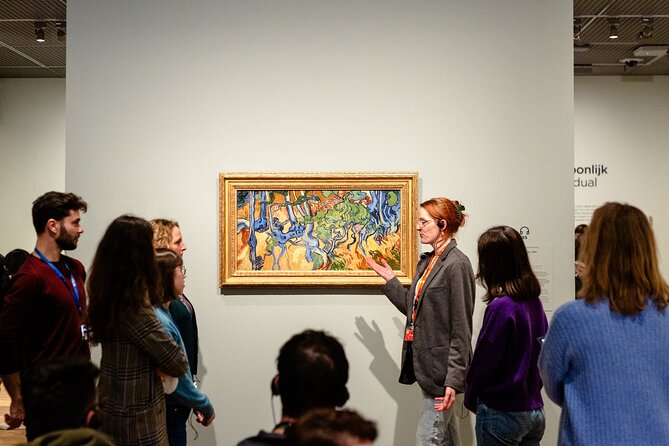
The final stop is the Auvers room on level three. It includes Tree Roots and Wheatfield with Crows, and lasts about 15 minutes.
This is a short but weighty ending. Tree Roots and Wheatfield with Crows are tied to the final stage of Van Gogh’s life and work. They should not be reduced to simple symbols of sadness, but their place in the timeline makes them emotionally powerful.
Wheatfield with Crows is often treated as a final statement, yet a careful guide can help you look at the painting itself rather than only its biography. Pay attention to the field, the paths, the sky, and the direction of the brushwork.
Tree Roots offers a different kind of concentration. It brings you close to tangled natural forms and intense surface movement. After seeing his early Dutch workers and later sunlit scenes, you can recognize how far his handling of paint has changed.
The 15-minute limit keeps the ending focused. If you need quiet time with these works, ask whether you can pause before leaving. The supplied details do not promise extra time, so do not assume the guide can extend the tour.
What $263.20 Per Person Gets You
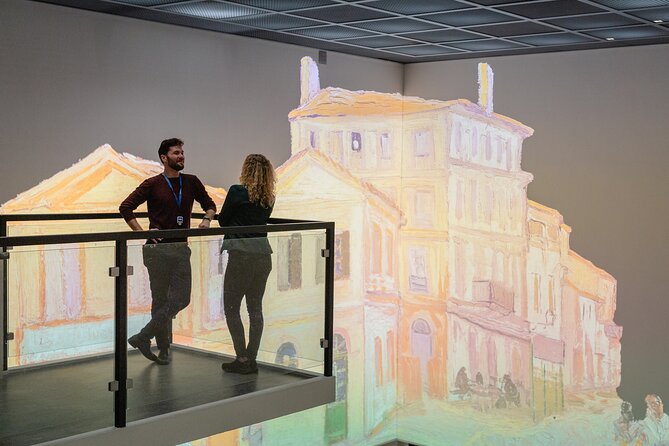
At $263.20 per person, this is a costly museum visit. You are paying for more than admission: the price covers a private guide, a planned two-hour route, and the whisper system.
The value depends on how you like to visit museums. If you are happy with a self-guided visit and already know Van Gogh’s work, the cost may be hard to justify. The museum’s own audio option or a slow independent visit could suit you better.
I see stronger value for first-time visitors, art lovers, and people with only one open block in their Amsterdam schedule. A private guide can prevent you from wandering without a plan, and the shorter format leaves room for other sights.
The group discount may improve the price for larger parties. Since the listed cost is per person and the actual discount details are not provided, check the final booking total carefully.
The private structure also makes the price easier to understand for couples or families who want conversation rather than a fixed public group. Still, this is an adult-only activity. Everyone joining must be 18 or older.
Who Will Enjoy This Visit Most
I would choose this tour if you want Van Gogh explained as a developing artist, not just a collection of famous images. The route gives you a strong framework and includes major works without asking you to spend the entire day in the museum.
It suits:
- Adults who enjoy art but want help reading paintings.
- Couples or small private groups who value questions and flexible conversation.
- First-time visitors with about two hours available.
- People who prefer a live guide to a recorded audio device.
- Visitors who want to connect Van Gogh’s paintings with the places and periods of his life.
It may not suit you if you prefer complete independence or want to inspect every room at your own pace. The tour also does not include food or drinks, so plan those separately before or after the museum.
The adult-only rule is important for families. Since the activity is available only to people aged 18 and older, it is not an option for a mixed-age family outing.
Practical Details That Affect Your Day
Confirmation arrives within 48 hours of booking, subject to availability. The experience is offered in English, and the private guide is described as being available in your chosen language, so confirm the language arrangement if English is not what you need.
The tour is close to public transport. Start at Cobra Café and finish at the museum. Since the museum is the end point, think ahead about coats and bags before you leave your hotel.
Free cancellation is available if you cancel at least 24 hours before the start time. Changes or cancellations made inside that window are not accepted for a refund.
I would avoid scheduling a tight museum or train connection immediately afterward. The official visit is about two hours, but meeting up, moving through the galleries, and leaving the museum still take time.
Should You Book the Van Gogh Museum Private Tour?
Book it if you want a focused, adult-only visit with a personal guide who can connect The Potato Eaters, Sunflowers, The Bedroom, Iris, and Wheatfield with Crows into one readable story.
I especially like the private format, the clear artistic timeline, and the whisper system. The guides named for this experience, including Sylvia, Giulia, and Kiran, are presented as lively, patient, and easy to follow.
Skip it if $263.20 per person feels too steep or if you prefer to set your own pace. For everyone else, this is a practical way to see the main Van Gogh collection in two hours, with enough explanation to make the paintings more memorable.
FAQ
How long does the Van Gogh Museum private tour last?
The guided visit lasts approximately two hours. The listed stops allow about 15 to 20 minutes in each section of the museum.
Is admission to the Van Gogh Museum included?
Yes. Admission to the museum is included in the tour.
What language is the tour offered in?
The tour is offered in English. The supplied details also refer to a private guide in your chosen language, so confirm language availability when booking if you need another language.
Where does the tour begin and end?
The tour begins at Cobra Café, Hobbemastraat 18, 1071 ZB Amsterdam. It ends at the Van Gogh Museum, Museumplein 6, 1071 DJ Amsterdam.
Can I stay in the museum after the guided visit?
You cannot stay after the visit if you are carrying thick winter jackets, suitcases, large bags, or liquids. If you have only a small jacket and small handbag, you may remain in the museum until closing time.
What is the cancellation policy?
You can cancel for a full refund up to 24 hours before the experience start time. Cancellations or changes made less than 24 hours before the start are not accepted for a refund.
Just added around Amsterdam
- Small Group Tour to NP Hoge Veluwe (van Gogh) from Amsterdam★ 5.0 · 19 reviews
- Van Gogh and Rembrandt Immersive Experience Entry Amsterdam★ 4.0 · 2 reviews
- Van Gogh Museum Guided Visit Including Tickets★ 4.5 · 9 reviews
- Van Gogh Museum Tour excluding Entrance Tickets★ 5.0 · 16 reviews
- Van Gogh Museum with Audio Guide★ 3.5 · 80 reviews
- Van Gogh Museum Entry Ticket and Guided Tour★ 4.5 · 48 reviews
- Van Gogh Museum, Small Group Tour (incl timed entry tickets)★ 5.0 · 5 reviews
- Amsterdam: Explore the Van Gogh Museum & His Masterpieces★ 3.5 · 64 reviews
Art Museum Tours in Amsterdam, compared.
Van Gogh Museum Amsterdam Exclusive Tour w/ Reserved Entry
Read our review →
Rijksmuseum Amsterdam Small-Group Tour with Private Upgrade
Read our review →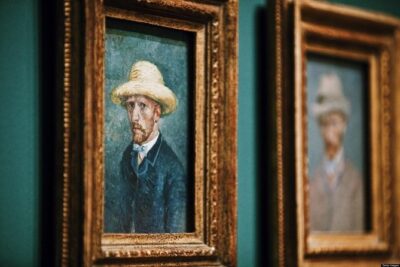
Van Gogh Museum Tour Reserved Entry Semi Private
Read our review →
Rijksmuseum Entry Ticket and Canal Cruise Combo
Read our review →Browse the lists this tour appears in